
Last Updated: 3 November 2026
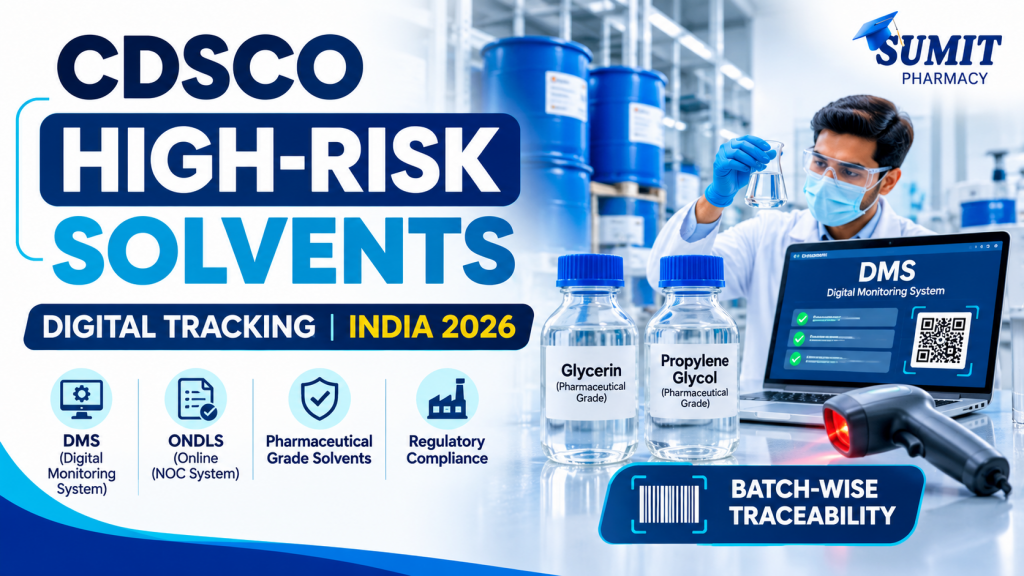
The CDSCO high-risk solvents 2026 regulatory update is an important development for India’s pharmaceutical manufacturing and quality control sector. The Central Drugs Standard Control Organisation (CDSCO) has reinforced digital monitoring of high-risk pharmaceutical-grade solvents through the Online National Drugs Licensing System (ONDLS), requiring batch-wise information and digital clearance before distribution of covered materials.
In a notice dated 27 October 2026, CDSCO directed State and Union Territory Drug Controllers to ensure compliance with the Digital Monitoring System (DMS) for high-risk solvents. The directive requires manufacturers, vendors and suppliers of covered pharmaceutical-grade materials to register on the ONDLS portal and submit information such as quantities manufactured, Certificates of Analysis (CoA), quantities supplied, vendor details and onward distribution records.
The development follows continuing concerns about pharmaceutical raw material quality and contamination of cough syrups with toxic substances such as diethylene glycol (DEG) and ethylene glycol (EG).
For pharmaceutical companies, this means greater emphasis on supply-chain traceability, vendor qualification, batch-level documentation and quality assurance.
In this article, we explain the CDSCO notification, the ONDLS Digital Monitoring System, the list of high-risk pharmaceutical solvents, DEG contamination risks, testing requirements and their implications for India’s pharmaceutical industry.
Key Highlights: CDSCO High-Risk Solvents Notification 2026
| Particular | Details |
|---|---|
| Regulatory authority | CDSCO |
| Government department | Ministry of Health and Family Welfare |
| Latest notice date | 27 October 2026 |
| Monitoring platform | ONDLS |
| Monitoring system | Digital Monitoring System (DMS) |
| Main objective | High-risk pharmaceutical solvent supply-chain monitoring |
| Key materials | Propylene glycol, glycerin, sorbitol, maltitol and other specified components |
| Important documentation | Batch details, CoA, vendor information and supply records |
| Distribution requirement | System-generated NOC before distribution of covered batches |
| Main stakeholders | Pharmaceutical-grade solvent manufacturers, vendors and suppliers |
The DMS was originally introduced through an earlier CDSCO communication in October 2025. The October 2026 directive reinforces its implementation and compliance requirements.
1. What Is the Latest CDSCO Notification About High-Risk Solvents?
On 27 October 2026, CDSCO issued a notice titled:
Digital Monitoring System on the ONDLS Portal for Monitoring the Supply Chain of High-Risk Solvents.
The objective is to strengthen the monitoring of pharmaceutical-grade solvents and excipients that may create serious patient safety risks if contaminated, adulterated or sourced from unreliable suppliers.
Under the directive, manufacturers and vendors or suppliers of covered pharmaceutical-grade materials are required to register on the ONDLS portal and upload batch-wise information.
The information includes:
- Total quantity of material manufactured.
- Batch-wise manufacturing details.
- Certificate of Analysis (CoA).
- Quantity supplied to different vendors.
- Vendor credentials.
- Complete onward distribution details.
An important requirement is that a covered batch should not be distributed without uploading the required information and obtaining a system-generated No Objection Certificate (NOC).
This introduces a more structured digital approach to the traceability of pharmaceutical raw materials.
Why is this development important?
Previously, supply-chain monitoring depended heavily on manufacturing records, vendor documents, certificates and regulatory inspections.
Digital monitoring makes it easier for regulators to connect batch information with suppliers and distribution records.
The purpose is to improve transparency and make it easier to trace a potentially problematic raw material through the pharmaceutical supply chain.
Official source: CDSCO – Public Notices
2. What Is ONDLS and How Does the Digital Monitoring System Work?
ONDLS stands for Online National Drugs Licensing System.
It is a digital platform developed by the Centre for Development of Advanced Computing (C-DAC) in coordination with CDSCO and State and Union Territory Drug Regulatory Authorities.
The platform supports online pharmaceutical licensing and related regulatory services.
The Digital Monitoring System operates through this online regulatory infrastructure.
Main Functions of the DMS
The important functions include:
1. Digital registration
Covered pharmaceutical-grade solvent manufacturers and suppliers register their relevant business and licensing details on the portal.
2. Batch-wise data submission
Information about each manufactured batch is uploaded to improve traceability.
3. Certificate of Analysis documentation
The relevant CoA information is submitted as part of the batch-level documentation.
4. Vendor and supply-chain tracking
Details of the vendors receiving the materials and onward distribution are recorded.
5. Digital NOC generation
A system-generated NOC is required before distribution of covered batches under the directive.
Simplified Digital Monitoring Workflow
Manufacturer Registration on ONDLS
↓
Manufacturing of Pharmaceutical-Grade Solvent
↓
Batch Information and CoA Upload
↓
Vendor and Quantity Details Submission
↓
Digital Monitoring and NOC Generation
↓
Distribution to Registered Supply-Chain Participants
↓
Batch Traceability and Regulatory Oversight
The system is intended to improve the ability to identify the source and movement of pharmaceutical-grade raw materials.
3. Which Pharmaceutical Solvents and Excipients Are Covered?
The CDSCO monitoring framework identifies specified high-risk pharmaceutical-grade solvents and excipients.
Some important materials covered include:
| Material | Pharmaceutical application |
|---|---|
| Propylene Glycol | Solvent and vehicle in pharmaceutical formulations |
| Glycerin (Glycerol) | Humectant, solvent and formulation vehicle |
| Sorbitol | Sweetening agent and humectant |
| Maltitol | Sweetening agent in pharmaceutical preparations |
| Hydrogenated Starch Hydrolysate | Pharmaceutical excipient |
| Polyethylene Glycol (specified molecular weights) | Solvent and formulation excipient |
| Ethyl Alcohol | Solvent and pharmaceutical formulation ingredient |
The notification annexure also identifies other specified material categories, including certain surfactants and related excipients.
Important: This table provides examples of covered materials and their functions. It is not a substitute for the complete regulatory annexure. The exact scope must be checked against the current CDSCO notification.
Why Are These Materials Important in Pharmaceutical Manufacturing?
These materials perform different functions in pharmaceutical formulations.
For example:
Propylene Glycol
Propylene glycol is used as a solvent and vehicle to improve the solubility of certain pharmaceutical ingredients. It is commonly encountered in liquid oral preparations and other dosage forms.
Glycerin
Glycerin is used as a humectant, solvent and viscosity-enhancing ingredient. It is an important component in several pharmaceutical and topical preparations.
Sorbitol
Sorbitol may be used as a sweetening agent, humectant and formulation excipient, particularly in liquid preparations.
Maltitol
Maltitol is used as a sweetening agent in certain pharmaceutical products.
These substances are useful when they meet the required pharmaceutical quality standards. Their inclusion in a high-risk monitoring framework does not mean that pharmaceutical-grade material is inherently unsafe.
The concern is contamination, adulteration, incorrect material identification or inadequate quality testing.
4. Why Is CDSCO Increasing Monitoring of Pharmaceutical Solvents?
One of the major concerns behind these measures is contamination of pharmaceutical-grade raw materials with toxic glycols.
Two important contaminants are:
- Diethylene Glycol (DEG)
- Ethylene Glycol (EG)
Both are toxic substances and should not be present beyond applicable permitted specifications in pharmaceutical ingredients.
What Is Diethylene Glycol (DEG) Contamination?
Diethylene glycol is an industrial chemical that can cause severe poisoning when ingested.
It can enter pharmaceutical supply chains through contaminated or adulterated raw materials.
A particularly important concern involves the possible contamination of glycerin or propylene glycol used in liquid pharmaceutical formulations.
If a manufacturer purchases contaminated raw materials and fails to identify the problem through appropriate testing, toxic substances may enter the finished medicine.
Why Is DEG Dangerous?
DEG poisoning can cause serious health consequences, including:
- Acute kidney injury.
- Metabolic disturbances.
- Neurological complications.
- Multiorgan damage.
- Death in severe cases.
Children are particularly vulnerable to unsafe medicines because of their lower body weight and the potential for serious consequences from contaminated formulations.
DEG and EG: Difference
| Parameter | DEG | EG |
|---|---|---|
| Full form | Diethylene Glycol | Ethylene Glycol |
| Chemical nature | Toxic glycol compound | Toxic glycol compound |
| Pharmaceutical concern | Contamination of excipients and liquid formulations | Contamination of pharmaceutical raw materials |
| Major health risk | Severe systemic toxicity, including kidney injury | Severe systemic toxicity, including kidney injury |
| Acceptability as a pharmaceutical excipient | Not an acceptable substitute for approved excipients | Not an acceptable substitute for approved excipients |
The US FDA has also issued guidance specifically addressing testing of glycerin, propylene glycol, maltitol solution, hydrogenated starch hydrolysate, sorbitol solution and other high-risk drug components for DEG and EG.
Reference: FDA – Testing of High-Risk Drug Components for DEG and EG
5. Connection Between Cough Syrup Contamination and CDSCO’s New Measures
The problem of toxic pharmaceutical raw material contamination is not new.
India and other countries have experienced serious medicine safety incidents involving contaminated liquid formulations.
The Chhindwara cough syrup investigation in Madhya Pradesh brought renewed attention to pharmaceutical manufacturing quality, raw material testing and supply-chain responsibility.
CDSCO’s earlier communication on raw material testing specifically referred to child deaths allegedly linked to contaminated cough syrups.
The issue demonstrated why checking only the finished product or relying entirely on supplier documentation is not sufficient.
A raw material may appear acceptable based on its commercial description, but its actual composition and purity must be verified.
How Can Contaminated Solvents Enter the Supply Chain?
A simplified risk pathway is:
Unreliable Raw Material Supplier
↓
Contaminated or Adulterated Pharmaceutical-Grade Material
↓
Inadequate Vendor Qualification
↓
Insufficient Incoming Raw Material Testing
↓
Contaminated Raw Material Used in Manufacturing
↓
Potentially Contaminated Finished Medicine
↓
Patient Safety Risk
This is why regulators are focusing on multiple levels of quality control rather than depending on a single inspection or certificate.
The World Health Organization has also advised manufacturers of liquid dosage forms, particularly syrups containing propylene glycol, polyethylene glycol, sorbitol or glycerin, to test for contaminants such as DEG and EG before using these materials in medicines.
Reference: WHO – Medical Product Alert on Contaminated Syrup Medicines
6. CDSCO Also Reinforces Mandatory Testing of Raw Materials and Finished Formulations
Alongside the digital monitoring notice, CDSCO issued another important communication dated 27 October 2026.
Its subject is:
Strict Compliance with the Drugs Rules, 1945, for Testing of Raw Materials and Finished Formulations.
This communication reinforces the statutory requirement for pharmaceutical manufacturers to test raw materials, including critical excipients such as:
- Propylene glycol.
- Glycerol.
- Sorbitol.
- Other active and inactive pharmaceutical ingredients.
The requirement covers each batch or lot of raw material used in manufacturing and each batch of the final product.
The testing must be performed either in the manufacturer’s own laboratory or in a laboratory approved by the licensing authority, as applicable under the Rules.
Relevant Regulatory Provisions
CDSCO specifically refers to:
- Rule 74(c) of the Drugs Rules, 1945.
- Rule 78(c)(ii) of the Drugs Rules, 1945.
- Schedule U for maintenance of prescribed testing records.
The communication also emphasises robust vendor qualification and sourcing raw materials from reliable, approved vendors.
Important Distinction: Existing Requirement vs Current Enforcement
Batch-wise testing is not a completely new legal obligation created in October 2026.
The statutory requirements already existed under the Drugs Rules, 1945.
The latest communication reinforces compliance and directs State and UT Drug Controllers to ensure that manufacturers follow these requirements.
This distinction is important for Regulatory Affairs professionals because a regulatory direction reinforcing an existing statutory requirement should not be incorrectly described as a newly introduced amendment to the Act or Rules.
Official source: CDSCO – Public Notices and Regulatory Communications
7. Certificate of Analysis (CoA): Why Is It Important?
A Certificate of Analysis is a document that records the analytical testing results of a particular batch of raw material or finished product.
It provides information about whether the tested material complies with specified quality requirements.
Important Information in a CoA
| Parameter | Purpose |
|---|---|
| Material name | Identifies the tested material |
| Batch number | Establishes batch identity |
| Manufacturer details | Identifies the source |
| Specification | Defines the applicable quality criteria |
| Test results | Shows analytical findings |
| Test methods | Identifies the methods used |
| Date of analysis | Records when testing was performed |
| Approval status | Supports material quality disposition |
For high-risk solvents, appropriate testing for DEG and EG contamination is particularly important.
However, a CoA should not be treated as a substitute for the manufacturer’s own legally required incoming material testing.
Digital submission of a CoA improves documentation and traceability, while laboratory testing provides analytical evidence of material quality.
Both are important.
8. What Is the Role of Quality Assurance (QA) and Quality Control (QC)?
The CDSCO digital tracking initiative increases the importance of both QA and QC departments.
Role of Quality Control
The QC department is responsible for analytical testing and verification of pharmaceutical raw materials and finished formulations.
Its responsibilities may include:
- Sampling of incoming raw materials.
- Verification of material identity.
- Testing against approved specifications.
- Checking for relevant impurities and contaminants.
- Reviewing analytical test results.
- Supporting batch release decisions through documented results.
Role of Quality Assurance
The QA department is responsible for establishing and maintaining the overall pharmaceutical quality system.
Its responsibilities include:
- Vendor qualification and approval.
- Review of Certificates of Analysis.
- Verification of batch documentation.
- Monitoring material traceability.
- Management of deviations and non-conformances.
- Supplier audits and quality agreements.
- Ensuring compliance with applicable GMP requirements.
QA vs QC in Pharmaceutical Solvent Monitoring
| Quality Assurance | Quality Control |
|---|---|
| Focuses on prevention of quality problems | Focuses on detection of quality problems |
| Approves and qualifies vendors | Performs material testing |
| Reviews quality systems | Reviews analytical results |
| Controls documentation systems | Maintains testing records |
| Manages deviations and CAPA | Identifies out-of-specification results |
| Monitors regulatory compliance | Verifies material specifications |
The DMS is a digital monitoring tool. It does not replace the responsibilities of QA and QC departments.
9. Who Will Be Affected by the CDSCO Digital Monitoring System?
The development will have different implications for different pharmaceutical industry stakeholders.
A. Pharmaceutical Solvent Manufacturers
Manufacturers of covered pharmaceutical-grade solvents will need to pay particular attention to:
- ONDLS registration.
- Applicable manufacturing licences.
- Batch-wise data upload.
- Certificate of Analysis documentation.
- Quantity manufactured.
- Vendor details.
- Digital clearance before distribution.
B. Solvent Suppliers and Vendors
Suppliers and vendors must maintain accurate details of the batches they receive and distribute.
Their documentation should support the traceability of materials through the supply chain.
C. Formulation Manufacturers
Pharmaceutical formulation manufacturers need to strengthen their incoming raw material controls.
They should ensure:
- Purchase from approved vendors.
- Verification of supplier documentation.
- Testing of each incoming batch or lot.
- Appropriate recording of material usage.
- Traceability between raw material and finished product batches.
D. Quality Assurance and Quality Control Professionals
QA/QC teams will have an important role in implementing and maintaining compliance.
Professionals involved in pharmaceutical manufacturing should understand both analytical testing and digital documentation requirements.
E. Retailers and Wholesalers
The wider ONDLS Track and Trace Stock module also provides stock-tracking functions for licensed retailers and wholesalers.
However, this should not be confused with the solvent-specific DMS direction.
The October 2026 user manual describes a broader system involving vendor registration, inward stock, finished product stock for manufacturers, stock release and NOC generation.
The specific obligations applicable to a business depend on its licence, role and the relevant regulatory directions.
The October 2026 solvent directive should not be interpreted as a blanket requirement for every retail pharmacy to obtain a solvent-related NOC for all medicines it sells.
ONDLS portal: https://statedrugs.gov.in/SFDA/Homepage
10. Potential Impact on India’s Pharmaceutical Industry
The CDSCO high-risk solvents 2026 initiative could influence pharmaceutical manufacturing and distribution in several ways.
1. Improved Supply-Chain Transparency
Batch-wise digital records can help regulators identify the manufacturers and vendors associated with particular material batches.
2. Stronger Vendor Qualification
Pharmaceutical companies will have greater reasons to verify the identity, reliability and compliance status of their raw material suppliers.
3. Better Raw Material Traceability
Digital distribution records may make investigations and recalls more efficient when a material is suspected of being contaminated or non-compliant.
4. Increased Compliance Workload
Manufacturers and suppliers will need to manage additional portal entries, records, batch documents and vendor information.
5. Possible Short-Term Supply Delays
Some industry representatives have raised concerns about possible processing delays and supply disruptions during implementation.
If registration, documentation or NOC generation is delayed, the distribution of covered materials may also be affected.
These are potential implementation challenges, not evidence that a nationwide shortage has already occurred.
6. Greater Importance of Pharmaceutical Quality Systems
Companies will need to treat raw material sourcing, testing and distribution as interconnected parts of pharmaceutical quality management.
The long-term benefit will depend on accurate data, efficient portal operation, reliable analytical testing and effective regulatory enforcement.
11. What Should Pharmaceutical Manufacturers Do Now?
Manufacturers and suppliers dealing with covered pharmaceutical-grade materials should focus on the following compliance activities.
| Priority | Recommended action |
|---|---|
| 1 | Verify applicable manufacturing licence and ONDLS registration |
| 2 | Register relevant vendors and supply-chain participants |
| 3 | Maintain batch-wise manufacturing and quantity records |
| 4 | Upload required Certificates of Analysis |
| 5 | Maintain accurate vendor and onward distribution details |
| 6 | Follow the system-generated NOC requirement before covered batch distribution |
| 7 | Strengthen incoming material testing |
| 8 | Maintain vendor qualification and approval records |
| 9 | Ensure traceability between raw material and finished product batches |
| 10 | Review current CDSCO instructions and portal guidance |
Companies should also review their SOPs for raw material procurement, sampling, testing, material release and supplier management.
12. Digital Tracking vs Laboratory Testing: What Is the Difference?
This is one of the most important concepts to understand.
Digital tracking and laboratory testing serve different purposes.
| Digital Monitoring System | Laboratory Testing |
|---|---|
| Records material movement | Evaluates material quality |
| Tracks vendors and batches | Detects impurities and contaminants |
| Records supply-chain details | Measures compliance with specifications |
| Supports traceability | Provides analytical evidence |
| Generates digital NOC | Supports QC approval or rejection decisions |
A digital record cannot independently establish whether a material is chemically pure.
Similarly, laboratory testing cannot provide complete supply-chain traceability on its own.
Effective pharmaceutical quality assurance requires both digital traceability and scientifically valid analytical testing.
13. Frequently Asked Questions (FAQs)
Q1. What is the CDSCO high-risk solvents notification of October 2026?
CDSCO’s notice dated 27 October 2026 reinforces the Digital Monitoring System on the ONDLS portal for monitoring the supply chain of specified high-risk pharmaceutical-grade solvents and excipients.
Q2. What is DMS in the pharmaceutical industry?
DMS stands for Digital Monitoring System. It is used to monitor information relating to covered pharmaceutical-grade solvent batches, suppliers and their onward distribution.
Q3. What is ONDLS?
ONDLS stands for Online National Drugs Licensing System. It is a government digital platform developed by C-DAC in coordination with CDSCO and State and UT Drug Regulatory Authorities.
Q4. Which pharmaceutical solvents are considered high-risk under this monitoring framework?
Important examples include propylene glycol, glycerin, sorbitol, maltitol and other specified pharmaceutical-grade materials listed in the applicable notification.
Q5. What is the purpose of the system-generated NOC?
The system-generated No Objection Certificate is required before distribution of covered batches under the CDSCO direction. It forms part of the digital release and traceability process.
Q6. Is a Certificate of Analysis sufficient for pharmaceutical raw material approval?
No. A CoA is important supporting documentation, but manufacturers must also comply with applicable raw material testing requirements under the Drugs Rules, 1945.
Q7. Why is DEG contamination dangerous in cough syrups?
Diethylene glycol is a toxic chemical. Exposure through contaminated medicines can cause severe poisoning, including acute kidney injury and other serious complications.
Q8. Does the digital monitoring system replace pharmaceutical QC testing?
No. Digital tracking records supply-chain information, while QC testing verifies the identity, purity and quality of raw materials and finished products.
Q9. Is this a complete ban on propylene glycol or glycerin in medicines?
No. These are legitimate pharmaceutical ingredients when they meet the applicable quality standards. The monitoring initiative is intended to strengthen their quality and traceability.
Q10. Does the new CDSCO notification apply to every pharmacy shop?
The solvent-specific directive primarily addresses manufacturers, vendors and suppliers of covered pharmaceutical-grade materials. The wider ONDLS system has separate stock-tracking functions for different licensed businesses, so the exact obligations must be checked according to the relevant licence and regulatory instructions.
Q11. What is the role of QA and QC in solvent monitoring?
QA manages vendor qualification, documentation and quality systems. QC performs analytical testing of raw materials and finished products and records the results.
Q12. Where can manufacturers access ONDLS?
The official portal is available at https://statedrugs.gov.in/SFDA/Homepage.
14. Conclusion
The CDSCO high-risk solvents 2026 initiative represents an important development in India’s pharmaceutical quality and regulatory monitoring framework.
By strengthening batch-wise digital tracking through ONDLS, the regulator aims to improve transparency, supplier accountability and traceability of pharmaceutical-grade solvents and excipients.
The accompanying emphasis on raw material testing and vendor qualification also highlights an important principle of pharmaceutical manufacturing: the quality of a finished medicine depends heavily on the quality of the ingredients used to manufacture it.
For pharmaceutical companies, the focus must be on accurate documentation, reliable suppliers, appropriate analytical testing and effective quality management systems.
For pharmacy students and professionals, this development demonstrates how pharmaceutical science, quality assurance, quality control and Regulatory Affairs work together to protect patient safety.
The central lesson is simple: pharmaceutical quality cannot depend only on the final product. It must begin with the raw material and remain controlled throughout the entire supply chain.
References and Further Reading
- CDSCO: Digital Monitoring System on the ONDLS portal for monitoring the supply chain of high-risk solvents. Public notice dated 27 October 2026. Official CDSCO Public Notices
- CDSCO: Strict compliance with the Drugs Rules, 1945, for testing of raw materials and finished formulations. Communication dated 27 October 2026. Official CDSCO Public Notices
- CDSCO / ONDLS: Track and Trace Stock – User Manual for Drug Manufacturers and Retailers / Wholesalers, Version 1.0, October 2026. Download User Manual
- US FDA: Testing of Glycerin, Propylene Glycol, Maltitol Solution, Hydrogenated Starch Hydrolysate, Sorbitol Solution and Other High-Risk Drug Components for DEG and EG, May 2023. FDA Guidance
- World Health Organization: Medical Product Alert No. 6/2023 – Substandard (Contaminated) Syrup Medicines. WHO Alert
- Business Standard: CDSCO mandates digital batch-wise clearance for high-risk pharmaceutical solvents, 2 November 2026. Read Report
- Mint: India’s apex drugs regulator strengthens oversight of pharmaceutical-grade raw materials linked to syrup contamination risks, 2 November 2026. Read Report
Disclaimer: This article is intended for pharmaceutical education and industry information. It does not replace official CDSCO notifications, applicable statutory requirements or professional regulatory advice. Manufacturers and suppliers should refer to the latest official instructions for their specific licensing and compliance obligations.