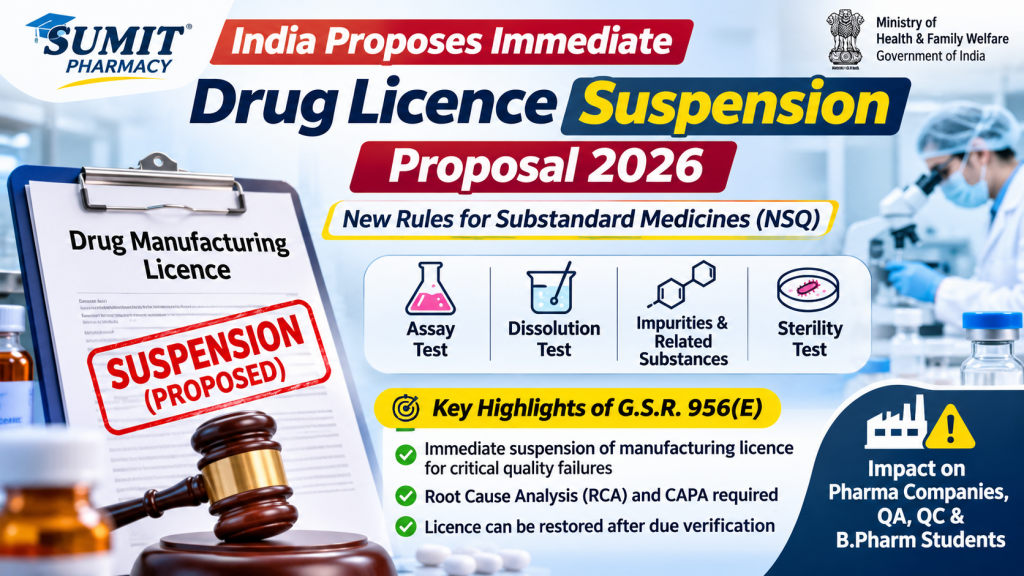
Drug licence suspension proposal 2026 is an important regulatory development for India’s pharmaceutical industry. The Ministry of Health and Family Welfare has proposed amendments to the Drugs Rules, 1945, that could allow immediate suspension of a drug manufacturing licence following specified critical quality failures reported by a Government Analyst. The proposal focuses on Not of Standard Quality (NSQ) medicines and emphasizes Root Cause Analysis (RCA), Corrective and Preventive Actions (CAPA), and stronger pharmaceutical quality compliance.
The proposed amendment focuses on medicines declared Not of Standard Quality (NSQ) because of failures involving assay, dissolution, related substances, impurities or sterility. It also proposes that manufacturers must conduct an effective Root Cause Analysis (RCA) and implement Corrective and Preventive Actions (CAPA) before the suspension can be revoked.
The development is particularly relevant to pharmaceutical manufacturers, Quality Assurance (QA) professionals, Quality Control (QC) analysts, Regulatory Affairs professionals and B.Pharm students studying pharmaceutical legislation and quality management.
However, there is an important distinction: this is a draft amendment, not a final rule already in force.
In this article, we explain the proposed drug licence suspension rules in India, the meaning of NSQ medicines, the quality parameters involved, the role of CAPA and the possible impact on pharmaceutical companies.
1. What Is the Latest Drug Licence Suspension Proposal in India?
On 28 October 2026, the Ministry of Health and Family Welfare issued draft notification G.S.R. 956(E) proposing amendments to the Drugs Rules, 1945. The notification was published in the Gazette on 4 November 2026.
The proposal aims to strengthen regulatory action against pharmaceutical products that fail specified critical quality requirements.
Under the proposed provisions, the Central Licensing Approving Authority or the concerned State Licensing Authority would be required to immediately suspend the manufacturing licence for the concerned drug after receiving a Government Analyst’s certificate declaring the medicine Not of Standard Quality (NSQ) on the specified parameters.
The proposed suspension would continue until the manufacturer:
- Conducts an effective Root Cause Analysis.
- Identifies the reason for the quality failure.
- Implements appropriate Corrective and Preventive Actions.
- Satisfies the concerned licensing authority that the corrective measures have been implemented.
The licensing authority would verify the implementation before revoking the suspension.
The proposal also includes changes to the reporting mechanism so that relevant information reaches the Drugs Controller General of India (DCGI), the concerned State or Union Territory licensing authority, and the manufacturer and marketer.
Key details of the proposed amendment:
| Particular | Details |
|---|---|
| Draft notification | G.S.R. 956(E) |
| Notification date | 28 October 2026 |
| Gazette publication | 4 November 2026 |
| Existing legislation | Drugs Rules, 1945 |
| Main objective | Faster action against specified NSQ drug quality failures |
| Regulatory authorities | Central Licensing Approving Authority / State Licensing Authority |
| Corrective requirements | Root Cause Analysis and CAPA |
| Public consultation | 30 days from Gazette publication |
| Current status | Draft amendment; not yet a final operative amendment |
The proposal is intended to reduce delays between the identification of a critical drug quality failure and regulatory intervention.
2. What Are NSQ Drugs?
NSQ stands for Not of Standard Quality.
A pharmaceutical product is considered NSQ when it fails to comply with one or more applicable quality standards or specifications.
These specifications may include requirements relating to:
- Identity of the active pharmaceutical ingredient.
- Assay or drug content.
- Dissolution performance.
- Impurities and related substances.
- Sterility, where applicable.
- Other prescribed quality characteristics.
For example, a tablet labelled as containing 500 mg of an active pharmaceutical ingredient must comply with the applicable approved or pharmacopoeial specifications.
If the test result falls outside the applicable acceptance criteria, the product may be declared Not of Standard Quality, depending on the test findings and relevant regulatory requirements.
NSQ does not automatically mean that every batch manufactured by the company is defective. The specific product, batch, test result and regulatory investigation must be considered.
NSQ vs Spurious Drugs: What Is the Difference?
These terms should not be used interchangeably.
| NSQ Drugs | Spurious Drugs |
|---|---|
| Fail applicable quality standards or specifications | Are falsely represented or manufactured under circumstances covered by the legal definition |
| May involve assay, dissolution, impurities or other quality failures | May involve false identity, imitation or deceptive representation |
| Quality failure does not automatically prove deliberate fraud | May involve deliberate misrepresentation |
| Requires assessment of the actual quality failure | Requires assessment under the applicable legal definition |
This distinction is important for pharmacy students because a quality defect and a spurious drug are different regulatory concepts.
3. Which Pharmaceutical Quality Parameters Are Covered?
The proposed amendment specifically identifies important quality parameters that can trigger immediate suspension under the proposed mechanism.
These include:
A. Assay Test
An assay test determines the amount or concentration of the active pharmaceutical ingredient in a drug product.
For example, if a tablet is labelled as containing 500 mg of an active ingredient, the assay test helps determine whether the actual drug content complies with the applicable specification.
A result outside the permitted limits may indicate a serious manufacturing or formulation quality problem.
Possible contributing factors include:
- Incorrect dispensing or weighing.
- Inadequate mixing.
- Manufacturing process variation.
- Degradation of the active ingredient.
- Errors in raw material handling.
B. Dissolution Test
The dissolution test evaluates how quickly and to what extent a drug substance is released from a dosage form under specified testing conditions.
It is particularly important for tablets and capsules.
A product may contain the correct amount of drug but still show unsatisfactory dissolution performance.
Possible reasons include:
- Incorrect disintegrant concentration.
- Inappropriate compression force.
- Changes in formulation composition.
- Problems with granulation.
- Variations in coating characteristics.
Poor dissolution can affect the performance of a medicine and may indicate a formulation or manufacturing problem.
C. Related Substances and Impurities
Pharmaceutical impurities may originate from raw materials, manufacturing processes, degradation or contamination.
Their levels must remain within applicable limits.
Examples of potential sources include:
- Starting materials and intermediates.
- Residual solvents.
- Degradation products.
- Process-related impurities.
- Contamination during manufacturing or storage.
Impurity testing is important because certain impurities may affect product quality and patient safety.
D. Sterility
Sterility testing is essential for applicable sterile pharmaceutical products, including certain injections and ophthalmic preparations.
Sterility failures may indicate microbial contamination or problems in the manufacturing environment.
Possible contributing factors include:
- Inadequate sterilization.
- Poor aseptic processing practices.
- Environmental contamination.
- Equipment-related contamination.
- Failure of container closure integrity.
A sterility failure is a serious quality concern because contaminated sterile products may expose patients to significant risks.
4. What Changes Under the Proposed Drugs Rules Amendment 2026?
One of the main concerns addressed by the proposal is the time gap between identifying a drug as NSQ and taking regulatory action.
Under the existing framework, suspension or cancellation of a manufacturing licence involves prescribed regulatory procedures, including a show-cause process where applicable.
The proposed amendment seeks to introduce a faster mechanism for specified critical quality failures.
Existing approach vs proposed approach
| Existing regulatory approach | Proposed mechanism |
|---|---|
| Regulatory action follows the applicable existing procedure | Immediate suspension for specified qualifying NSQ findings |
| Show-cause procedure may be involved before suspension | Proposed provision enables immediate suspension on receipt of the specified Government Analyst report |
| Manufacturer responds to regulatory action | Manufacturer must investigate the quality failure |
| Corrective action is assessed under applicable procedures | RCA and CAPA implementation become central to revocation |
| Regulatory authority determines further action | Revocation follows due verification of CAPA implementation |
This comparison is a simplified explanation of the proposed change. The final legal position will depend on the wording of the amendment as finally notified and the applicable provisions of the Drugs Rules, 1945.
5. Why Are Root Cause Analysis and CAPA Important?
The proposal does not focus only on suspending a licence. It also emphasizes identifying the actual reason behind the quality failure and preventing recurrence.
This is where Root Cause Analysis and CAPA become important.
What Is Root Cause Analysis (RCA)?
Root Cause Analysis is a systematic investigation used to identify the underlying reason for a problem.
For example, imagine that a tablet batch fails its dissolution test.
Simply repeating the test or rejecting the batch does not explain why the failure occurred.
The investigation may need to examine:
- Raw material quality.
- Granulation parameters.
- Binder concentration.
- Compression force.
- Disintegration performance.
- Manufacturing records.
- Equipment condition.
- Analytical method performance.
The objective is to identify the actual contributing cause rather than treating only the visible symptom.
What Is CAPA?
CAPA stands for Corrective and Preventive Action.
Corrective Action: Action taken to eliminate the cause of an identified problem.
Preventive Action: Action taken to reduce the possibility of a similar problem occurring again.
Example:
| Quality problem | Possible corrective action | Possible preventive action |
|---|---|---|
| Tablet dissolution failure | Investigate and correct the identified formulation or process issue | Improve process controls and monitoring |
| Incorrect assay result | Investigate dispensing, mixing and analytical records | Strengthen dispensing verification and process controls |
| Microbial contamination | Investigate the contamination source and address it | Improve environmental monitoring and contamination control |
| Impurity level above specification | Identify the impurity source and correct the process | Strengthen raw material and process monitoring |
These are illustrative examples. Actual CAPA must be based on a scientifically justified investigation and the specific product and manufacturing process.
Important: Under the proposed amendment, merely submitting a CAPA document would not automatically restore the manufacturing licence. The proposed provision requires implementation to the satisfaction of the licensing authority and due verification.
6. What Will Be the Impact on Pharmaceutical Manufacturers?
If the proposal is finalized in its present form, pharmaceutical manufacturers may need to strengthen their quality management systems and investigation procedures.
A. Stronger Quality Control
Manufacturers will need to ensure that their testing systems reliably detect quality problems before products are released.
Important activities include:
- Raw material testing.
- In-process quality control.
- Finished product testing.
- Stability studies.
- Analytical method control.
- Laboratory documentation.
B. Greater Responsibility for Quality Assurance
QA departments will have an important role in reviewing investigations, batch documentation, deviations and CAPA effectiveness.
The ability to identify a quality problem and demonstrate appropriate corrective action will become particularly important.
C. Better Manufacturing Process Control
Manufacturers may need to review critical manufacturing parameters and ensure that processes remain within established limits.
This includes:
- Dispensing and weighing controls.
- Mixing and granulation.
- Compression and coating.
- Sterilization and aseptic processing, where applicable.
- Equipment qualification and maintenance.
- Environmental monitoring.
D. Stronger Regulatory Documentation
Manufacturers should maintain complete and traceable records to support quality investigations and regulatory review.
Incomplete documentation can make it difficult to establish the actual cause of a failure or demonstrate that appropriate CAPA has been implemented.
E. Potential Business and Supply Chain Consequences
Suspension of a manufacturing licence for a concerned drug can affect manufacturing operations and product availability.
Potential consequences may include:
- Production interruption.
- Delays in product supply.
- Regulatory investigations.
- Additional testing and validation expenses.
- Financial losses.
- Reputational damage.
The actual impact will depend on the product, scope of the suspension and regulatory decision.
7. What Does This Mean for QA, QC and Regulatory Affairs Professionals?
This development is particularly relevant to professionals working in pharmaceutical quality and regulatory functions.
For Quality Control Professionals
QC professionals should understand:
- Assay testing.
- Dissolution testing.
- Impurity profiling.
- Sterility testing.
- Analytical method validation.
- Laboratory investigations.
- Out-of-specification (OOS) results.
The accuracy and reliability of laboratory testing are central to identifying quality failures.
For Quality Assurance Professionals
QA professionals should understand:
- Deviation management.
- Root Cause Analysis.
- CAPA.
- Batch record review.
- Change control.
- GMP compliance.
- Quality risk management.
They may also be involved in evaluating whether corrective actions are effective and adequately documented.
For Regulatory Affairs Professionals
Regulatory Affairs professionals should monitor:
- Amendments to the Drugs Rules, 1945.
- CDSCO notifications.
- State licensing authority requirements.
- Regulatory communication.
- Product-related compliance documentation.
- Implementation of new regulatory requirements.
Regulatory professionals must distinguish between draft proposals, final notifications and provisions that have already come into force.
8. What Should B.Pharm Students Learn From This Update?
For B.Pharm students, this regulatory development provides a practical connection between subjects studied during the degree and actual pharmaceutical industry requirements.
The following topics are particularly relevant:
| B.Pharm subject | Related concepts |
|---|---|
| Pharmaceutical Quality Assurance | GMP, QA systems, CAPA and deviations |
| Pharmaceutical Analysis | Assay and impurity testing |
| Industrial Pharmacy | Manufacturing process control |
| Microbiology | Sterility and microbial contamination |
| Pharmaceutical Jurisprudence | Drugs and Cosmetics Act and Drugs Rules |
| Instrumental Methods of Analysis | Analytical testing and method performance |
Students preparing for pharmaceutical industry interviews should be able to explain the following questions:
- What are NSQ drugs?
- What is the difference between NSQ and spurious drugs?
- What is an assay test?
- What is a dissolution test?
- What is the difference between QA and QC?
- What is Root Cause Analysis?
- What is CAPA?
- What is the role of a Government Analyst?
- What is the purpose of the Drugs Rules, 1945?
- Why is sterility testing important?
Understanding these concepts is more useful than memorizing the headline of a regulatory notification.
9. Is the Drug Licence Suspension Proposal Already Implemented?
No. The notification discussed in this article is a draft proposal.
The Ministry has invited objections and suggestions within 30 days from the date the Gazette copies are made available to the public.
The proposed rules state that they would come into force on the date of their final publication in the Official Gazette.
Therefore, the proposed immediate suspension mechanism should not be described as an already implemented nationwide requirement.
Readers should check the final Gazette notification for any changes before treating the proposal as an operative legal requirement.
10. Official Notification and Important References
For accurate regulatory information, readers should refer to the original government notification and official regulatory sources rather than relying only on news reports.
Important references:
- Ministry of Health and Family Welfare – Draft notification G.S.R. 956(E), dated 28 October 2026.
- CDSCO – Official Gazette Notifications
- Ministry of Health and Family Welfare – Government updates
- Press Information Bureau – Government of India
- Drugs and Cosmetics Act and Rules – CDSCO
Readers should verify the complete draft notification and subsequent final notification before relying on specific legal requirements.
Frequently Asked Questions (FAQs)
1. What is the drug licence suspension proposal 2026?
It is a proposed amendment to the Drugs Rules, 1945, that seeks to allow immediate suspension of the relevant manufacturing licence when a Government Analyst reports specified critical quality failures in a medicine.
2. What is G.S.R. 956(E)?
G.S.R. 956(E) is the draft notification dated 28 October 2026 issued by the Ministry of Health and Family Welfare proposing amendments to the Drugs Rules, 1945, concerning suspension of manufacturing licences for specified NSQ drug quality failures.
3. Which tests can trigger immediate suspension under the proposal?
The specified quality parameters include assay, dissolution, related substances, impurities and sterility.
4. What are NSQ drugs?
NSQ means Not of Standard Quality. These are medicines that fail applicable quality standards or specifications.
5. What is CAPA in the pharmaceutical industry?
CAPA means Corrective and Preventive Action. It is a quality management process used to correct identified problems and prevent their recurrence.
6. What is Root Cause Analysis in pharmaceutical manufacturing?
Root Cause Analysis is a systematic investigation to identify the underlying cause of a quality failure, manufacturing deviation or other problem.
7. Can a pharmaceutical manufacturing licence be restored after suspension?
Under the proposed mechanism, suspension would continue until effective Root Cause Analysis and CAPA are implemented to the satisfaction of the licensing authority and their implementation is duly verified.
8. Is the new drug licence suspension rule applicable to all pharmaceutical companies right now?
No. The notification discussed here is a draft proposal. It should not be treated as an already operative amendment. Its final status must be checked through the Official Gazette.
9. Why is this proposal important for B.Pharm students?
It connects Pharmaceutical Quality Assurance, Pharmaceutical Analysis, Industrial Pharmacy and Pharmaceutical Jurisprudence with a current regulatory development in India.
10. Where can I check the latest CDSCO regulatory updates?
Students and pharmaceutical professionals can check the official CDSCO website, Ministry of Health and Family Welfare and Press Information Bureau for government notifications and updates.
Conclusion
The proposed drug licence suspension amendment of 2026 represents an important development in India’s pharmaceutical quality regulation.
By proposing faster regulatory action for specified critical NSQ findings and emphasizing Root Cause Analysis and CAPA, the Ministry aims to strengthen accountability in pharmaceutical manufacturing and improve protection of public health.
For pharmaceutical manufacturers, the proposal highlights the importance of reliable testing, effective quality systems and complete documentation.
For QA, QC and Regulatory Affairs professionals, it reinforces the importance of technical competence and regulatory compliance.
For B.Pharm students, it is a useful real-world example of how pharmaceutical quality control, manufacturing standards and drug laws work together to protect patients.
Stay updated with Sumit Pharmacy for pharmaceutical industry news, regulatory updates, B.Pharm study material and pharmacy career guidance.