

Regulatory Affairs Career in India has become one of the most discussed career options among B.Pharm students. With growing pharmaceutical exports, global regulations and increasing demand for compliance professionals, Regulatory Affairs offers strong long-term career opportunities.
Every Pharmacy Student Has Heard About Regulatory Affairs. But What Is the Reality?
If you walk into any pharmacy college today and ask students about the most attractive career options after B.Pharm, Regulatory Affairs will almost certainly appear in the top five answers.
Some students see it as a high-paying corporate career. Others believe it offers a better work-life balance than manufacturing jobs. Many coaching institutes and training centers promote Regulatory Affairs as one of the fastest-growing sectors in the pharmaceutical industry.
The problem is that very few students actually understand what Regulatory Affairs professionals do on a daily basis.
Most students know the name. Very few know the job.
Ask a final-year B.Pharm student what a Regulatory Affairs Executive does between 9 AM and 6 PM, and many will struggle to give a clear answer. Some imagine it is mostly government paperwork. Others believe it involves frequent interaction with drug inspectors and regulatory authorities. A few think that completing a short certification course is enough to secure a job in the field.
The reality is far more complex.
Behind every medicine available in a pharmacy, there is a team of Regulatory Affairs professionals working quietly in the background. Before a pharmaceutical company can launch a new product, export a medicine to another country, change a manufacturing site, modify a label, introduce a new strength, or obtain approval for a medical device, Regulatory Affairs professionals must ensure that every scientific, technical, legal, and regulatory requirement has been satisfied.
Without Regulatory Affairs, even a life-saving medicine cannot legally reach patients.
This is one of the reasons why Regulatory Affairs has become increasingly important over the last two decades. As pharmaceutical regulations become stricter and companies expand into global markets, the demand for professionals who understand both science and regulations continues to grow.
India’s pharmaceutical industry is currently among the largest in the world. Indian companies manufacture medicines for domestic use as well as for highly regulated markets such as the United States, Europe, Canada, Australia, Japan, and the United Kingdom. Every export market has its own regulatory requirements, submission formats, compliance expectations, and approval procedures.
Managing this complexity requires specialized professionals.
That responsibility falls on Regulatory Affairs teams.
For pharmacy students, this creates a significant career opportunity. Unlike traditional production or laboratory roles, Regulatory Affairs offers exposure to global pharmaceutical regulations, international submissions, product strategy, compliance management, and long-term leadership opportunities.
However, it is not a career path suitable for everyone.
Students who enjoy scientific documentation, attention to detail, regulatory compliance, structured problem-solving, and continuous learning often thrive in Regulatory Affairs. On the other hand, students who dislike documentation, technical writing, regulations, and lengthy review processes may find the field frustrating.
Before choosing Regulatory Affairs as a career, students should understand not only the advantages but also the challenges, realities, salary expectations, skill requirements, and future opportunities associated with the profession.
This article provides a complete evidence-based analysis of Regulatory Affairs careers in India for 2026. We will examine what Regulatory Affairs professionals actually do, how much they earn, which skills employers are looking for, what the future of the profession looks like, and whether Regulatory Affairs is truly one of the best career options available to B.Pharm and M.Pharm graduates today.
Why Regulatory Affairs Has Become One of the Most Popular Careers in the Pharmaceutical Industry
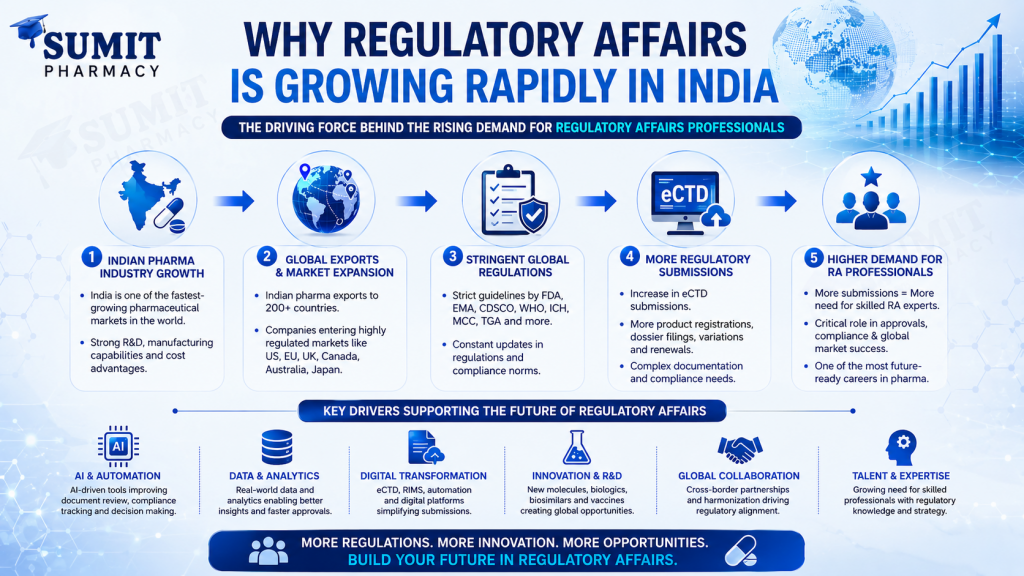
Ten years ago, if you asked pharmacy students about career options after graduation, most discussions revolved around Quality Control (QC), Quality Assurance (QA), Production, Marketing, or Government Jobs. Regulatory Affairs was often considered a niche field that only a small number of professionals entered after gaining experience in the industry.
Today, the situation looks very different.
Regulatory Affairs has evolved from a supporting department into one of the most strategically important functions within pharmaceutical organizations. In many companies, regulatory decisions directly influence product launches, market expansion, revenue generation, and long-term business growth.
So what changed?
The answer lies in the transformation of the global pharmaceutical industry.
The Pharmaceutical Industry Has Become More Regulated Than Ever
Modern medicines are no longer developed and sold only within a single country. Pharmaceutical companies now operate in highly interconnected global markets where products are manufactured in one country, tested in another, approved by multiple regulators, and sold across dozens of regions.
This creates a complex regulatory environment.
A company manufacturing tablets in India may need to satisfy:
- CDSCO requirements for India
- FDA requirements for the United States
- EMA requirements for Europe
- MHRA requirements for the United Kingdom
- Health Canada requirements for Canada
- TGA requirements for Australia
Each authority has its own submission procedures, documentation standards, review processes, labeling requirements, and compliance expectations.
Managing these requirements is impossible without trained Regulatory Affairs professionals.
As pharmaceutical regulations become more complex, companies need larger and more specialized regulatory teams. This trend has significantly increased the demand for Regulatory Affairs professionals worldwide.
India’s Growing Role in Global Pharmaceuticals
Another major reason for the growth of Regulatory Affairs careers is India’s expanding pharmaceutical industry.
India is often referred to as the “Pharmacy of the World” because of its large-scale production of generic medicines and vaccines.
Indian pharmaceutical companies export products to more than 200 countries. Many of these exports go to highly regulated markets such as the United States and Europe.
Every export product requires regulatory approval.
Every approval requires documentation.
Every document requires regulatory expertise.
This means that as Indian pharmaceutical exports continue to grow, the need for Regulatory Affairs professionals grows alongside them.
For students considering long-term career opportunities, this is an important trend because it suggests that Regulatory Affairs demand is driven by structural industry growth rather than temporary hiring cycles.
The Rise of Biosimilars, Vaccines and Medical Devices
Traditional small-molecule drugs are no longer the only products entering the market.
The pharmaceutical and healthcare industries are witnessing rapid growth in:
- Biosimilars
- Biologics
- Vaccines
- Medical devices
- Combination products
- Digital therapeutics
These products often face even stricter regulatory requirements than conventional medicines.
For example, obtaining approval for a biosimilar requires extensive analytical, clinical, and regulatory documentation. Medical devices are governed by separate regulations, technical standards, and risk classifications.
As healthcare products become more sophisticated, companies increasingly depend on regulatory specialists who can navigate these complex approval pathways.
Regulatory Affairs Is No Longer Just Documentation
One of the biggest misconceptions among students is that Regulatory Affairs is simply a documentation job.
That perception may have been partially true decades ago, but modern Regulatory Affairs has evolved into a strategic function.
Today, Regulatory Affairs professionals contribute to decisions such as:
- Which countries a product should enter
- Which approval pathway should be used
- How quickly a product can reach the market
- How regulatory risks can be minimized
- How product changes should be implemented
In many organizations, Regulatory Affairs professionals participate in business discussions that directly affect company revenue and market expansion.
This strategic importance has significantly increased the value of experienced regulatory professionals.
Why Students Are Attracted to Regulatory Affairs
From a student perspective, several factors make Regulatory Affairs attractive.
First, it offers an opportunity to remain connected to pharmaceutical science without working exclusively in manufacturing plants or laboratory environments.
Second, many Regulatory Affairs positions provide office-based work with relatively structured schedules compared to certain manufacturing functions.
Third, the field offers exposure to international regulations and global pharmaceutical operations, which many students find intellectually stimulating.
Fourth, career progression can be substantial for professionals who continuously upgrade their regulatory knowledge and develop expertise in international markets.
Perhaps most importantly, Regulatory Affairs is one of the few pharmacy careers where scientific knowledge, communication skills, business understanding, and regulatory expertise intersect.
For students who enjoy both science and strategy, this combination can be highly rewarding.
The Reality Behind the Popularity
Despite its growing popularity, Regulatory Affairs should not be viewed as an easy career option.
Many students enter the field expecting quick promotions, high salaries, and simple office work.
The reality is that Regulatory Affairs demands continuous learning.
Regulations change.
Guidelines evolve.
Submission formats are updated.
New regulatory pathways emerge.
A successful Regulatory Affairs professional may spend years developing expertise in specific therapeutic areas, product categories, or international markets.
The career rewards can be significant, but they are usually earned through consistent professional development rather than short-term certification courses.
This is an important reality that students should understand before choosing the field.
The growing popularity of Regulatory Affairs is justified, but the profession requires commitment, patience, and a genuine interest in regulatory science. Students who enter the field with realistic expectations are far more likely to build successful long-term careers than those who see it as a shortcut to high-paying pharmaceutical jobs.
What Regulatory Affairs Professionals Actually Do: Beyond the Job Title
One of the biggest reasons students misunderstand Regulatory Affairs is that the actual work is rarely discussed in detail.
Ask a pharmacy student what a Quality Control analyst does, and they will probably mention laboratory testing.
Ask the same student what a Production Executive does, and they will likely talk about manufacturing operations.
But when it comes to Regulatory Affairs, most students simply say:
“They handle approvals and documentation.”
While technically correct, that explanation barely scratches the surface.
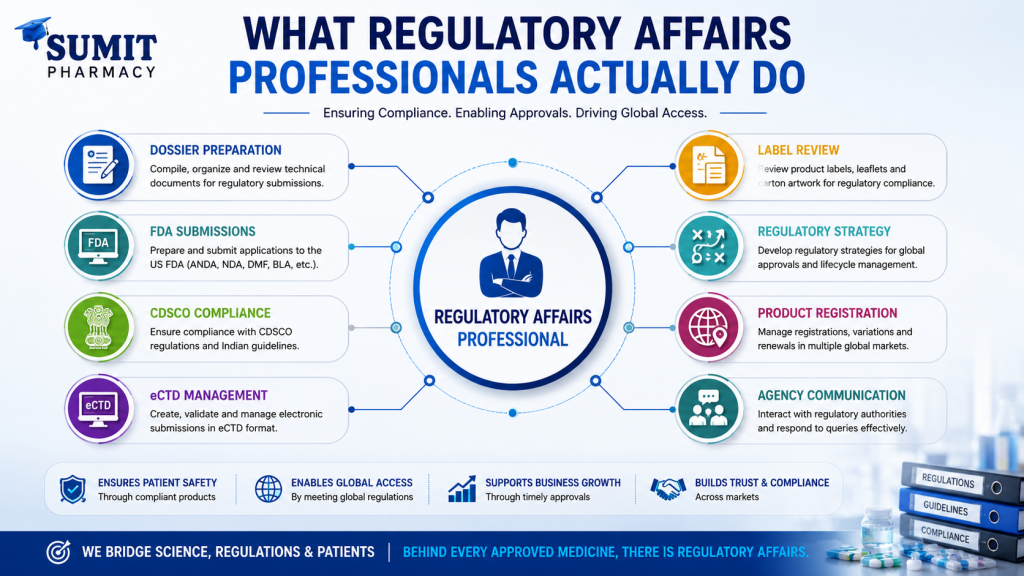
In reality, Regulatory Affairs professionals sit at the intersection of science, law, business strategy, manufacturing, and healthcare regulations. Their job is not merely to prepare documents; it is to ensure that pharmaceutical products can legally reach the market while meeting all regulatory requirements.
To understand the profession properly, it is important to follow the journey of a pharmaceutical product.
Imagine a Pharmaceutical Company Wants to Launch a New Product
Suppose a company develops a new tablet for diabetes.
Before the product can be sold, several questions must be answered:
- Is the formulation acceptable to regulators?
- Is the manufacturing process compliant with GMP requirements?
- Has sufficient stability data been generated?
- Is the labeling accurate?
- Are the claims scientifically justified?
- Which regulatory pathway should be used?
- Which documents need to be submitted?
Every one of these questions involves Regulatory Affairs.
The RA team works closely with multiple departments to collect, review, organize, and submit the information required by regulatory authorities.
Without this process, the product cannot legally enter the market.
Regulatory Affairs Is a Cross-Functional Career
Unlike some pharmaceutical roles that remain confined to a single department, Regulatory Affairs professionals interact with many teams.
A Regulatory Affairs professional may communicate with:
- Research and Development (R&D)
- Formulation Scientists
- Quality Assurance
- Quality Control
- Manufacturing Teams
- Clinical Research Teams
- Pharmacovigilance Teams
- Marketing Teams
- Regulatory Authorities
This makes Regulatory Affairs one of the most cross-functional careers in the pharmaceutical industry.
Students who enjoy working with different teams often find this aspect particularly attractive.
The Core Responsibilities of Regulatory Affairs Professionals
Although responsibilities vary depending on experience level and company type, most Regulatory Affairs professionals are involved in several key activities.
Dossier Preparation
A dossier is a comprehensive collection of documents submitted to regulatory authorities for product approval.
Preparing a regulatory dossier is one of the most important responsibilities in Regulatory Affairs.
These dossiers may contain:
- Product information
- Manufacturing details
- Quality data
- Stability studies
- Analytical reports
- Clinical information
- Regulatory declarations
A single submission can contain thousands of pages of technical documentation.
The Regulatory Affairs team ensures that everything is accurate, complete, and compliant before submission.
Product Registration
Before a product can be marketed in a country, it often requires regulatory approval.
Regulatory Affairs professionals coordinate product registrations by:
- Preparing applications
- Compiling supporting data
- Communicating with authorities
- Tracking review progress
- Responding to queries
For companies operating internationally, this process may occur simultaneously across multiple countries.
Regulatory Intelligence
One responsibility that students rarely hear about is Regulatory Intelligence.
Regulations constantly evolve.
New guidelines are introduced.
Existing requirements are revised.
Submission formats change.
Regulatory Affairs professionals continuously monitor these developments and inform their organizations about important regulatory updates.
This allows companies to remain compliant and avoid costly mistakes.
Labeling and Artwork Review
Every word printed on a medicine package is regulated.
Before packaging materials are approved, Regulatory Affairs teams review:
- Product labels
- Cartons
- Package inserts
- Promotional materials
The goal is to ensure that all information complies with regulatory requirements and does not make unsupported claims.
A seemingly small labeling error can result in serious regulatory consequences.
Responding to Regulatory Queries
Regulatory authorities frequently request additional information during the review process.
These requests are often called deficiencies, observations, or regulatory queries.
Regulatory Affairs professionals coordinate responses by:
- Collecting information from internal teams
- Preparing explanations
- Providing supporting documentation
- Submitting responses within deadlines
This requires both scientific understanding and excellent communication skills.
Managing Product Changes
A pharmaceutical product rarely remains unchanged throughout its lifecycle.
Companies may need to:
- Change manufacturing sites
- Modify packaging
- Update specifications
- Introduce new strengths
- Revise labeling
Many of these changes require regulatory approval.
Regulatory Affairs professionals evaluate regulatory requirements and coordinate submissions to obtain approval before implementation.
Regulatory Affairs Is More Strategic Than Many Students Realize
As professionals gain experience, their responsibilities become increasingly strategic.
Senior Regulatory Affairs professionals may help answer questions such as:
- Which country should the company enter next?
- Which approval pathway offers the fastest market access?
- What regulatory risks could delay product launch?
- How can approval timelines be shortened?
At this level, Regulatory Affairs becomes much more than document management.
It becomes a business-critical decision-making function.
The Skills Hidden Behind the Job
When students hear terms like “documentation” or “submission,” they often assume the work is administrative.
In reality, effective Regulatory Affairs professionals must combine several competencies simultaneously:
- Scientific understanding
- Technical writing
- Regulatory knowledge
- Critical thinking
- Communication skills
- Project management
- Attention to detail
A strong Regulatory Affairs professional is not simply someone who fills forms.
They are professionals who understand how scientific information, regulatory requirements, and business objectives interact.
Reality Check
Many students enter Regulatory Affairs believing that the role mainly involves preparing documents and sending emails.
The reality is more demanding.
A successful Regulatory Affairs professional must understand pharmaceutical science well enough to evaluate technical information, communicate effectively with multiple departments, interpret complex regulations, and make decisions that can directly influence product approvals and business outcomes.
This is one reason why experienced Regulatory Affairs professionals are highly valued within the pharmaceutical industry.
The work may not always be visible to patients, but without Regulatory Affairs, most pharmaceutical products would never reach the market in the first place.
A Day in the Life of a Regulatory Affairs Executive: What Happens Between 9 AM and 6 PM?
One of the most common questions students ask is:
“What does a Regulatory Affairs professional actually do during the day?”
This is an important question because many career decisions are made based on assumptions rather than reality.
A student may hear that Regulatory Affairs offers good salaries and career growth, but salary alone does not determine job satisfaction. The real question is whether you can imagine yourself performing the daily responsibilities associated with the role.
To answer that question, let us look at a typical day of an entry-level Regulatory Affairs Executive working in a pharmaceutical company.
9:00 AM – Checking Regulatory Updates and Emails
The day often begins with reviewing emails and checking ongoing projects.
Unlike many college assignments that have flexible timelines, regulatory work is deadline-driven.
A Regulatory Affairs Executive may receive emails related to:
- Product registrations
- Regulatory authority queries
- Submission deadlines
- Internal approvals
- Document revisions
- Label updates
In multinational companies, emails may also arrive from international teams located in different time zones.
A significant part of the morning may involve prioritizing tasks and identifying urgent regulatory activities.
10:00 AM – Working on Regulatory Documentation
This is where most students begin to understand the nature of Regulatory Affairs.
Documentation is a major component of the profession.
A Regulatory Affairs Executive may spend several hours reviewing and preparing documents such as:
- Product dossiers
- Regulatory applications
- Variation submissions
- Technical reports
- Product information documents
- Labeling updates
This work requires extreme attention to detail.
A small error in product strength, batch information, manufacturing details, or labeling text can create regulatory problems later.
Many students underestimate how important accuracy is in Regulatory Affairs.
11:30 AM – Coordination with Other Departments
Regulatory Affairs rarely works in isolation.
Suppose the RA team needs updated stability data for a product registration.
They may need information from:
- Quality Control
- Quality Assurance
- R&D
- Analytical Development
- Manufacturing
As a result, Regulatory Affairs professionals frequently communicate with multiple departments.
This is one reason why communication skills become increasingly important as careers progress.
Many successful Regulatory Affairs professionals are not necessarily the smartest people in the room, but they are often among the best communicators.
1:00 PM – Lunch Break
Unlike manufacturing roles that may involve shift work or production emergencies, many Regulatory Affairs positions follow relatively structured office schedules.
This contributes to the perception that Regulatory Affairs offers a better work-life balance compared with certain production-related functions.
However, this advantage should not be exaggerated.
Submission deadlines can still create significant pressure.
2:00 PM – Responding to Regulatory Queries
One of the most challenging aspects of the profession involves responding to questions from regulatory authorities.
For example, a regulatory agency may ask:
- Why was a specific specification selected?
- Can additional stability data be provided?
- Why was a formulation change implemented?
- Can analytical validation data be submitted?
The Regulatory Affairs Executive coordinates with technical teams, gathers information, and prepares scientifically justified responses.
This process often requires strong scientific understanding rather than simple administrative skills.
3:30 PM – Submission Tracking and Project Management
Many Regulatory Affairs departments manage dozens or even hundreds of active submissions simultaneously.
A Regulatory Affairs Executive may spend part of the afternoon tracking:
- Submission status
- Approval timelines
- Regulatory commitments
- Upcoming deadlines
- Product registrations
Project management becomes increasingly important as responsibilities grow.
Experienced Regulatory Affairs professionals often describe themselves as both regulatory specialists and project managers.
4:30 PM – Reviewing Labels and Packaging Material
Students are often surprised to learn how much regulatory oversight exists for pharmaceutical packaging.
Before a label is approved, it must comply with regulatory requirements.
The Regulatory Affairs team may review:
- Product name
- Strength
- Storage conditions
- Warning statements
- Prescribing information
- Package inserts
A seemingly minor labeling mistake can lead to regulatory observations, product recalls, or approval delays.
5:30 PM – Planning the Next Day
Toward the end of the day, Regulatory Affairs professionals often review project progress and prepare priorities for the following day.
Depending on the company and ongoing projects, this may include:
- Upcoming submissions
- Internal meetings
- Regulatory deadlines
- Product launches
- Authority responses
The work may appear routine from the outside, but behind every task lies significant regulatory responsibility.
How Different Is the Work at Senior Levels?
Many students assume that a Regulatory Affairs Manager simply performs the same work as an Executive but with more experience.
This is only partially true.
As professionals move into senior roles, their responsibilities become increasingly strategic.
A Regulatory Affairs Manager may spend time:
- Developing regulatory strategies
- Evaluating market entry options
- Leading submission teams
- Interacting with global regulatory groups
- Managing regulatory risks
- Supporting product launch decisions
At this stage, Regulatory Affairs becomes closely linked to business decision-making.
What Kind of Person Enjoys This Work?
Regulatory Affairs is often an excellent fit for students who:
- Enjoy reading and understanding complex information
- Pay attention to details
- Like structured work environments
- Communicate effectively
- Enjoy solving technical problems
- Prefer office-based scientific careers
On the other hand, students who dislike documentation, become frustrated by regulations, or prefer highly experimental laboratory work may find the profession less satisfying.
Reality Check: The Most Common Surprise for Freshers
Many fresh graduates enter Regulatory Affairs expecting a relatively simple documentation role.
Their biggest surprise is usually the volume of learning required.
Even after obtaining a job, Regulatory Affairs professionals continue learning throughout their careers.
New guidelines are released.
Regulations change.
Submission requirements evolve.
International markets introduce new expectations.
In many ways, Regulatory Affairs is a profession where learning never truly stops.
For the right individual, this continuous learning is one of the most rewarding aspects of the career.
For others, it can become one of the biggest challenges.
That is why understanding the daily reality of the profession is so important before making a career decision.
Can a B.Pharm Student Really Enter Regulatory Affairs? The Truth About Eligibility, Skills and Freshers
If there is one question that appears repeatedly in pharmacy career discussions, it is this:
“Can a B.Pharm graduate get a job in Regulatory Affairs?”
The short answer is yes.
The longer answer is that getting into Regulatory Affairs is possible for B.Pharm graduates, but the path is often more competitive and nuanced than many students expect.
A major reason for confusion is that students receive conflicting advice.
Some people claim that only M.Pharm graduates are hired in Regulatory Affairs.
Others suggest that a short certification course guarantees entry into the field.
Neither statement is entirely correct.
The reality lies somewhere in between.
The Educational Eligibility Reality
Most pharmaceutical companies consider the following qualifications acceptable for entry into Regulatory Affairs:
- B.Pharm
- M.Pharm
- Pharm.D
- Life Sciences (in some cases)
- Biotechnology (certain roles)
However, not all qualifications are viewed equally.
A pharmacy graduate already possesses an advantage because pharmaceutical regulations are closely linked to drug development, manufacturing, quality systems, and healthcare products.
This background allows pharmacy students to understand regulatory concepts more easily than candidates from many non-pharmacy disciplines.
For this reason, B.Pharm remains one of the most common educational qualifications found in Regulatory Affairs departments.
Do Companies Prefer M.Pharm Candidates?
In many situations, yes.
But students often misunderstand why.
It is not because a B.Pharm graduate is incapable of performing Regulatory Affairs work.
The reason is that M.Pharm graduates generally possess:
- More advanced technical knowledge
- Better research exposure
- Greater familiarity with scientific literature
- Stronger documentation experience
From an employer’s perspective, these skills may reduce training requirements.
However, this does not mean B.Pharm graduates are excluded.
In reality, thousands of Regulatory Affairs professionals across India started their careers after completing B.Pharm.
The key difference is that they developed the required skills early and positioned themselves effectively during the recruitment process.
The Biggest Mistake B.Pharm Students Make
Many students believe that obtaining a degree automatically makes them employable.
Unfortunately, employers do not hire degrees.
They hire skills.
Two students may hold the same B.Pharm qualification, yet one receives multiple interview calls while the other struggles to secure opportunities.
The difference usually comes down to:
- Communication skills
- Industry knowledge
- Documentation abilities
- Internship experience
- Professional attitude
This is where many fresh graduates fall behind.
What Employers Actually Look For
Students often imagine that recruiters spend most of their time checking academic marks.
While academics matter, employers usually focus on whether a candidate can contribute to the organization.
For entry-level Regulatory Affairs positions, recruiters commonly evaluate:
Pharmaceutical Knowledge
Can the candidate understand:
- Dosage forms?
- Drug development concepts?
- Stability studies?
- GMP principles?
- Regulatory terminology?
A pharmacy graduate should already possess much of this foundation.
Documentation Ability
Regulatory Affairs is heavily documentation-driven.
Employers often prefer candidates who can:
- Write clearly
- Organize information
- Interpret technical documents
- Prepare professional reports
This skill is frequently overlooked during college education.
Communication Skills
One uncomfortable truth about Regulatory Affairs is that communication matters far more than many students realize.
Regulatory professionals interact with:
- Internal teams
- Senior management
- Regulatory authorities
- International colleagues
Poor communication can slow projects and create misunderstandings.
As a result, candidates with strong communication skills often progress faster.
Attention to Detail
A single mistake in regulatory documentation can create serious consequences.
Recruiters therefore value candidates who:
- Work carefully
- Verify information
- Follow procedures
- Maintain accuracy
Students who are naturally detail-oriented often perform well in Regulatory Affairs environments.
Does Internship Experience Matter?
Absolutely.
In fact, internship experience can sometimes provide a greater advantage than an additional certification.
Imagine two candidates:
Candidate A:
- B.Pharm
- Two certifications
- No industry exposure
Candidate B:
- B.Pharm
- One internship in a pharmaceutical company
- Basic understanding of regulatory documentation
Many employers would prefer Candidate B.
Why?
Because industry exposure demonstrates practical understanding.
Even a short internship can help students:
- Understand pharmaceutical workflows
- Observe documentation systems
- Learn professional communication
- Gain familiarity with regulatory processes
Students often underestimate how valuable this experience can be.
Should Students Pursue Regulatory Affairs Certifications?
This is one of the most misunderstood topics.
A certification is not a magic ticket to employment.
No reputable company hires candidates simply because they completed a certificate course.
However, good certifications can still provide value.
They can help students:
- Learn regulatory terminology
- Understand submission processes
- Gain confidence during interviews
- Demonstrate interest in the field
The key is to view certifications as learning tools rather than employment guarantees.
Reality Check: The Certification Industry
Every year, many students spend significant amounts of money on Regulatory Affairs courses because they are promised:
- Guaranteed jobs
- Immediate placement
- High salaries
Students should approach such claims with caution.
The pharmaceutical industry values competence more than certificates.
A candidate who genuinely understands Regulatory Affairs concepts will usually outperform someone who only possesses a certificate.
What Can a B.Pharm Student Do During College?
Students often wait until graduation before thinking about careers.
This is a mistake.
Regulatory Affairs preparation should begin during college itself.
First Year
Focus on building strong pharmaceutical fundamentals.
Second Year
Develop:
- Communication skills
- Microsoft Excel skills
- Scientific writing abilities
Third Year
Start learning:
- GMP
- CDSCO regulations
- ICH guidelines
- Basic regulatory concepts
Final Year
Focus on:
- Internships
- Resume development
- Interview preparation
- Regulatory Affairs applications
This gradual approach is far more effective than attempting to learn everything after graduation.
The Good News for B.Pharm Students
Many students become discouraged when they see job descriptions requesting experience.
What they fail to notice is that every experienced Regulatory Affairs professional was once a fresher.
The industry continuously needs new talent.
Companies require individuals who can be trained, developed, and integrated into regulatory teams.
For motivated B.Pharm graduates who possess strong fundamentals, good communication skills, and a willingness to learn, Regulatory Affairs remains one of the most accessible and rewarding career paths within the pharmaceutical industry.
The degree alone may not guarantee success.
But a pharmacy graduate who develops the right skills can absolutely build a successful long-term career in Regulatory Affairs.
The Salary Reality Nobody Talks About: How Much Do Regulatory Affairs Professionals Actually Earn?
If there is one topic that attracts students to Regulatory Affairs more than any other, it is salary.
Search for Regulatory Affairs careers on YouTube, LinkedIn, or Google, and you will quickly find claims such as:
- “Earn ₹15 LPA after B.Pharm”
- “High-paying pharmaceutical career”
- “International salary opportunities”
- “One of the best office jobs in pharma”
While some of these claims contain elements of truth, they often present an incomplete picture.
The reality is that Regulatory Affairs can become a highly rewarding career financially, but the salary journey is usually gradual rather than immediate.
Students who enter the field expecting a ₹10–15 LPA package immediately after graduation are often disappointed.
Students who understand the long-term growth potential are usually much more satisfied.
The Biggest Salary Myth in Regulatory Affairs
One of the most common misconceptions is that Regulatory Affairs automatically pays more than every other pharmaceutical career.
This is not true.
At the fresher level, salaries in Regulatory Affairs, QA, QC, Production, and Pharmacovigilance often overlap significantly.
The major difference appears later.
As professionals gain expertise in:
- International regulations
- Global submissions
- eCTD systems
- Regulatory strategy
- Product registration
their market value increases substantially.
In other words, Regulatory Affairs is often a career where experience creates the biggest financial rewards.
What Can Freshers Realistically Expect?
Freshers should focus on reality rather than internet hype.
For most entry-level Regulatory Affairs positions in India:
| Experience | Typical Salary Range |
| Fresher (0–1 Year) | ₹3–6 LPA |
| 1–3 Years | ₹4–8 LPA |
| 3–5 Years | ₹6–12 LPA |
| 5–10 Years | ₹10–20 LPA |
| Manager Level | ₹15–35 LPA |
| Senior Leadership | ₹35–80+ LPA |
These figures vary depending on:
- Company
- City
- Market expertise
- Regulatory specialization
- Communication skills
- Performance history
Students should view these ranges as realistic expectations rather than guarantees.
Why Some Freshers Earn More Than Others
Many students compare salaries and become confused.
Two Regulatory Affairs professionals with similar qualifications may earn very different salaries.
The reason usually lies in the value they bring to employers.
For example:
A fresher who understands:
- CDSCO regulations
- GMP concepts
- Documentation systems
- Professional communication
may receive better opportunities than someone who only possesses academic knowledge.
Employers reward capability, not just qualifications.
The International Market Advantage
One of the most attractive aspects of Regulatory Affairs is its connection to global pharmaceutical markets.
A professional who understands:
- US FDA submissions
- EMA requirements
- eCTD publishing
- Global registration procedures
often becomes significantly more valuable than someone working only in domestic regulatory functions.
This explains why experienced Regulatory Affairs professionals frequently enjoy stronger salary growth than many other pharmaceutical roles.
Global expertise commands premium compensation.
Why Experience Matters More Than Degrees
Students often ask:
“Should I do M.Pharm for a higher salary?”
The answer is not always straightforward.
An M.Pharm degree can certainly strengthen technical knowledge and improve opportunities.
However, in Regulatory Affairs, practical experience often becomes more important than academic qualifications after a few years.
Consider two professionals:
Professional A:
- M.Pharm
- 1 year experience
Professional B:
- B.Pharm
- 5 years Regulatory Affairs experience
In many companies, Professional B may command a higher salary because of industry experience and proven regulatory expertise.
This does not mean education is unimportant.
It simply means that Regulatory Affairs is a skill-driven profession.
Why Salary Growth Accelerates Later
One reason Regulatory Affairs attracts ambitious professionals is that salary growth often accelerates after the early career stage.
During the first few years, professionals focus on:
- Learning regulations
- Understanding submissions
- Developing technical expertise
After gaining experience, they begin handling:
- Complex registrations
- International markets
- Regulatory strategy
- Agency interactions
At this stage, companies become willing to pay significantly more for specialized expertise.
The Cities That Usually Pay Better
Location plays an important role in compensation.
In India, some of the strongest Regulatory Affairs opportunities are concentrated in:
- Mumbai
- Navi Mumbai
- Hyderabad
- Bangalore
- Ahmedabad
- Pune
- Delhi NCR
These cities host many pharmaceutical headquarters, manufacturing facilities, and global service centers.
As a result, they often provide better salary growth and career progression opportunities.
Salary vs Work-Life Balance
An interesting aspect of Regulatory Affairs is that compensation is often accompanied by relatively stable working conditions.
Compared with some manufacturing roles, Regulatory Affairs professionals frequently experience:
- More structured schedules
- Office-based work
- Reduced shift requirements
- Greater flexibility
Of course, deadlines and regulatory submissions can still create pressure.
However, many professionals consider the overall work-life balance favorable compared with certain manufacturing functions.
Reality Check: The First Few Years Can Feel Slow
This is something that many students are never told.
The early years in Regulatory Affairs can feel less exciting than expected.
Freshers often spend considerable time:
- Learning documentation systems
- Reviewing regulations
- Assisting senior professionals
- Preparing submission components
Some students become impatient during this stage.
However, these years are extremely important because they build the foundation for future growth.
The professionals earning high salaries today are often those who invested heavily in learning during the early stages of their careers.
What Salary Should Students Focus On?
A common mistake is evaluating a career entirely based on starting salary.
This approach can be misleading.
A better question is:
“What can this career become after 10 years?”
When viewed from that perspective, Regulatory Affairs becomes far more attractive.
The profession offers:
- Strong long-term growth
- Global opportunities
- Strategic responsibilities
- Leadership pathways
- Competitive compensation
Students who focus only on their first salary may underestimate the true potential of the field.
The Bottom Line
Regulatory Affairs is unlikely to make most fresh graduates wealthy overnight.
It is not a shortcut career.
It is not a guaranteed high-income profession from day one.
What it does offer is something arguably more valuable:
A structured pathway toward long-term professional growth.
For students willing to continuously learn, develop expertise, and understand global regulations, Regulatory Affairs can evolve into one of the most financially rewarding careers available within the pharmaceutical industry.
The key is patience.
The biggest salaries in Regulatory Affairs are usually earned not by the people who entered the field fastest, but by those who stayed long enough to master it.
Why Pharmaceutical Companies Are Hiring More Regulatory Affairs Professionals Than Ever Before
One of the most important questions students should ask before choosing any career is:
“Why does this profession exist, and what is driving demand for it?”
This question matters because not every career grows at the same rate.
Some professions expand rapidly because industries are growing.
Others stagnate because automation, outsourcing, or changing business models reduce demand.
To understand the future of Regulatory Affairs, students must understand what is happening in the pharmaceutical industry itself.
The good news is that the factors driving Regulatory Affairs demand are not temporary trends. Most are long-term structural changes that are expected to continue for years.
India’s Pharmaceutical Industry Is Expanding Globally
India is currently one of the world’s largest producers of generic medicines and vaccines.
Over the last two decades, Indian pharmaceutical companies have expanded far beyond the domestic market.
Today, companies such as:
- Sun Pharma
- Dr. Reddy’s
- Cipla
- Lupin
- Aurobindo Pharma
- Zydus Lifesciences
- Glenmark
- Alkem
- Intas
sell products across multiple international markets.
Every country has its own regulatory requirements.
A product approved in India cannot automatically be sold in the United States, Europe, Australia, Canada, or Japan.
Separate submissions are often required.
Separate reviews are conducted.
Separate approvals must be obtained.
This creates enormous demand for professionals who understand international regulatory systems.
As Indian pharmaceutical exports continue to grow, companies need larger Regulatory Affairs teams to manage these increasingly complex requirements.
Every New Market Creates More Regulatory Work
Students often assume that launching a product is a one-time activity.
In reality, regulatory work continues throughout the product lifecycle.
Imagine a company decides to launch a product in:
- India
- United States
- European Union
- United Kingdom
- Australia
Each market requires:
- Registration dossiers
- Regulatory submissions
- Label reviews
- Authority communication
- Compliance maintenance
As companies enter additional countries, regulatory workload multiplies.
This is one reason why multinational pharmaceutical organizations maintain large Regulatory Affairs departments.
More markets mean more regulations.
More regulations mean more Regulatory Affairs professionals.
The Rise of Biosimilars and Complex Medicines
The pharmaceutical industry is changing.
Traditional tablets and capsules still dominate the market, but companies are increasingly investing in:
- Biosimilars
- Biologics
- Cell therapies
- Gene therapies
- Personalized medicine
These products are scientifically more complex and face stricter regulatory scrutiny.
For example, a simple generic tablet may require far less regulatory documentation than a biosimilar product.
As pharmaceutical science becomes more sophisticated, regulatory requirements become more demanding.
This trend naturally increases the importance of Regulatory Affairs expertise.
Medical Devices Are Creating New Opportunities
Many pharmacy students focus exclusively on medicines and overlook the rapidly expanding medical device sector.
Medical devices include:
- Diagnostic equipment
- Surgical instruments
- Implants
- Monitoring systems
- Digital health devices
Governments worldwide have introduced increasingly stringent regulations for medical devices.
India has also strengthened its medical device regulatory framework in recent years.
As a result, Regulatory Affairs opportunities are expanding beyond pharmaceuticals into medical devices and healthcare technologies.
Students with regulatory expertise may eventually work across multiple healthcare sectors rather than being limited to traditional pharmaceutical products.
Regulations Are Becoming More Stringent
Many people assume that pharmaceutical regulations remain relatively stable.
The reality is the opposite.
Regulatory agencies continuously update:
- Safety requirements
- Manufacturing expectations
- Clinical standards
- Quality guidelines
- Data integrity requirements
Consider how much attention regulators now pay to:
- Data integrity
- Electronic records
- Risk management
- Product traceability
- Pharmacovigilance
These areas receive far greater scrutiny today than they did twenty years ago.
Every new regulatory requirement creates additional responsibilities for Regulatory Affairs teams.
Companies Cannot Afford Regulatory Mistakes
A failed regulatory submission can be extremely expensive.
Product launches may be delayed.
Revenue may be lost.
Additional studies may be required.
Regulatory observations may damage a company’s reputation.
In highly competitive pharmaceutical markets, even small delays can have significant financial consequences.
Because of this, companies increasingly invest in experienced Regulatory Affairs professionals who can reduce regulatory risk and improve approval success rates.
From a business perspective, Regulatory Affairs is no longer viewed as a support function.
It is viewed as a strategic investment.
Digital Transformation Is Increasing Demand for Skilled Professionals
The pharmaceutical industry is becoming more digital.
Regulatory submissions that were once paper-based are now largely electronic.
Companies increasingly use:
- eCTD systems
- Regulatory information management systems
- Electronic document management systems
- Digital compliance platforms
This transformation is creating demand for professionals who can combine regulatory knowledge with digital skills.
Future Regulatory Affairs professionals will need to understand both regulations and technology.
This trend aligns closely with the new PCI curriculum, which introduces students to areas such as digital technologies, data handling, and emerging technological concepts.
What About Artificial Intelligence?
Whenever AI is discussed, students immediately ask:
“Will AI replace Regulatory Affairs professionals?”
At present, the answer appears to be no.
AI can assist with:
- Document review
- Data extraction
- Regulatory intelligence
- Submission support
However, regulatory decision-making remains highly dependent on human expertise.
Regulators require scientific justification, risk assessment, strategic judgment, and accountability.
AI is likely to change how Regulatory Affairs professionals work, but it is unlikely to eliminate the profession.
In fact, professionals who understand both regulatory science and digital technologies may become even more valuable.
Why Companies Prefer Regulatory Professionals Over Generalists
Years ago, some regulatory responsibilities were distributed among multiple departments.
Today, companies increasingly prefer specialized Regulatory Affairs teams.
The reason is simple:
Modern regulations have become too complex for occasional management by non-specialists.
Organizations need professionals who:
- Understand regulatory pathways
- Monitor guideline updates
- Manage submissions
- Communicate with authorities
- Maintain compliance
This specialization has strengthened the position of Regulatory Affairs within pharmaceutical organizations.
The Bigger Picture
When students evaluate careers, they often focus on immediate job openings.
A more important question is:
“Will this profession still be important ten years from now?”
For Regulatory Affairs, the evidence strongly suggests yes.
The factors driving demand are not temporary:
- Pharmaceutical exports continue to grow.
- Global regulations continue to expand.
- New healthcare technologies require oversight.
- Medical devices are becoming more regulated.
- Biosimilars are increasing.
- Digital submissions are becoming standard.
All of these trends point in the same direction.
The pharmaceutical industry is becoming more regulated, not less regulated.
As long as medicines, medical devices, and healthcare products require approval before reaching patients, Regulatory Affairs professionals will remain essential.
And that is precisely why companies continue hiring them in increasing numbers.
Regulatory Affairs vs QA vs QC vs Pharmacovigilance: Which Career Is Actually Better?
One of the biggest mistakes pharmacy students make is asking:
“Which career is the best?”
The better question is:
“Which career is the best for me?”
This distinction is important because no pharmaceutical career is universally superior. Every field has its own advantages, challenges, salary potential, work environment, and growth opportunities.
The problem is that students often compare careers using incomplete information.
For example:
- Someone says QA has better growth.
- Another person claims Regulatory Affairs pays more.
- A YouTube video suggests Pharmacovigilance is the future.
- A senior recommends QC because it is easier to enter.
The result is confusion.
Instead of following opinions, students should compare careers using objective factors.
Let’s examine how Regulatory Affairs compares with some of the most common pharmaceutical career paths.
Regulatory Affairs vs Quality Assurance (QA)
This is one of the most common comparisons because both careers focus heavily on compliance and regulations.
However, the nature of work is quite different.
Quality Assurance primarily focuses on ensuring that pharmaceutical products are manufactured according to established quality standards.
Regulatory Affairs focuses on ensuring that products comply with regulatory requirements and obtain necessary approvals.
In simple terms:
QA ensures products are manufactured correctly.
RA ensures products can legally reach the market.
Work Environment
QA professionals spend significant time interacting with:
- Manufacturing teams
- Auditors
- Documentation systems
- Deviations
- CAPAs
- Investigations
Regulatory Affairs professionals spend more time handling:
- Product registrations
- Regulatory submissions
- Dossiers
- Regulatory strategies
- Authority interactions
Students who enjoy manufacturing operations may prefer QA.
Students who enjoy documentation, strategy, and regulations often prefer Regulatory Affairs.
Salary Comparison
At the fresher level, salaries are often similar.
As careers progress, Regulatory Affairs professionals with international expertise frequently experience stronger salary growth because global regulatory knowledge is highly specialized.
Work-Life Balance
Both careers can offer good work-life balance.
However, QA professionals may face increased pressure during:
- Regulatory inspections
- Internal audits
- Customer audits
Regulatory Affairs professionals typically experience pressure around submission deadlines and authority responses.
Career Growth
Both fields offer strong long-term growth.
However, Regulatory Affairs often provides broader exposure to global markets and international regulations.
Regulatory Affairs vs Quality Control (QC)
Quality Control remains one of the most common entry points into the pharmaceutical industry.
QC professionals primarily work in laboratories where they perform:
- Raw material testing
- In-process testing
- Finished product testing
- Method validation
- Stability testing
The work environment is very different from Regulatory Affairs.
Laboratory vs Office Environment
This is often the deciding factor.
QC is laboratory-oriented.
Regulatory Affairs is primarily office-oriented.
Students who enjoy instruments, analytical testing, and laboratory work may find QC more satisfying.
Students who prefer documentation, strategy, and regulatory systems may prefer Regulatory Affairs.
Career Growth Differences
QC provides valuable scientific experience.
However, many professionals eventually transition into:
- QA
- Regulatory Affairs
- Validation
- Compliance
because these areas often provide broader career opportunities later.
Salary Reality
Freshers frequently enter QC because entry-level opportunities are more numerous.
However, long-term salary growth in Regulatory Affairs is often stronger for professionals who develop expertise in global submissions and regulatory strategy.
Regulatory Affairs vs Pharmacovigilance (PV)
This comparison has become increasingly important in recent years.
Both careers are office-based and involve significant documentation.
Yet the focus of each profession is entirely different.
What Pharmacovigilance Professionals Do
Pharmacovigilance focuses on:
- Drug safety monitoring
- Adverse event reporting
- Signal detection
- Risk management
- Safety assessments
The objective is to ensure that medicines remain safe after they enter the market.
What Regulatory Affairs Professionals Do
Regulatory Affairs focuses on:
- Product approvals
- Registrations
- Regulatory compliance
- Submissions
- Regulatory strategy
The objective is to ensure that products meet regulatory requirements throughout their lifecycle.
Which Has Better Growth?
Both fields have strong growth potential.
Regulatory Affairs generally provides broader exposure to product strategy and regulatory decision-making.
Pharmacovigilance offers strong opportunities in:
- Drug safety
- Risk management
- Global safety operations
The better choice depends on personal interests.
Students interested in safety science often prefer Pharmacovigilance.
Students interested in regulations and approvals often prefer Regulatory Affairs.
Regulatory Affairs vs Clinical Research
Clinical Research attracts students who want closer involvement with drug development.
Clinical Research professionals may work on:
- Clinical trials
- Study monitoring
- Patient data
- Trial coordination
- Research documentation
Compared with Regulatory Affairs, Clinical Research often involves greater interaction with clinical studies and healthcare professionals.
Which Field Is More Stable?
Regulatory Affairs tends to benefit from consistent demand because every approved product requires ongoing regulatory support.
Clinical Research demand can fluctuate depending on:
- Research activity
- Trial pipelines
- Company investments
Both remain valuable career options.
Which Career Offers More Global Exposure?
Both can provide international opportunities.
However, Regulatory Affairs professionals frequently interact with multiple global markets simultaneously, which can create broader international exposure over time.
A Comparison Table Students Can Actually Use
| Factor | Regulatory Affairs | QA | QC | Pharmacovigilance |
| Entry Difficulty | Moderate | Moderate | Easier | Moderate |
| Documentation Work | Very High | High | Moderate | High |
| Laboratory Work | Very Low | Low | Very High | Very Low |
| Global Exposure | High | Moderate | Low | High |
| Salary Growth | High | Good | Moderate | Good |
| Work-Life Balance | Good | Good | Moderate | Good |
| Learning Curve | High | High | Moderate | High |
| Long-Term Growth | Excellent | Very Good | Good | Very Good |
The Career Nobody Should Choose
Students often ask:
“Which career should I avoid?”
The honest answer is that no pharmaceutical career should be chosen purely because someone else recommends it.
A student who hates documentation may struggle in Regulatory Affairs.
A student who dislikes laboratory work may become unhappy in QC.
A student who dislikes audits may find QA stressful.
A student who has no interest in drug safety may lose motivation in Pharmacovigilance.
Career satisfaction often depends more on personality fit than salary comparisons.
So Which Career Is Better?
If your priorities are:
- International exposure
- Regulatory knowledge
- Strategic work
- Long-term salary growth
- Global opportunities
then Regulatory Affairs becomes one of the strongest options available after B.Pharm.
If you enjoy manufacturing systems and quality compliance, QA may be a better fit.
If you enjoy analytical testing and laboratory work, QC may be the right choice.
If you are fascinated by drug safety and risk management, Pharmacovigilance may be more rewarding.
The truth is that each of these careers can lead to successful and financially rewarding professional lives.
The goal is not to find the universally “best” career.
The goal is to find the career that aligns best with your interests, strengths, and long-term goals.
And for students who enjoy regulations, documentation, strategy, compliance, and continuous learning, Regulatory Affairs remains one of the most compelling career choices available in the pharmaceutical industry today.
The Biggest Mistakes Students Make While Preparing for a Regulatory Affairs Career
Every year, thousands of pharmacy students decide that they want to enter Regulatory Affairs.
Some succeed.
Many struggle.
Interestingly, the difference is rarely intelligence.
Most students who fail to enter Regulatory Affairs are not less capable. They simply spend their time developing the wrong skills or following incorrect advice.
After speaking with industry professionals, reviewing job descriptions, and observing hiring trends, several common mistakes appear repeatedly.
Students who avoid these mistakes often gain a significant advantage over their peers.
Mistake #1: Believing That a Certificate Guarantees a Job
This is probably the most expensive mistake many students make.
The internet is filled with advertisements promising:
- 100% placement
- Guaranteed Regulatory Affairs jobs
- Fast-track career growth
- Industry-ready training
As a result, students often spend thousands or even lakhs of rupees on certifications expecting immediate employment.
The reality is different.
Employers do not hire certificates.
They hire competent people.
A certificate can help you learn.
A certificate can strengthen your resume.
A certificate can improve your confidence during interviews.
But a certificate alone rarely gets someone hired.
Many companies would rather recruit a candidate with strong communication skills, pharmaceutical knowledge, and internship experience than someone with multiple certificates but little practical understanding.
Mistake #2: Ignoring Communication Skills
Many pharmacy students focus exclusively on technical subjects.
They memorize definitions.
They study regulations.
They learn pharmaceutical concepts.
But they neglect communication.
This becomes a serious problem during interviews.
Regulatory Affairs professionals spend much of their careers communicating with:
- Internal departments
- Regulatory authorities
- International teams
- Senior management
A candidate who cannot explain concepts clearly often struggles to create a positive impression.
Some students assume that communication skills are only important for marketing jobs.
In reality, communication is one of the most valuable skills in Regulatory Affairs.
Mistake #3: Thinking Regulatory Affairs Is Easy Office Work
Students are sometimes attracted to Regulatory Affairs because they hear it involves office-based work.
While this is true, many underestimate the complexity of the profession.
Regulatory Affairs involves:
- Continuous learning
- Regulatory updates
- Technical documentation
- Strict deadlines
- Scientific evaluation
The work may not involve manufacturing equipment or laboratory instruments, but it is intellectually demanding.
Students who expect a simple desk job often become disappointed.
Mistake #4: Waiting Until Final Year to Start Preparation
One of the most common career planning mistakes is procrastination.
Many students spend:
- First year without exploring careers
- Second year without developing skills
- Third year without internships
Then suddenly start preparing during the final semester.
By that point, stronger candidates may already possess:
- Internships
- Certifications
- Industry awareness
- Professional networks
Career preparation should begin early.
Even small efforts during the first few years of college can create major advantages later.
Mistake #5: Ignoring Internships
Students often underestimate the value of internships.
Some believe internships are merely formalities.
Others focus entirely on certifications.
However, internship experience frequently provides insights that cannot be obtained from classroom learning.
A student who has spent even a few weeks inside a pharmaceutical company often gains a better understanding of:
- Documentation systems
- Department interactions
- Industry expectations
- Professional communication
This practical exposure can significantly improve interview performance.
Mistake #6: Not Learning Regulatory Terminology
Imagine attending a Regulatory Affairs interview and being unfamiliar with terms such as:
- CTD
- eCTD
- ANDA
- NDA
- DMF
- GMP
- ICH
Unfortunately, this happens more often than students realize.
Recruiters do not expect fresh graduates to be experts.
However, they do expect basic awareness.
Students who understand commonly used regulatory terminology often appear more prepared and genuinely interested in the field.
Mistake #7: Copying Other People’s Career Decisions
This mistake extends beyond Regulatory Affairs.
Many students choose careers because:
- Their friends are choosing them.
- A senior recommended them.
- A YouTube creator praised them.
- A coaching institute promoted them.
These reasons are understandable but risky.
The right career depends on individual interests and strengths.
A career that is perfect for one person may be completely unsuitable for another.
Before committing to Regulatory Affairs, students should honestly evaluate whether they enjoy:
- Documentation
- Regulations
- Compliance
- Technical writing
- Continuous learning
If the answer is yes, Regulatory Affairs may be an excellent fit.
Mistake #8: Neglecting Digital Skills
The pharmaceutical industry is becoming increasingly digital.
Modern Regulatory Affairs professionals frequently work with:
- Excel
- Document management systems
- eCTD platforms
- Regulatory databases
- Digital submission systems
Students who ignore digital literacy may find themselves at a disadvantage.
Basic proficiency in Microsoft Excel, Word, PowerPoint, and document handling should now be considered essential rather than optional.
Mistake #9: Focusing Only on Salary
This mistake affects students across every profession.
A high starting salary may appear attractive, but it does not necessarily indicate long-term career satisfaction.
Some students reject excellent learning opportunities because another role offers a slightly higher initial package.
Experienced professionals often emphasize that the first few years should focus on:
- Learning
- Skill development
- Exposure
- Industry understanding
Strong foundations frequently lead to better long-term outcomes than chasing short-term salary gains.
Mistake #10: Underestimating the Importance of Continuous Learning
Unlike some professions where knowledge remains relatively stable, Regulatory Affairs evolves constantly.
New regulations emerge.
Guidelines are revised.
Submission formats change.
Compliance expectations increase.
A professional who stops learning can quickly become outdated.
Students entering Regulatory Affairs should understand that continuous education is not optional.
It is part of the profession itself.
Reality Check: Why Some Students Succeed Faster Than Others
Students often assume that successful professionals possess exceptional intelligence.
While intelligence certainly helps, career success in Regulatory Affairs is usually driven by a different combination of factors:
- Consistency
- Curiosity
- Communication
- Professionalism
- Willingness to learn
The students who perform well are often not those with the highest academic scores.
Instead, they are the ones who begin preparing early, stay informed about industry developments, seek practical exposure, and continuously improve their skills.
A Better Strategy for Pharmacy Students
Instead of asking:
“Which certificate should I buy?”
Ask:
“What skills do employers actually value?”
Instead of asking:
“How can I get a Regulatory Affairs job quickly?”
Ask:
“How can I become a strong Regulatory Affairs candidate?”
This shift in mindset may seem small, but it often determines the difference between short-term frustration and long-term career success.
Regulatory Affairs rewards competence, curiosity, and persistence far more than shortcuts.
Students who understand this early place themselves in a much stronger position for future opportunities.
What Nobody Tells Pharmacy Students About Regulatory Affairs: The Ground Reality
If you search for Regulatory Affairs careers online, most content follows a predictable pattern.
It highlights:
- Good salaries
- Growing demand
- International opportunities
- Career growth
- Global exposure
All of these points are true.
The problem is that they represent only one side of the story.
Students deserve to understand the complete picture before making career decisions.
This section discusses the realities that are rarely mentioned in promotional videos, coaching advertisements, or career seminars.
Not to discourage students—but to help them make informed decisions.
Reality #1: Regulatory Affairs Is Not a Shortcut to a High Salary
Many students are attracted to Regulatory Affairs because they hear stories about professionals earning impressive salaries.
What is often omitted is the timeline.
The professionals earning:
- ₹15 LPA
- ₹20 LPA
- ₹30 LPA+
usually did not achieve those salaries immediately after graduation.
Most spent years building expertise in:
- Regulatory submissions
- International markets
- Product registrations
- Agency interactions
- Regulatory strategy
The pharmaceutical industry pays well for expertise, not for job titles.
Students expecting rapid financial success may become frustrated.
Students focused on long-term professional growth usually perform much better.
Reality #2: The First Job Is Often the Hardest to Get
Many pharmacy students believe that Regulatory Affairs has enormous demand.
This is true.
However, there is an important distinction:
Companies often have strong demand for experienced professionals.
Freshers face a different challenge.
Many organizations prefer candidates with:
- Internship experience
- Industry exposure
- Basic regulatory understanding
This creates a common frustration.
Students see numerous Regulatory Affairs openings online but discover that many require prior experience.
This does not mean freshers cannot enter the field.
It simply means that the first opportunity may require persistence.
Reality #3: Documentation Is Far More Important Than Most Students Realize
Many students imagine Regulatory Affairs as a strategic business role from day one.
The reality is that early-career professionals spend considerable time working with documentation.
This may include:
- Submission preparation
- Data compilation
- Document review
- Regulatory forms
- Product information files
Some students enjoy this work.
Others quickly realize they prefer laboratory activities, research, or field-based roles.
Before choosing Regulatory Affairs, students should honestly assess whether they enjoy detailed documentation.
Because documentation is not a temporary part of the job.
It is one of the core functions of the profession.
Reality #4: Continuous Learning Never Stops
A surprising number of students assume that once they secure a Regulatory Affairs position, the difficult learning phase is over.
In reality, it is just beginning.
Regulatory professionals must continuously monitor:
- New guidelines
- Regulatory updates
- Compliance expectations
- Submission requirements
- International developments
Someone who stops learning for several years can quickly become outdated.
This is one reason why experienced Regulatory Affairs professionals are highly valued.
They have accumulated years of regulatory knowledge that cannot be acquired quickly.
Reality #5: Communication Skills Can Determine Career Growth
This is one of the least discussed realities in Regulatory Affairs.
Many students assume technical knowledge alone determines success.
Technical knowledge is important.
But communication often determines how quickly careers progress.
As professionals move into senior positions, they spend increasing amounts of time:
- Coordinating teams
- Explaining regulatory strategies
- Presenting information
- Managing projects
- Communicating with stakeholders
Two professionals may possess similar technical expertise.
The one with stronger communication skills frequently advances faster.
Reality #6: Not Every Certification Provides Value
The Regulatory Affairs training market has expanded rapidly.
Some courses are excellent.
Others provide very little practical value.
Students should be cautious of programs that promise:
- Guaranteed jobs
- Immediate placements
- High salaries after certification
A certificate cannot replace:
- Experience
- Communication skills
- Industry understanding
- Professional competence
The best certifications enhance knowledge.
They do not replace real-world learning.
Reality #7: Regulatory Affairs Is Not for Everyone
This may sound obvious, but it is worth emphasizing.
Students often choose careers based on popularity rather than compatibility.
Regulatory Affairs is an excellent profession for individuals who enjoy:
- Regulations
- Compliance
- Documentation
- Structured work
- Technical writing
- Continuous learning
However, students who prefer:
- Laboratory experimentation
- Manufacturing operations
- Sales interactions
- Highly dynamic work environments
may find greater satisfaction in other pharmaceutical careers.
There is nothing wrong with that.
Choosing the right career is more important than choosing the most popular career.
Reality #8: Promotions Take Time
Another misconception is that Regulatory Affairs offers extremely rapid career progression.
While growth opportunities are strong, advancement usually depends on:
- Experience
- Technical expertise
- Regulatory knowledge
- Performance
- Leadership ability
Promotions rarely happen simply because someone completed a course or earned a degree.
Most successful professionals build their careers gradually over many years.
Reality #9: Global Knowledge Creates Massive Career Advantages
One of the biggest differences between average and highly successful Regulatory Affairs professionals is international exposure.
A professional who understands only local regulations may have limited opportunities.
A professional familiar with:
- FDA requirements
- EMA submissions
- eCTD processes
- Global registration pathways
often becomes significantly more valuable.
This is one reason many experienced Regulatory Affairs professionals invest heavily in learning international regulations.
Reality #10: Regulatory Affairs Is Becoming More Strategic
Perhaps the most exciting development in the profession is its evolution.
Years ago, Regulatory Affairs was often viewed primarily as a documentation department.
Today, many organizations treat Regulatory Affairs as a strategic function.
Regulatory professionals increasingly contribute to decisions involving:
- Product launches
- Market expansion
- Regulatory risk management
- Business strategy
- Global growth initiatives
This transformation is creating new opportunities for ambitious professionals.
Expectations vs Reality
| Expectation | Reality |
| Regulatory Affairs is easy office work | It is intellectually demanding and highly regulated |
| A certificate guarantees a job | Skills and competence matter far more |
| Freshers get high salaries immediately | Salary growth usually occurs over time |
| Learning ends after getting hired | Continuous learning is essential |
| Documentation is a small part of the job | Documentation is one of the core responsibilities |
| Only M.Pharm graduates succeed | Many successful professionals started with B.Pharm |
The Most Important Truth
If there is one message students should take from this entire article, it is this:
Regulatory Affairs is neither as easy as its promoters claim nor as difficult as its critics suggest.
It is a profession that rewards:
- Patience
- Curiosity
- Accuracy
- Communication
- Professionalism
- Continuous learning
Students looking for shortcuts often become disappointed.
Students willing to develop expertise over time frequently build highly successful careers.
That is the real story of Regulatory Affairs.
And understanding that reality is far more valuable than any marketing promise.
The Future of Regulatory Affairs: Will AI Replace Regulatory Professionals Between 2026 and 2035?
No discussion about careers is complete today without addressing artificial intelligence.
Whether it is software development, finance, healthcare, education, or pharmaceuticals, the same question keeps appearing:
“Will AI replace human professionals?”
Pharmacy students are asking the same question about Regulatory Affairs.
With the rise of tools such as ChatGPT, AI-powered document review systems, regulatory intelligence platforms, and automated submission software, many students worry that Regulatory Affairs jobs may disappear in the future.
The short answer is:
No, AI is unlikely to replace Regulatory Affairs professionals.
However, AI will almost certainly change how Regulatory Affairs professionals work.
And students who understand this distinction will be better prepared for the future.
Why AI Is Entering Regulatory Affairs
The pharmaceutical industry generates enormous amounts of documentation.
A single regulatory submission may contain:
- Product specifications
- Manufacturing information
- Stability data
- Clinical reports
- Validation reports
- Regulatory correspondence
Large pharmaceutical companies manage thousands of such documents simultaneously.
This creates an ideal environment for automation.
AI systems can help by:
- Organizing information
- Reviewing documents
- Identifying inconsistencies
- Extracting data
- Monitoring regulatory updates
These tasks consume significant time when performed manually.
As a result, pharmaceutical companies are increasingly exploring AI-assisted regulatory workflows.
What AI Can Already Do?
Today’s AI tools are surprisingly capable.
They can assist with:
Document Review
AI can quickly scan large volumes of documentation and identify:
- Missing information
- Formatting issues
- Inconsistencies
- Potential compliance concerns
Regulatory Intelligence
AI systems can monitor:
- FDA updates
- EMA announcements
- CDSCO notifications
- ICH guideline revisions
This helps organizations stay informed about regulatory changes.
Information Retrieval
Instead of manually searching hundreds of documents, professionals can use AI tools to retrieve relevant information rapidly.
Drafting Support
AI can help generate:
- Initial document drafts
- Regulatory summaries
- Meeting notes
- Internal communications
These capabilities improve productivity and reduce repetitive work.
What AI Cannot Easily Replace
Despite its impressive abilities, AI still has significant limitations.
Regulatory Affairs involves far more than processing information.
It requires:
- Judgment
- Scientific interpretation
- Risk assessment
- Strategic decision-making
- Accountability
Consider a situation where a pharmaceutical company receives an unexpected regulatory query from a major authority.
The company must decide:
- What information should be submitted?
- How should risks be addressed?
- Which regulatory strategy should be followed?
- What are the potential business consequences?
These decisions require human expertise.
Regulators expect accountability.
They do not approve products based solely on machine-generated recommendations.
Regulatory Affairs Is Ultimately a Human Responsibility
One important reality often overlooked in AI discussions is that regulators interact with organizations, not algorithms.
When a submission is reviewed:
- A company is responsible.
- Regulatory professionals are responsible.
- Management is responsible.
AI cannot assume legal responsibility for regulatory decisions.
As long as regulatory accountability exists, skilled human professionals will remain essential.
The Future Professional Will Work With AI, Not Against It
The most realistic scenario is not replacement.
It is collaboration.
Future Regulatory Affairs professionals will likely use AI as a productivity tool.
Instead of spending hours searching documents, they may spend minutes.
Instead of manually reviewing large datasets, AI may assist with preliminary analysis.
This allows professionals to focus on higher-value activities such as:
- Strategy development
- Regulatory planning
- Risk assessment
- Agency interactions
- Business decision support
In many ways, AI may actually increase the importance of experienced professionals by allowing them to focus on work that requires human judgment.
eCTD and Digital Submissions Are Becoming Standard
Another major trend shaping the future of Regulatory Affairs is the growth of electronic submissions.
Years ago, regulatory submissions often involved extensive paper documentation.
Today, global regulators increasingly expect:
- Electronic submissions
- Structured digital formats
- Standardized documentation systems
The adoption of:
- eCTD
- Regulatory Information Management Systems (RIMS)
- Electronic Document Management Systems (EDMS)
has transformed regulatory operations.
Professionals who understand these systems will likely enjoy stronger career opportunities in the coming years.
Global Harmonization Is Changing the Industry
Regulatory agencies worldwide are working toward greater harmonization.
Organizations such as ICH have played a major role in creating common standards for:
- Quality
- Safety
- Efficacy
- Documentation
Although regional differences still exist, many regulatory systems are becoming increasingly aligned.
This trend creates opportunities for professionals who understand international regulations rather than focusing exclusively on a single market.
Global knowledge is becoming more valuable than ever.
The Growth of Indian Pharmaceutical Exports
One of the strongest arguments for the future growth of Regulatory Affairs comes from India’s expanding role in global healthcare.
Indian pharmaceutical companies continue to increase their presence in:
- United States
- Europe
- Latin America
- Africa
- Southeast Asia
- Middle East
Every new export market introduces additional regulatory requirements.
Every regulatory requirement creates demand for skilled professionals.
As long as Indian pharmaceutical exports continue to grow, Regulatory Affairs expertise will remain highly relevant.
The Emerging Role of Data and Analytics
Regulatory Affairs is gradually becoming more data-driven.
Future professionals may increasingly work with:
- Regulatory databases
- Analytics dashboards
- Compliance metrics
- Submission tracking systems
- Digital regulatory intelligence platforms
This does not mean students need to become software engineers.
However, basic familiarity with:
- Excel
- Data analysis
- Digital tools
- AI-assisted workflows
will likely become increasingly valuable.
This is one reason why recent educational reforms introducing digital skills into pharmacy education are receiving attention.
What Skills Will Matter Most by 2035?
If a pharmacy student wants to prepare for the future today, several skills are likely to remain highly valuable.
Scientific Understanding
AI can process information.
It cannot fully replace scientific judgment.
Regulatory Knowledge
Understanding regulations will remain fundamental.
Communication Skills
Human communication will continue to drive collaboration and decision-making.
Strategic Thinking
Organizations need professionals who can evaluate options and make informed recommendations.
Digital Literacy
The ability to work effectively with modern digital tools will become increasingly important.
Reality Check: The Bigger Risk Is Not AI
Many students worry about AI replacing jobs.
A more immediate concern may be something else:
Professionals who refuse to adapt.
Throughout history, technological changes have generally rewarded individuals who learn new tools and penalized those who resist them.
The Regulatory Affairs professionals most likely to thrive between 2026 and 2035 will be those who combine:
- Pharmaceutical knowledge
- Regulatory expertise
- Communication skills
- Digital literacy
These individuals will be far more valuable than professionals who rely solely on traditional approaches.
Final Prediction for 2035
Will Regulatory Affairs exist in 2035?
Almost certainly.
Will AI change the profession?
Absolutely.
Will the job look exactly the same as it does today?
Probably not.
The future Regulatory Affairs professional will likely spend less time on repetitive administrative work and more time on strategic, scientific, and decision-making activities.
For pharmacy students, this is actually encouraging news.
The profession is not disappearing.
It is evolving.
And students who prepare for that evolution will find themselves entering a field that remains one of the most important functions within the global pharmaceutical industry.
In the next section, we will answer the most important question of all:
Should you choose Regulatory Affairs as a career in 2026?
Should You Choose Regulatory Affairs as a Career in 2026? An Evidence-Based Verdict
After discussing salaries, responsibilities, industry demand, future trends, AI, certifications, and career growth, we arrive at the most important question:
Is Regulatory Affairs actually worth choosing as a career in 2026?
The answer depends less on the profession itself and more on the person choosing it.
One of the biggest problems in career guidance is that students are often given universal answers.
Someone says:
“Regulatory Affairs is the best field.”
Another person says:
“QA has more opportunities.”
Someone else claims:
“Pharmacovigilance has a better future.”
The reality is that every pharmaceutical career rewards a different type of person.
Instead of asking whether Regulatory Affairs is the best career, students should ask:
“Am I the type of person who is likely to succeed in Regulatory Affairs?”
That question produces much more useful answers.
Who Should Seriously Consider Regulatory Affairs?
Regulatory Affairs is often an excellent career choice for students who enjoy working with information, regulations, and structured systems.
You may be a strong fit for Regulatory Affairs if:
You Enjoy Documentation
Many students dislike documentation.
Regulatory Affairs professionals work with documentation every day.
If you enjoy organizing information, reviewing details, and creating structured reports, this can become a major advantage.
You Like Learning New Things
Regulations constantly evolve.
New guidelines are introduced.
International requirements change.
Students who enjoy continuous learning often perform very well in Regulatory Affairs.
You Prefer Office-Based Professional Work
Some pharmacy careers involve:
- Manufacturing environments
- Shift schedules
- Laboratory testing
Regulatory Affairs is generally more office-oriented.
Students who prefer structured professional environments often find this attractive.
You Pay Attention to Details
A small mistake in a regulatory submission can create significant consequences.
People who naturally notice details often excel in the profession.
You Enjoy Combining Science and Strategy
Regulatory Affairs is unusual because it combines:
- Pharmaceutical science
- Regulatory knowledge
- Business objectives
- Compliance requirements
Students who enjoy both scientific and strategic thinking frequently thrive in this field.
Who May Struggle in Regulatory Affairs?
Not every career is suitable for everyone.
Students should also understand who may find Regulatory Affairs less satisfying.
Students Who Hate Documentation
This is probably the biggest warning sign.
Documentation is not a temporary part of the job.
It is a core responsibility.
Students who strongly dislike paperwork and technical writing may become frustrated.
Students Looking for Fast Results
Regulatory Affairs rewards expertise.
Expertise takes time.
Students expecting rapid promotions and immediate high salaries may find the profession slower than anticipated.
Students Who Dislike Reading
Successful Regulatory Affairs professionals spend significant time reading:
- Guidelines
- Regulations
- Technical documents
- Submission requirements
Students who dislike reading and learning new information continuously may struggle.
Students Seeking Highly Dynamic Work Environments
Some individuals enjoy careers involving:
- Travel
- Field activities
- Constantly changing environments
Regulatory Affairs is generally more structured and process-driven.
A Career Scorecard for Regulatory Affairs
To make the evaluation easier, let’s score Regulatory Affairs across several important factors.
| Parameter | Score (Out of 10) |
| Long-Term Career Growth | 9/10 |
| Job Stability | 9/10 |
| International Opportunities | 9/10 |
| Work-Life Balance | 8/10 |
| Salary Potential | 8.5/10 |
| Learning Opportunities | 10/10 |
| Freshers Entry Difficulty | 6.5/10 |
| Future Relevance | 9/10 |
| AI Resistance | 8/10 |
| Overall Career Potential | 8.8/10 |
These scores are not absolute, but they reflect current industry trends and long-term outlook.
The Biggest Advantage of Regulatory Affairs
If one advantage stands above all others, it is this:
Regulatory Affairs sits at the center of modern pharmaceutical decision-making.
As pharmaceutical products become more complex and regulations become more demanding, companies increasingly depend on professionals who understand how to navigate regulatory systems.
This gives Regulatory Affairs a level of strategic importance that many other pharmaceutical functions do not possess.
The Biggest Challenge of Regulatory Affairs
The biggest challenge is not technical complexity.
It is patience.
The profession rewards expertise accumulated over years.
Students looking for shortcuts often become disappointed.
Students willing to invest in long-term learning often build highly successful careers.
Final Recommendation for Different Students
For B.Pharm Students
Regulatory Affairs is one of the strongest non-manufacturing career options available after graduation.
However, students should begin developing skills early through:
- Internships
- Communication improvement
- Regulatory awareness
- Documentation practice
For M.Pharm Students
Regulatory Affairs offers excellent opportunities to combine advanced pharmaceutical knowledge with regulatory expertise.
Students interested in global pharmaceutical operations should strongly consider the field.
For Working Professionals
Professionals from QA, QC, Production, Validation, and Clinical Research often transition successfully into Regulatory Affairs.
Such transitions can significantly expand long-term career opportunities.
The Final Verdict
After analyzing industry trends, hiring patterns, salary progression, future technologies, and pharmaceutical market growth, one conclusion becomes clear:
Regulatory Affairs remains one of the most promising career options available to pharmacy graduates in 2026.
The profession offers:
- Strong demand
- Global relevance
- Long-term stability
- Excellent growth opportunities
- Exposure to international pharmaceutical markets
At the same time, students should enter the field with realistic expectations.
Regulatory Affairs is not an easy career.
It is not a shortcut to wealth.
It is not a profession where learning ever stops.
What it offers instead is something more valuable:
A sustainable, respected, and future-oriented career path within one of the world’s most important industries.
For students who enjoy regulations, scientific documentation, strategic thinking, and continuous learning, Regulatory Affairs may not simply be a good career choice.
It may be one of the best career decisions they ever make.
Frequently Asked Questions (FAQs)
Can a B.Pharm student get a Regulatory Affairs job?
Yes. Many Regulatory Affairs professionals begin their careers after completing B.Pharm. However, developing strong communication, documentation, and regulatory knowledge significantly improves employability.
Is M.Pharm mandatory for Regulatory Affairs?
No. M.Pharm can provide advantages, but it is not mandatory. Many successful professionals enter the field with a B.Pharm degree.
What is the starting salary in Regulatory Affairs?
Most freshers in India can expect salaries between ₹3–6 LPA, depending on skills, location, company, and industry exposure.
Which cities offer the best Regulatory Affairs opportunities?
Major opportunities are concentrated in Mumbai, Hyderabad, Bangalore, Ahmedabad, Pune, Chennai, and Delhi NCR.
Is Regulatory Affairs better than QA?
Neither is universally better. Regulatory Affairs generally offers greater exposure to global regulations, while QA provides stronger involvement in manufacturing quality systems.
Is Regulatory Affairs better than Pharmacovigilance?
Both fields have excellent growth potential. Regulatory Affairs focuses on approvals and compliance, while Pharmacovigilance focuses on drug safety.
Do certifications guarantee jobs?
No. Certifications can improve knowledge but do not guarantee employment. Employers prioritize skills, understanding, communication ability, and practical exposure.
Is Regulatory Affairs stressful?
Like any professional career, it can be stressful during submission deadlines and regulatory reviews. However, many professionals consider the overall work-life balance favorable.
Will AI replace Regulatory Affairs professionals?
AI is likely to automate some repetitive tasks but is unlikely to replace professionals responsible for regulatory strategy, scientific judgment, and compliance decisions.
What is the future scope of Regulatory Affairs?
The future outlook remains strong due to increasing global regulations, pharmaceutical exports, biosimilars, medical devices, digital health products, and AI-assisted regulatory systems.
Is Regulatory Affairs a good long-term career?
Yes. For students who enjoy regulations, documentation, compliance, and continuous learning, Regulatory Affairs offers strong long-term growth and international opportunities.
Read our complete guide on the New PCI B.Pharm Syllabus 2026 to understand how pharmacy education is evolving for future careers.https://sumitpharmacy.com/new-pci-b-pharm-syllabus-2026-complete-analysis-pros-cons-industry-impact-ground-reality/
About the Author
Sumit Singh is a pharmacy educator and founder of Sumit Pharmacy. He is currently pursuing M.Pharm (Pharmaceutics) and creates evidence-based educational content on pharmaceutical careers, regulatory affairs, higher education and pharmaceutical industry trends.