
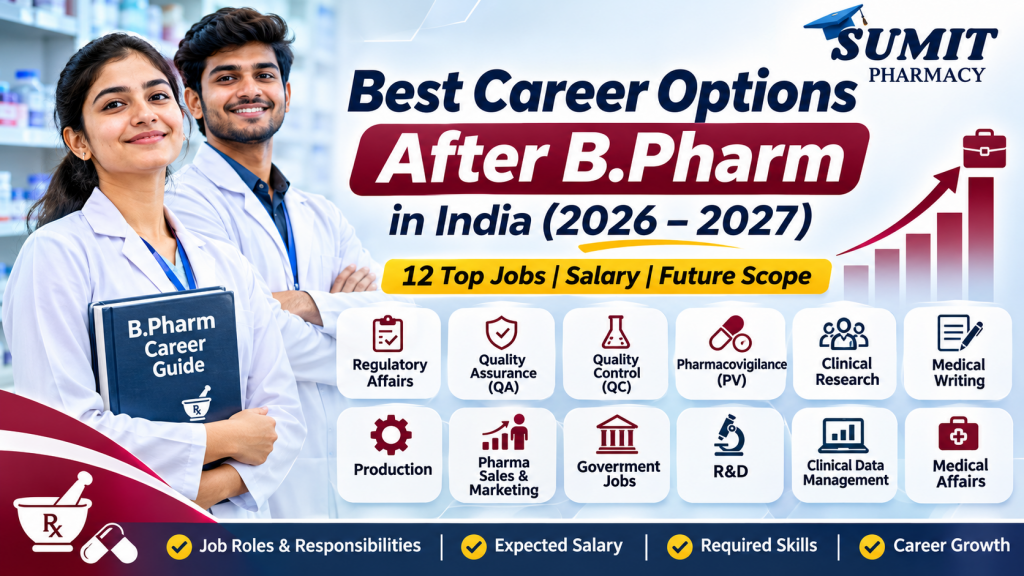
Best career options after B Pharm depend on your interests, skills, preferred work environment and long-term goals. After completing a Bachelor of Pharmacy degree, you can explore careers in Regulatory Affairs, Quality Assurance, Quality Control, Pharmacovigilance, Clinical Research, Medical Writing, Production, pharmaceutical sales and government services.
However, not every career is suitable for every graduate. Some jobs involve laboratory testing, some require extensive documentation, while others involve travelling, sales targets or patient interaction.
This guide explains the major career options after B.Pharm in India for 2026–2027, including entry-level job roles, indicative salaries, required skills, career growth and the advantages and disadvantages of each path.
The objective is simple: help you choose a career based on actual job responsibilities rather than advertisements promising high salaries or guaranteed placements.
What Is the Scope of B.Pharm in India in 2026–2027?
A B.Pharm degree can lead to opportunities across pharmaceutical manufacturing, drug development, quality management, regulatory compliance, clinical research, drug safety and healthcare services.
India’s pharmaceutical industry remains a major global supplier of medicines. Deloitte’s FY2027 industry outlook identifies digital transformation, advanced research and development, quality assurance, regulatory compliance, biologics and workforce development among the sector’s important priorities.
These developments create opportunities for pharmacy graduates, but industry growth does not automatically guarantee a job for every graduate. Employers still evaluate practical knowledge, communication skills, relevant experience and role-specific competence.
For students, the important question is not simply whether the pharmaceutical industry is growing. It is which career path offers the best combination of employability, personal fit and long-term growth.
Best Career Options After B Pharm: Quick Comparison
The following table compares common jobs after B Pharmacy in India. Salary figures are indicative estimates for entry-level candidates, not official national averages or guaranteed offers.
| Career option | Typical entry-level role | Indicative starting salary | Best suited for |
|---|---|---|---|
| Regulatory Affairs | Regulatory Affairs Executive | ₹2.5–5 LPA | Documentation and regulations |
| Quality Assurance | QA Executive | ₹2–4.5 LPA | Compliance and quality systems |
| Quality Control | QC Analyst | ₹2–4.5 LPA | Laboratory testing |
| Pharmacovigilance | Drug Safety Associate | ₹2.5–4.5 LPA | Drug safety and data review |
| Clinical Research | Clinical Research Coordinator or Trial Assistant | ₹2.5–4.5 LPA | Clinical studies and research |
| Medical Writing | Medical Writer or Junior Scientific Writer | ₹2.5–5 LPA | Scientific communication |
| Clinical Data Management | Clinical Data Management Associate | ₹2.5–4.5 LPA | Clinical data and accuracy |
| Pharmaceutical Production | Production Executive | ₹2–4 LPA | Manufacturing operations |
| Pharmaceutical Sales | Medical Representative | ₹2.5–4.5 LPA fixed pay | Communication and fieldwork |
| Government Pharmacy Jobs | Pharmacist or eligible government post | Varies by recruitment | Public-sector employment |
| Research and Development | Research Assistant or Junior Formulation Role | ₹2.5–5 LPA | Formulation and research |
| Medical Affairs | Entry-level scientific or medical-information role | Varies considerably | Scientific communication |
Important: Actual salary depends on the employer, city, academic background, skills, job description and selection process. Incentives, bonuses and variable pay may also affect total compensation. Verify the salary and eligibility requirements in each job advertisement.
1. Regulatory Affairs: A Career in Pharmaceutical Regulations
Regulatory Affairs is one of the career options after B Pharm worth exploring if you enjoy scientific documentation, compliance and understanding pharmaceutical regulations.
Regulatory Affairs professionals help pharmaceutical companies meet the requirements for developing, registering, manufacturing and marketing medicines in different countries.
What does a Regulatory Affairs Executive do?
Typical responsibilities include:
- Preparing and reviewing regulatory documentation.
- Supporting product registration and approval activities.
- Coordinating with Quality Assurance, Production, Research and Development, and other departments.
- Monitoring regulatory guidelines and changes.
- Supporting submissions to relevant regulatory authorities.
- Maintaining product registration information and regulatory records.
The precise responsibilities depend on whether the role involves Indian regulatory affairs, international submissions, product lifecycle management or another regulatory specialty.
Skills required
- Basic pharmaceutical knowledge.
- Technical writing and documentation.
- Understanding of regulatory terminology.
- Attention to detail.
- Written and verbal communication.
- Familiarity with relevant guidelines and electronic documentation systems.
Salary and career growth
An entry-level Regulatory Affairs role may offer approximately ₹2.5–5 LPA, although individual offers can fall outside this range.
With experience, professionals can progress into specialist, senior executive, regulatory strategy, submission management and managerial roles. Higher salaries generally require relevant experience and demonstrated expertise.
Advantages
- Exposure to pharmaceutical regulations and global markets.
- Opportunities to develop specialized knowledge.
- Potential progression into strategic and managerial positions.
- Work that connects scientific information with regulatory decision-making.
Challenges
- Documentation can be extensive.
- Regulatory requirements change over time.
- Submission deadlines can create pressure.
- Freshers may need to compete for limited entry-level openings.
Who should choose Regulatory Affairs? Students who prefer structured work, technical documentation, regulations and continuous learning should consider this career.
For a more detailed explanation, read our article on Regulatory Affairs Career in India: Salary, Scope, Job Reality and Future.
2. Quality Assurance: Maintaining Pharmaceutical Quality
Quality Assurance (QA) focuses on the systems and procedures used to ensure that pharmaceutical products are manufactured consistently and in accordance with applicable quality requirements.
It is an important career option after B.Pharm for students interested in Good Manufacturing Practices (GMP), documentation, audits and compliance.
What does a QA Executive do?
Depending on the position, responsibilities may include:
- Reviewing batch manufacturing and packaging records.
- Supporting deviation investigations.
- Assisting with Corrective and Preventive Actions (CAPA).
- Maintaining controlled documents.
- Supporting internal and external audits.
- Monitoring compliance with approved procedures.
- Participating in quality risk management activities.
Not every entry-level QA position includes all these responsibilities. The exact work depends on the department and employer.
Skills required
- Understanding of GMP principles.
- Documentation and record review.
- Attention to detail.
- Basic knowledge of pharmaceutical manufacturing.
- Problem-solving and communication.
Salary and growth
Freshers may encounter offers around ₹2–4.5 LPA. With experience, QA professionals can move into specialist, validation, compliance, audit and quality management positions.
Advantages and challenges
QA can provide broad exposure to pharmaceutical quality systems and manufacturing processes. However, documentation, investigations and audit preparation can be demanding, particularly when compliance issues arise.
Best suited for: Graduates who like systems, procedures, compliance and structured problem-solving.
3. Quality Control: A Laboratory-Based Career
Quality Control (QC) involves testing pharmaceutical materials and products to determine whether they meet established specifications.
If you enjoy laboratory work, analytical instruments and scientific testing, QC is one of the most relevant jobs after B Pharmacy to investigate.
What does a QC Analyst do?
Depending on the facility and job description, a QC Analyst may:
- Test raw materials and finished products.
- Assist with sample preparation.
- Perform or support analytical testing.
- Maintain laboratory records.
- Follow approved analytical procedures.
- Support instrument calibration and laboratory compliance.
- Report results and investigate unexpected findings under established procedures.
Some positions focus on chemical analysis, while others involve microbiology or specialized testing.
Skills required
- Basic analytical chemistry.
- Knowledge of laboratory safety.
- Understanding of analytical methods.
- Accurate recordkeeping.
- Familiarity with relevant instruments and procedures.
Salary and career growth
Indicative starting salaries are approximately ₹2–4.5 LPA, depending on the employer, location and technical requirements.
Experienced professionals may progress into senior analyst, method development, analytical research, laboratory supervision or management roles.
Advantages and challenges
QC provides practical laboratory experience and helps graduates develop analytical skills. However, some roles involve repetitive testing, strict procedures and shift-based work.
Best suited for: Students who enjoy laboratory testing, scientific measurements and analytical problem-solving.
4. Pharmacovigilance: Monitoring the Safety of Medicines
Pharmacovigilance (PV) focuses on identifying, assessing, understanding and preventing adverse effects and other medicine-related safety problems.
It is an option for graduates interested in drug safety, medical information and the analysis of clinical or post-marketing safety data.
What does a Drug Safety Associate do?
Responsibilities can include:
- Processing individual case safety reports.
- Reviewing information about suspected adverse reactions.
- Entering and checking case information in safety databases.
- Supporting case follow-up.
- Assisting with safety documentation and reporting timelines.
- Following applicable pharmacovigilance procedures.
The scope of work depends on the employer, project and experience level.
Skills required
- Basic pharmacology.
- Medical terminology.
- Accurate data entry and review.
- Written communication.
- Attention to detail.
- Understanding of adverse drug reaction reporting.
Salary and career growth
Freshers may encounter salaries around ₹2.5–4.5 LPA. Career progression can include senior case processing, quality review, aggregate reporting, signal detection and other drug safety functions, depending on qualifications and experience.
Advantages and challenges
PV can provide exposure to medicine safety and international safety processes. Some entry-level roles, however, involve high-volume case processing, strict timelines and repetitive tasks.
Best suited for: Graduates who are interested in pharmacology, medicine safety, clinical information and detail-oriented data review.
5. Clinical Research: Supporting Clinical Trials
Clinical research involves studying medicines and other healthcare interventions in human participants under approved protocols and applicable ethical and regulatory requirements.
This career may suit B.Pharm graduates interested in clinical studies, research coordination and the development of medical evidence.
Possible entry-level roles
- Clinical Trial Assistant.
- Clinical Research Coordinator.
- Clinical Operations Assistant.
- Clinical Research Associate trainee, where eligible.
- Clinical documentation support.
These titles are not interchangeable. Employers may require specific qualifications, training or prior experience for particular positions.
What does a clinical research professional do?
Responsibilities may include:
- Supporting trial documentation.
- Maintaining study records.
- Coordinating with research sites.
- Tracking study progress.
- Assisting with protocol compliance.
- Supporting communication between trial teams.
- Helping maintain accurate study documentation.
Clinical research work must follow applicable ethical, regulatory and quality requirements.
Salary and growth
Indicative entry-level salaries may fall around ₹2.5–4.5 LPA, depending on the role and organization.
With experience, professionals may move into clinical operations, trial monitoring, project coordination, study management or related positions.
Advantages and challenges
Clinical research offers exposure to clinical development and research operations. However, some positions involve travel, site coordination, strict timelines or extensive documentation.
Best suited for: Graduates interested in clinical studies, research processes and medical evidence.
6. Medical Writing: Turning Scientific Information into Clear Documents
Medical writing involves communicating scientific, clinical and medical information accurately for a defined audience.
It can be a suitable career option after B.Pharm for students who enjoy reading scientific literature, writing reports and explaining technical concepts.
What does a medical writer do?
Depending on the specialization, responsibilities may include:
- Preparing scientific summaries.
- Writing educational medical content.
- Reviewing scientific literature.
- Supporting clinical or regulatory documents.
- Editing technical manuscripts.
- Preparing presentations and reports.
- Checking references and scientific accuracy.
Not all medical writing jobs involve regulatory submissions. Some focus on education, publications, marketing or clinical documentation.
Skills required
- Strong written English.
- Scientific understanding.
- Literature searching and evaluation.
- Referencing and citation skills.
- Editing and proofreading.
- Ability to explain complex concepts clearly.
Salary and career growth
Freshers may encounter offers around ₹2.5–5 LPA, depending on their writing samples, subject knowledge, employer and role.
Career paths can include scientific editor, regulatory medical writer, publication specialist and senior medical writer.
Advantages and challenges
Medical writing can offer opportunities in scientific communication and, in some positions, remote or hybrid work. However, competition can be significant, and writing quality must be demonstrated rather than merely claimed.
Best suited for: Graduates who enjoy scientific reading, research and writing more than laboratory or manufacturing work.
7. Clinical Data Management: Working with Clinical Trial Data
Clinical Data Management (CDM) involves collecting, organizing, checking and maintaining data generated during clinical studies.
This field may suit graduates who are comfortable with structured information, accuracy and computer-based work.
What does a CDM professional do?
Responsibilities may include:
- Reviewing clinical study data.
- Identifying missing or inconsistent information.
- Supporting data queries.
- Maintaining data quality.
- Working with clinical databases and study documentation.
- Coordinating with clinical research teams.
The exact responsibilities depend on the organization and position.
Skills required
- Attention to detail.
- Basic clinical research knowledge.
- Spreadsheet skills.
- Data review and documentation.
- Familiarity with clinical data systems, where required.
Salary and career growth
Entry-level salaries may fall around ₹2.5–4.5 LPA, depending on the employer and candidate’s skills.
Experienced professionals may progress into senior data management, database development, data review and project management roles.
Best suited for: Graduates who prefer data-oriented work and clinical research processes.
8. Pharmaceutical Production: Working in Medicine Manufacturing
Pharmaceutical Production involves manufacturing medicines according to approved procedures, specifications and quality requirements.
It is one of the more direct industry career options after B.Pharm, particularly for graduates interested in manufacturing operations.
What does a Production Executive do?
Depending on the facility and product, responsibilities may include:
- Supporting manufacturing operations.
- Following approved batch instructions.
- Maintaining production records.
- Monitoring process parameters.
- Following safety and hygiene requirements.
- Coordinating with QA and QC.
- Supporting production planning and troubleshooting.
Skills required
- Basic pharmaceutics.
- Knowledge of dosage forms and manufacturing.
- Understanding of GMP.
- Documentation.
- Teamwork and process discipline.
Salary and career growth
Freshers may encounter starting salaries around ₹2–4 LPA. Progression can lead to senior production roles, shift supervision, manufacturing management or specialized operations.
Advantages and challenges
Production provides practical exposure to manufacturing and industrial processes. Some roles involve rotating shifts, standing for extended periods, controlled environments or strict production schedules.
Best suited for: Students interested in pharmaceutical manufacturing and process operations.
9. Pharmaceutical Sales and Marketing: A Communication-Driven Career
Pharmaceutical sales is another common route after B.Pharm. Medical Representatives communicate product information to healthcare professionals within the boundaries of applicable laws, company policies and ethical promotional standards.
What does a Medical Representative do?
Typical responsibilities include:
- Visiting assigned healthcare professionals.
- Communicating approved product information.
- Building professional relationships.
- Meeting territory and sales objectives.
- Reporting field activity.
- Coordinating with sales managers and distributors.
Skills required
- Communication and presentation.
- Relationship management.
- Planning and organization.
- Product knowledge.
- Professional conduct.
- Comfort with travel and targets.
Salary and career growth
Starting compensation may be around ₹2.5–4.5 LPA in fixed pay, but packages vary. Incentives and reimbursements may be separate, so compare the fixed component rather than relying only on advertised total compensation.
Career growth can include senior representative, area management, regional management and other commercial leadership roles.
Advantages and challenges
Sales can offer performance-based growth and strong commercial skills. However, travel, sales targets and frequent fieldwork are not suitable for everyone.
Best suited for: Graduates who enjoy communication, networking, fieldwork and target-driven responsibilities.
10. Government Jobs After B Pharmacy
Government jobs after B Pharmacy attract candidates seeking public-sector employment, structured recruitment processes and defined service conditions.
Potential opportunities may include pharmacist positions and other posts for which pharmacy graduates meet the published eligibility criteria.
Where should you look?
Depending on the recruitment cycle, check:
- State health department recruitment portals.
- Government hospital recruitment notices.
- State public service commissions.
- Central government recruitment portals.
- Government medical institutions.
- Public-sector organizations advertising eligible pharmacy positions.
Important eligibility distinction
A B.Pharm degree does not automatically make a candidate eligible for every government healthcare post.
Some positions require pharmacist registration, while others may specify additional qualifications, age limits, experience or examinations.
The Pharmacy Council of India explains that pharmacist registration is handled by the relevant State Pharmacy Councils, subject to statutory requirements. Always read the official recruitment notification and confirm registration requirements with the relevant authority.
Salary and growth
Government pay varies significantly by post, pay level, allowances, state and recruitment rules. Do not rely on a single salary estimate for all government pharmacist jobs.
Advantages and challenges
Government employment may offer structured pay and service conditions. However, vacancies can be limited, competition can be high and recruitment timelines may be lengthy.
Best suited for: Graduates prepared to monitor official notifications and study consistently for competitive recruitment.
11. Research and Development: Developing Better Medicines
Research and Development (R&D) involves developing, evaluating or improving pharmaceutical products, formulations, analytical methods and manufacturing processes.
This can be an attractive career for students who enjoy scientific investigation. However, specialized R&D roles may prefer or require M.Pharm, a Ph.D. or specific technical experience.
Possible work areas
- Formulation development.
- Analytical development.
- Preformulation studies.
- Process development.
- Product optimization.
- Research documentation.
Actual eligibility depends on the employer and research function.
Skills required
- Pharmaceutics or analytical science knowledge.
- Experimental design and interpretation.
- Laboratory skills.
- Scientific documentation.
- Data analysis and problem-solving.
Salary and growth
Some entry-level research-support or junior formulation positions may offer around ₹2.5–5 LPA. Specialized research roles can have different eligibility and compensation structures.
Should you pursue M.Pharm?
If your main goal is a specialized formulation development or research career, M.Pharm in a relevant specialization may improve your technical preparation and access to certain roles. It does not guarantee a research job.
Best suited for: Graduates who enjoy experiments, scientific analysis and developing pharmaceutical products.
12. Medical Affairs and Other Emerging Roles
Medical Affairs involves scientific communication and evidence-related support for healthcare products. Depending on the position, responsibilities may include scientific information, medical education, literature review and communication with healthcare professionals.
Not every Medical Affairs role accepts fresh B.Pharm graduates. Some positions prefer advanced qualifications or relevant experience, so check eligibility carefully.
Other developing areas include:
- Digital quality systems.
- Regulatory technology.
- Pharmaceutical data analytics.
- AI-assisted scientific workflows.
- Biologics and biosimilars.
- Advanced manufacturing.
The industry’s direction suggests that digital skills and specialized scientific knowledge may become increasingly useful. However, an emerging area is not automatically an easy entry-level career. Candidates must build the relevant technical foundation.
Which Career Is Best After B Pharm? Use This Decision Guide
Instead of choosing a job because it is trending, match the work to your interests.
| If you prefer… | Explore these careers |
|---|---|
| Documentation and regulations | Regulatory Affairs |
| Quality systems and compliance | Quality Assurance |
| Laboratory testing | Quality Control |
| Medicine safety | Pharmacovigilance |
| Clinical studies | Clinical Research |
| Scientific writing | Medical Writing |
| Data and computer-based work | Clinical Data Management |
| Manufacturing operations | Production |
| Communication and travel | Pharmaceutical Sales |
| Public-sector recruitment | Government Jobs |
| Formulation research | R&D and relevant higher studies |
| Scientific information and medical communication | Medical Affairs, where eligible |
No single option is best for every graduate. Your interests, abilities, financial needs and willingness to pursue further education all matter.
How to Get Your First Pharma Job After B.Pharm: A Practical 90-Day Plan
A degree alone may not be enough to stand out in a competitive fresher job market. Use the next three months to build evidence that you understand your chosen role.
Days 1–15: Choose One Career Path
Select one primary career and one backup.
For example:
- Primary: Regulatory Affairs.
- Backup: Quality Assurance.
Read at least 15–20 relevant job descriptions. Note recurring eligibility criteria, technical skills, software requirements and experience expectations.
Do not try to prepare for every pharmaceutical department simultaneously.
Days 16–30: Build the Fundamentals
Study the concepts that repeatedly appear in the job descriptions.
For example:
- Regulatory Affairs: regulatory pathways, product registration and submission terminology.
- QA: GMP, deviations, CAPA and document control.
- QC: analytical methods, laboratory safety and instrument fundamentals.
- Pharmacovigilance: adverse drug reactions, case processing and safety terminology.
- Medical Writing: literature searching, referencing and scientific writing.
Use reliable educational material and official guidance where applicable.
Days 31–45: Create Practical Work Samples
Prepare samples relevant to your chosen field.
Examples include:
- A structured regulatory document summary.
- A mock deviation investigation using clearly fictional data.
- A sample literature review with accurate references.
- A clinical data quality checklist.
- A scientific article written for a defined audience.
Label practice documents as samples. Never present simulated work as actual industry experience or confidential company documentation.
Days 46–60: Improve Your CV and Interview Skills
Your CV should emphasize:
- Relevant academic projects.
- Practical training and internships.
- Technical skills you can demonstrate.
- Research, presentations or documentation work.
- Relevant certifications, if completed.
Prepare concise answers to common technical questions. Be able to explain what you know and what you have not yet done professionally.
Days 61–90: Apply and Track Results
Apply to relevant fresher and trainee roles through company career pages and credible job platforms.
Maintain a spreadsheet with:
- Company and position.
- Eligibility requirements.
- Application date.
- Current status.
- Skills you need to improve.
- Interview feedback.
If you receive few responses, review whether your CV matches the roles. If interviews are unsuccessful, identify the technical questions you could not answer and prepare those topics.
The objective of these 90 days is not to guarantee employment. It is to make your applications more targeted and improve your readiness for entry-level recruitment.
B.Pharm vs M.Pharm: Should You Work or Study Further?
After B.Pharm, graduates commonly face two choices: enter the workforce or pursue higher education.
| Factor | Start working after B.Pharm | Pursue M.Pharm |
|---|---|---|
| Income | Potential to earn immediately | Tuition and living costs may apply |
| Industry experience | Starts earlier | Usually begins later, unless gained alongside study |
| Specialization | Develops through job experience | Structured academic specialization |
| R&D opportunities | Depends on role and employer | May improve eligibility for certain specialized roles |
| Long-term outcome | Depends on skills and progression | Depends on specialization, institute, projects and employability |
M.Pharm is not automatically better than starting work. Likewise, getting a job immediately is not always the best choice.
Before deciding, compare the cost of the degree, the quality of the institution, placement evidence, your preferred specialization and the actual eligibility requirements of jobs you want.
If your target is a specialized research position, postgraduate study may be valuable. If you can secure a relevant job and develop skills on the job, working first may also be a reasonable strategy.
Common Mistakes to Avoid When Choosing a Career After B.Pharm
1. Choosing a Career Only for Salary
A high advertised salary is not enough reason to select a role. Understand the daily responsibilities, required skills and work conditions.
2. Paying for a Course Without Checking Its Value
A certificate does not guarantee placement. Before paying, check the syllabus, practical work, trainer qualifications, employer recognition and independently verifiable placement evidence.
3. Applying Without Reading Eligibility Criteria
Some jobs require specific degrees, registration, experience or technical skills. Read the complete job description before applying.
4. Preparing for Too Many Fields at Once
Trying to master QA, QC, Regulatory Affairs, Pharmacovigilance and Clinical Research simultaneously can leave you underprepared for all of them. Choose a primary target.
5. Ignoring Communication Skills
Technical knowledge matters, but you must also explain your knowledge clearly in interviews, emails and professional documents.
6. Believing Every Online Salary Claim
A single high salary example does not represent the typical salary of all freshers. Compare multiple relevant vacancies and verify fixed pay, variable compensation and job responsibilities.
Frequently Asked Questions About Career Options After B Pharm
1. What are the best career options after B Pharm in India?
Common options include Regulatory Affairs, Quality Assurance, Quality Control, Pharmacovigilance, Clinical Research, Medical Writing, Clinical Data Management, Production, Pharmaceutical Sales, government jobs and selected R&D positions.
The best option depends on your interests, skills and eligibility.
2. Which jobs can a B.Pharm fresher apply for?
Depending on the employer’s requirements, freshers can explore trainee or entry-level positions in QA, QC, Regulatory Affairs, Pharmacovigilance, Clinical Research, Medical Writing, Production and Pharmaceutical Sales.
Always check the specific eligibility criteria.
3. What is the starting salary after B.Pharm in India?
There is no single starting salary for all pharmacy graduates. Entry-level offers vary by department, employer, city, technical skills and prior experience. The salary ranges in this article are indicative estimates, not guaranteed offers or official national averages.
4. Which career after B.Pharm has good long-term growth?
Regulatory Affairs, Quality Assurance, Pharmacovigilance, Clinical Research, specialized scientific writing and pharmaceutical commercial roles can all offer progression. Long-term growth depends on experience, performance, specialization and employer opportunities.
5. Is Regulatory Affairs a good career after B.Pharm?
It can be a good option for graduates interested in regulations, documentation, compliance and international pharmaceutical markets. However, entry-level opportunities are competitive, and continuous learning is essential.
6. Can I get a Pharmacovigilance job after B.Pharm?
Some employers recruit B.Pharm graduates for entry-level drug safety roles. Requirements differ by company and project, so check the advertised qualifications and technical expectations.
7. Are government jobs available after B.Pharm?
Yes, recruitment notifications may include pharmacist and other eligible positions. Eligibility, registration, age limits, examinations and salary depend on the specific post and recruiting authority.
8. Is M.Pharm necessary after B.Pharm?
No. You can pursue employment after B.Pharm. M.Pharm may be useful for particular specialized roles, academic pathways and research positions, depending on the employer’s requirements.
9. Which career is suitable for students who dislike laboratory work?
Consider exploring Regulatory Affairs, Pharmacovigilance, Medical Writing, Clinical Data Management or selected clinical research roles. Each has its own technical requirements, so review the daily responsibilities before deciding.
10. How can I improve my chances of getting a job after B.Pharm?
Choose a target role, study relevant technical fundamentals, improve communication, prepare a role-specific CV, develop demonstrable skills and apply consistently to suitable vacancies. Internships and practical exposure can also help when available.
Conclusion: Choose the Right Career, Not Just a Popular Career
The best career options after B Pharm are not identical for every graduate. Regulatory Affairs may suit someone who enjoys documentation and regulations, while QC may be better for someone who prefers laboratory testing. Pharmacovigilance, Clinical Research, Medical Writing, Production, Sales and government recruitment offer different types of work and different challenges.
Start by identifying the work you can realistically see yourself doing. Then check current job descriptions, build the required skills and evaluate opportunities using evidence rather than salary promises.
A B.Pharm degree provides a foundation. Your specialization, practical knowledge, communication skills and career decisions determine how effectively you use it.
For more pharmacy career guidance, explore the Sumit Pharmacy articles on Regulatory Affairs and the latest B.Pharm curriculum.