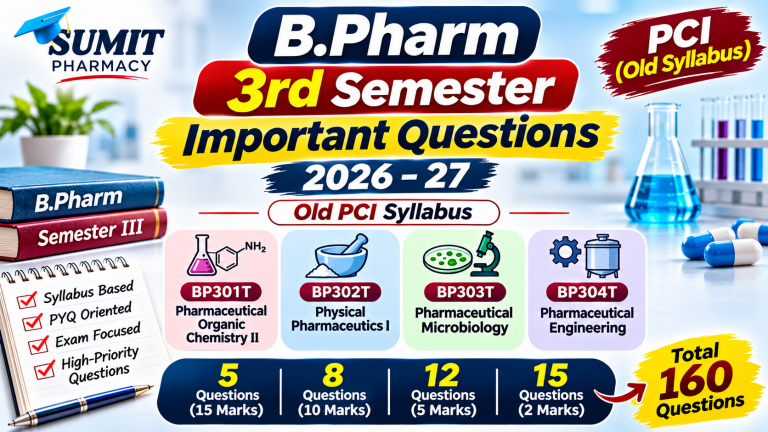
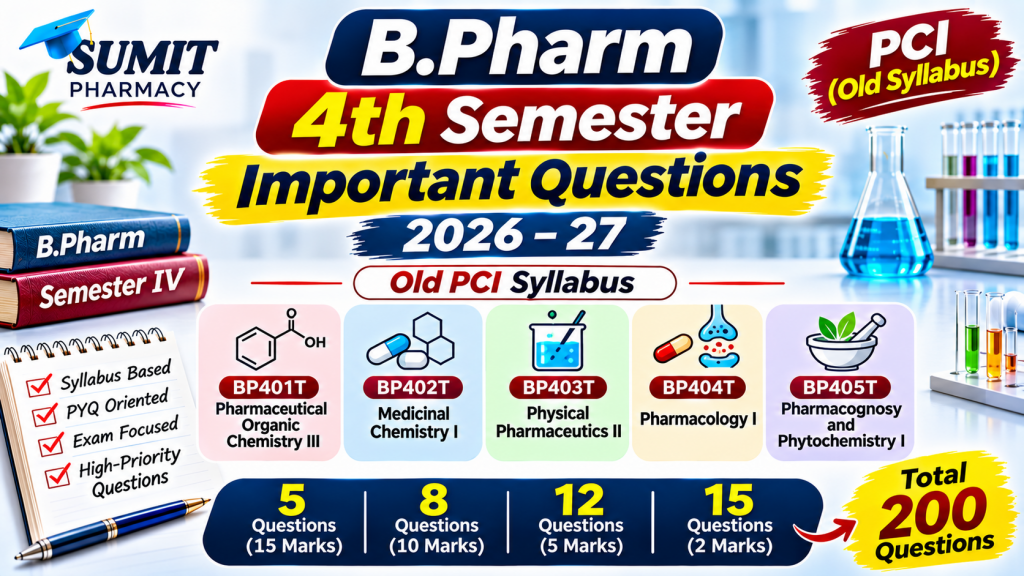
Preparing for your B.Pharm 4th Semester examinations? This subject-wise question bank will help you focus on important topics from the old PCI B.Pharm syllabus.
In this article, you will find 200 selected important and expected questions covering all five theory subjects of B.Pharm Semester IV. Questions are arranged according to 15-mark, 10-mark, 5-mark and 2-mark categories to make examination preparation and revision easier.
The question selection focuses on important syllabus topics, commonly tested concepts and available previous-year examination patterns. It covers major areas such as organic reaction mechanisms, medicinal chemistry, rheology, pharmacological mechanisms and phytochemical constituents.
This question bank follows the old PCI B.Pharm syllabus (BP401T–BP405T). Students following the revised NEP 2020 curriculum should check their applicable syllabus because the subject structure is different.
B.Pharm 4th Semester Subjects and Subject Codes
The old PCI B.Pharm Semester IV curriculum includes five theory subjects and four practical subjects.
| Subject code | Subject name |
|---|---|
| BP401T | Pharmaceutical Organic Chemistry III |
| BP402T | Medicinal Chemistry I |
| BP403T | Physical Pharmaceutics II |
| BP404T | Pharmacology I |
| BP405T | Pharmacognosy and Phytochemistry I |
B.Pharm 4th Semester Important Questions – Marks-Wise Distribution
Each subject contains 40 selected questions.
| Question type | Number of questions |
|---|---|
| Long-answer questions (15 marks) | 5 |
| Descriptive questions (10 marks) | 8 |
| Short-answer questions (5 marks) | 12 |
| Very short-answer questions (2 marks) | 15 |
| Total per subject | 40 |
| Total for five subjects | 200 |
Note: This marks-wise structure is a preparation format. The actual question-paper pattern may vary between universities.
1. BP401T – Pharmaceutical Organic Chemistry III Important Questions
Pharmaceutical Organic Chemistry III focuses on stereochemistry, heterocyclic compounds and the chemistry of important organic molecules used in pharmaceutical sciences. Students should give special attention to structures, nomenclature, preparation methods, chemical reactions and reaction mechanisms.
A. Important 15-Mark Questions
- Define stereoisomerism and explain optical isomerism in detail. Discuss chirality, enantiomers, diastereomers and racemic mixtures with suitable examples.
- Explain geometrical isomerism in organic compounds. Discuss cis-trans and E-Z nomenclature with suitable examples.
- Explain the classification, nomenclature, preparation and chemical reactions of five-membered heterocyclic compounds, including furan, pyrrole and thiophene.
- Describe the structure, aromaticity, preparation and chemical reactions of six-membered heterocyclic compounds, including pyridine.
- Explain the chemistry of fused heterocyclic compounds. Discuss the structure, properties and important reactions of indole, quinoline and isoquinoline.
B. Important 10-Mark Questions
- Explain the Cahn–Ingold–Prelog (CIP) rules used for assigning R and S configurations.
- Differentiate between enantiomers, diastereomers and meso compounds with suitable examples.
- Explain optical activity and discuss the methods used to measure optical rotation.
- Describe the conformational analysis of ethane and cyclohexane.
- Explain the preparation and chemical reactions of furan.
- Discuss the preparation and chemical properties of pyrrole and thiophene.
- Explain the basicity of pyridine and describe its important chemical reactions.
- Discuss the preparation and reactions of quinoline and isoquinoline.
C. Important 5-Mark Questions
- Define stereochemistry and explain its importance in pharmaceutical sciences.
- Differentiate between optical and geometrical isomerism.
- Write a short note on chirality.
- Explain the concept of enantiomers.
- Define diastereomers with suitable examples.
- Explain the assignment of R and S configurations.
- Write a short note on racemic mixtures.
- Explain the aromatic character of pyrrole.
- Differentiate between furan, pyrrole and thiophene.
- Write a short note on the basicity of pyridine.
- Explain the structure of indole.
- Write a short note on quinoline.
D. Important 2-Mark Questions
- Define stereoisomerism.
- What is chirality?
- Define enantiomers.
- What are diastereomers?
- Define racemic mixture.
- What is optical rotation?
- What is a meso compound?
- Define geometrical isomerism.
- What are heterocyclic compounds?
- Name three five-membered heterocyclic compounds.
- What is pyrrole?
- Define pyridine.
- What is indole?
- Define quinoline.
- What are fused heterocyclic compounds?
2. BP402T – Medicinal Chemistry I Important Questions
Medicinal Chemistry I deals with the relationship between the chemical structure of drugs and their biological activity. It covers drug discovery, physicochemical properties, drug metabolism and the chemistry of important drug classes, including sympathomimetics, sedatives, hypnotics, antipsychotics, anticonvulsants and general anaesthetics.
Students should focus on classification, chemical structures, mechanisms of action, structure–activity relationships (SAR), therapeutic uses and important examples.
A. Important 15-Mark Questions
- Explain the basic principles of drug discovery and development. Discuss the physicochemical properties affecting biological activity, including solubility, partition coefficient, ionisation and hydrogen bonding.
- Define structure–activity relationship (SAR). Explain the SAR of sympathomimetic drugs with suitable examples.
- Classify sedative and hypnotic drugs. Discuss the SAR, mechanism of action and therapeutic uses of benzodiazepines and barbiturates.
- Classify antipsychotic drugs. Explain the SAR and medicinal chemistry of phenothiazine derivatives with suitable examples.
- Classify anticonvulsant drugs. Discuss the chemistry, SAR and therapeutic uses of important anticonvulsants, including phenytoin, carbamazepine and barbiturates.
B. Important 10-Mark Questions
- Explain the different stages involved in drug discovery and development.
- Discuss the role of physicochemical properties in drug absorption and biological activity.
- Explain the classification, chemistry and medicinal uses of sympathomimetic agents.
- Describe the chemistry and SAR of sympatholytic drugs.
- Explain the classification and medicinal chemistry of sedative and hypnotic agents.
- Discuss the classification, SAR and therapeutic uses of antipsychotic drugs.
- Explain the chemistry and medicinal uses of anticonvulsant drugs.
- Classify general anaesthetics and discuss their important chemical properties and therapeutic applications.
C. Important 5-Mark Questions
- Define medicinal chemistry and explain its importance.
- Write a short note on drug discovery.
- Explain the importance of partition coefficient in drug action.
- Define structure–activity relationship (SAR).
- Write a short note on prodrugs.
- Classify sympathomimetic agents with examples.
- Explain the mechanism of action of adrenaline.
- Differentiate between sedatives and hypnotics.
- Write a short note on benzodiazepines.
- Classify antipsychotic drugs with examples.
- Write a short note on phenytoin.
- Explain the classification of general anaesthetics.
D. Important 2-Mark Questions
- Define medicinal chemistry.
- What is drug discovery?
- Define structure–activity relationship.
- What is a prodrug?
- Define partition coefficient.
- What are sympathomimetic agents?
- Give two examples of sympatholytic drugs.
- Define sedative drugs.
- What are hypnotics?
- Give two examples of benzodiazepines.
- Define antipsychotic drugs.
- What are anticonvulsants?
- Give two examples of general anaesthetics.
- What is bioisosterism?
- Define drug metabolism.
3. BP403T – Physical Pharmaceutics II Important Questions
Physical Pharmaceutics II deals with the physical principles involved in pharmaceutical dispersions, rheology, suspensions, emulsions, semisolid dosage forms and stability of pharmaceutical preparations.
Students should focus on principles, classifications, theories, graphs, equations and pharmaceutical applications. Numerical problems and diagrams are also important for this subject.
A. Important 15-Mark Questions
- Define colloidal dispersions and explain their classification, properties and pharmaceutical applications. Discuss the optical, kinetic and electrical properties of colloidal systems.
- Define rheology and explain Newtonian and non-Newtonian flow systems. Discuss viscosity, thixotropy, rheopexy and their pharmaceutical applications with suitable graphs.
- Explain suspensions in detail. Discuss their classification, formulation, stability problems, flocculated and deflocculated systems and methods of evaluation.
- Explain emulsions and their classification. Discuss theories of emulsification, identification tests, stability problems and methods of evaluation.
- Explain the stability of pharmaceutical products. Discuss different types of degradation, factors affecting stability and methods used to improve the stability of pharmaceutical formulations.
B. Important 10-Mark Questions
- Explain the electrical properties of colloidal dispersions, including zeta potential and electrophoresis.
- Describe the methods of preparation and purification of colloidal systems.
- Explain the different types of non-Newtonian flow and their pharmaceutical significance.
- Discuss the theories of viscosity and explain the measurement of viscosity using suitable instruments.
- Explain the formulation and evaluation of pharmaceutical suspensions.
- Describe the formulation, identification and evaluation of emulsions.
- Discuss the factors affecting the physical stability of emulsions and methods used to prevent cracking and creaming.
- Explain the different types of pharmaceutical degradation and discuss methods used to improve drug stability.
C. Important 5-Mark Questions
- Define colloidal dispersion and explain its pharmaceutical importance.
- Differentiate between lyophilic and lyophobic colloids.
- Write a short note on Brownian movement.
- Explain the Tyndall effect.
- Define zeta potential and explain its importance.
- Differentiate between Newtonian and non-Newtonian flow.
- Explain thixotropy with a suitable example.
- Differentiate between flocculated and deflocculated suspensions.
- Write a short note on sedimentation volume.
- Differentiate between oil-in-water and water-in-oil emulsions.
- Explain the identification tests for emulsions.
- Write a short note on pharmaceutical stability testing.
D. Important 2-Mark Questions
- Define colloid.
- What is a dispersed phase?
- Define dispersion medium.
- What is the Tyndall effect?
- Define Brownian movement.
- What is zeta potential?
- Define rheology.
- What is viscosity?
- Define thixotropy.
- What is a Newtonian fluid?
- Define suspension.
- What is sedimentation volume?
- Define emulsion.
- What is creaming?
- Define drug stability.
4. BP404T – Pharmacology I Important Questions
Pharmacology I introduces the basic principles of pharmacology, routes of drug administration, pharmacokinetics, pharmacodynamics, drug receptors and the pharmacology of the peripheral and central nervous systems.
Students should focus on mechanisms of action, classification, pharmacological effects, therapeutic uses and adverse effects of important drug groups.
A. Important 15-Mark Questions
- Define pharmacology and explain its scope. Discuss the different routes of drug administration, including their advantages and disadvantages.
- Explain pharmacokinetics in detail. Discuss absorption, distribution, metabolism and excretion (ADME) of drugs with suitable diagrams.
- Explain pharmacodynamics and discuss drug receptors, dose-response relationships, potency, efficacy and factors modifying drug action.
- Describe the anatomy and physiology of the autonomic nervous system. Classify cholinergic and adrenergic drugs and explain their mechanisms of action and therapeutic uses.
- Explain the pharmacology of general anaesthetics and sedative-hypnotic drugs. Discuss their classification, mechanism of action, therapeutic uses and adverse effects.
B. Important 10-Mark Questions
- Explain the different sources and classification of drugs with suitable examples.
- Describe the different mechanisms of drug absorption and factors affecting drug absorption.
- Explain drug distribution and discuss plasma protein binding and volume of distribution.
- Describe drug metabolism and explain Phase I and Phase II metabolic reactions.
- Explain drug excretion and discuss renal excretion of drugs.
- Classify cholinergic drugs and explain their pharmacological actions and therapeutic uses.
- Classify adrenergic drugs and discuss the pharmacological actions of adrenaline and noradrenaline.
- Explain the pharmacology of drugs acting on the central nervous system, with special reference to general anaesthetics.
C. Important 5-Mark Questions
- Define pharmacology and explain its branches.
- Differentiate between pharmacokinetics and pharmacodynamics.
- Explain the different routes of drug administration.
- Define bioavailability and mention the factors affecting it.
- Write a short note on first-pass metabolism.
- Differentiate between potency and efficacy.
- Explain the concept of therapeutic index.
- Write a short note on drug receptors.
- Differentiate between agonists and antagonists.
- Explain the functions of the sympathetic nervous system.
- Write a short note on cholinergic drugs.
- Explain the mechanism of action of general anaesthetics.
D. Important 2-Mark Questions
- Define pharmacology.
- What is pharmacokinetics?
- Define pharmacodynamics.
- What is absorption?
- Define distribution.
- What is metabolism?
- Define excretion.
- What is bioavailability?
- Define half-life of a drug.
- What is volume of distribution?
- Define agonist.
- What is an antagonist?
- Define therapeutic index.
- What is a drug receptor?
- Define first-pass metabolism.
5. BP405T – Pharmacognosy and Phytochemistry I Important Questions
Pharmacognosy and Phytochemistry I deals with medicinal plants, natural products, plant metabolites and the identification, extraction and evaluation of crude drugs. Important areas include plant tissue culture, primary and secondary metabolites, alkaloids, glycosides, tannins and other phytochemical constituents.
Students should focus on classification, biological sources, chemical constituents, identification tests, extraction methods and therapeutic uses of crude drugs.
A. Important 15-Mark Questions
- Define pharmacognosy and explain its history, scope and development. Discuss the importance of natural products in modern medicine.
- Explain plant tissue culture in detail. Discuss its principle, types, techniques, applications and importance in the production of secondary metabolites.
- Explain the different primary and secondary metabolites found in medicinal plants. Discuss their classification, biosynthesis and pharmaceutical importance.
- Define alkaloids and explain their classification, chemical properties, extraction, identification tests and pharmaceutical applications.
- Explain glycosides and their classification. Discuss the chemistry, identification and medicinal importance of important glycosides.
B. Important 10-Mark Questions
- Explain the traditional systems of medicine, including Ayurveda, Siddha, Unani and traditional Chinese medicine.
- Describe the methods of cultivation, collection, processing and storage of medicinal plants.
- Explain the different methods of extraction used in pharmacognosy and discuss the factors affecting extraction.
- Discuss the definition, classification, identification and pharmaceutical importance of tannins.
- Explain the chemistry, classification and medicinal importance of volatile oils.
- Describe the methods of evaluation of crude drugs, including organoleptic, microscopic, physical and chemical evaluation.
- Explain the different methods used for the isolation and identification of phytoconstituents.
- Discuss the biological sources, chemical constituents and medicinal uses of important crude drugs containing alkaloids and glycosides.
C. Important 5-Mark Questions
- Define pharmacognosy and explain its importance.
- Write a short note on Ayurveda.
- Differentiate between primary and secondary metabolites.
- Explain the importance of plant tissue culture.
- Write a short note on callus culture.
- Define alkaloids and classify them with examples.
- Explain the general identification tests for alkaloids.
- Define glycosides and mention their major types.
- Write a short note on cardiac glycosides.
- Explain the identification tests for tannins.
- Write a short note on volatile oils.
- Explain the importance of phytochemical screening.
D. Important 2-Mark Questions
- Define pharmacognosy.
- What is a crude drug?
- Define plant tissue culture.
- What is callus?
- Define primary metabolites.
- What are secondary metabolites?
- Define alkaloids.
- What are glycosides?
- Define tannins.
- What are volatile oils?
- Define extraction.
- What is phytochemical screening?
- Define chromatography.
- What is a marker compound?
- Define crude drug evaluation.
B.Pharm 4th Semester Exam Preparation Strategy
Preparing five subjects together requires a planned approach. Each subject has a different examination focus, so students should use subject-specific revision methods.
1. Prepare 15-Mark Questions First
Start with the major topics from each subject.
- Pharmaceutical Organic Chemistry III: Practise stereochemistry, R/S configuration, geometrical isomerism and heterocyclic structures.
- Medicinal Chemistry I: Learn drug classification, structures, SAR, mechanisms and therapeutic uses.
- Physical Pharmaceutics II: Prepare rheology, colloidal systems, suspensions, emulsions, graphs and numerical problems.
- Pharmacology I: Understand ADME, receptor mechanisms, autonomic pharmacology and central nervous system drugs.
- Pharmacognosy and Phytochemistry I: Learn plant metabolites, extraction, plant tissue culture, alkaloids and glycosides.
2. Practise Chemical Structures and Drug Classification
Medicinal Chemistry and Organic Chemistry require regular practice. Prepare chemical structures, important reactions, drug classifications and structure–activity relationships.
3. Prepare Diagrams and Graphs
Practise the following diagrams:
- R/S configuration and stereoisomerism.
- Structures of important heterocyclic compounds.
- Dose-response curves.
- Drug absorption and distribution diagrams.
- Colloidal systems and rheological flow curves.
- Flocculated and deflocculated suspensions.
- Emulsion structures.
- Plant tissue culture techniques.
- Extraction and phytochemical screening flowcharts.
4. Revise Pharmacological Mechanisms
For Pharmacology I, prepare each drug group using a consistent format:
- Classification
- Mechanism of action
- Pharmacological actions
- Therapeutic uses
- Adverse effects
- Important examples
5. Practise Previous-Year Question Papers
Solve previous-year papers to understand how questions are framed and which topics deserve more revision time. Do not rely only on expected questions.
6. Prepare Practical Viva Separately
The old PCI Semester IV curriculum also includes four practical subjects:
| Practical code | Subject |
|---|---|
| BP406P | Medicinal Chemistry I Practical |
| BP407P | Physical Pharmaceutics II Practical |
| BP408P | Pharmacology I Practical |
| BP409P | Pharmacognosy and Phytochemistry I Practical |
Prepare practical records, experiments, apparatus, principles, calculations, observations and viva questions separately.
Frequently Asked Questions (FAQs)
1. What are the important questions for B.Pharm 4th Semester?
This article provides 200 selected important questions covering all five theory subjects of the old PCI B.Pharm Semester IV syllabus. Questions are divided into 15-mark, 10-mark, 5-mark and 2-mark categories.
2. How many subjects are there in B.Pharm 4th Semester?
The old PCI B.Pharm Semester IV curriculum includes five theory subjects and four practical subjects.
3. What are the subject codes for B.Pharm 4th Semester?
The five theory subject codes are BP401T, BP402T, BP403T, BP404T and BP405T.
4. Which topics are important in Pharmaceutical Organic Chemistry III?
Important topics include stereochemistry, optical isomerism, geometrical isomerism, R/S configuration, furan, pyrrole, thiophene, pyridine, indole and quinoline.
5. Which topics are important in Medicinal Chemistry I?
Focus on drug discovery, physicochemical properties, SAR, sympathomimetic drugs, sedative-hypnotics, antipsychotics, anticonvulsants and general anaesthetics.
6. Which topics are important in Physical Pharmaceutics II?
Important topics include colloidal dispersions, rheology, Newtonian and non-Newtonian flow, suspensions, emulsions, viscosity and pharmaceutical stability.
7. Which topics are important in Pharmacology I?
Prepare pharmacokinetics, pharmacodynamics, ADME, drug receptors, autonomic nervous system, cholinergic drugs, adrenergic drugs and general anaesthetics.
8. Which topics are important in Pharmacognosy and Phytochemistry I?
Focus on plant tissue culture, primary and secondary metabolites, alkaloids, glycosides, tannins, volatile oils, extraction and phytochemical screening.
9. Are these B.Pharm 4th Semester expected questions guaranteed to appear in examinations?
No. These are high-priority practice questions selected using syllabus coverage and available previous-year question-paper trends. Actual examination questions are decided by the respective examining authority.
10. Is this question bank based on the old PCI syllabus?
Yes. This question bank follows the old PCI B.Pharm Semester IV syllabus, covering BP401T to BP405T. Students following a revised curriculum should check their applicable syllabus before preparing from this list.
11. Where can I download B.Pharm 4th Semester notes?
You can explore subject-wise pharmacy notes and study material on Sumit Pharmacy.
Final Advice for B.Pharm Students
Do not prepare only the expected questions. Use this question bank to prioritise your revision, but cover the complete prescribed syllabus wherever possible.
For Organic Chemistry, practise stereochemistry and heterocyclic structures. For Medicinal Chemistry, learn drug classifications and SAR. For Physical Pharmaceutics, understand rheology and dispersed systems. For Pharmacology, focus on drug mechanisms and pharmacological actions. For Pharmacognosy, prepare phytochemical constituents, identification tests and extraction methods.
For more B.Pharm notes, syllabus updates, examination resources and pharmacy career guidance, visit Sumit Pharmacy.