
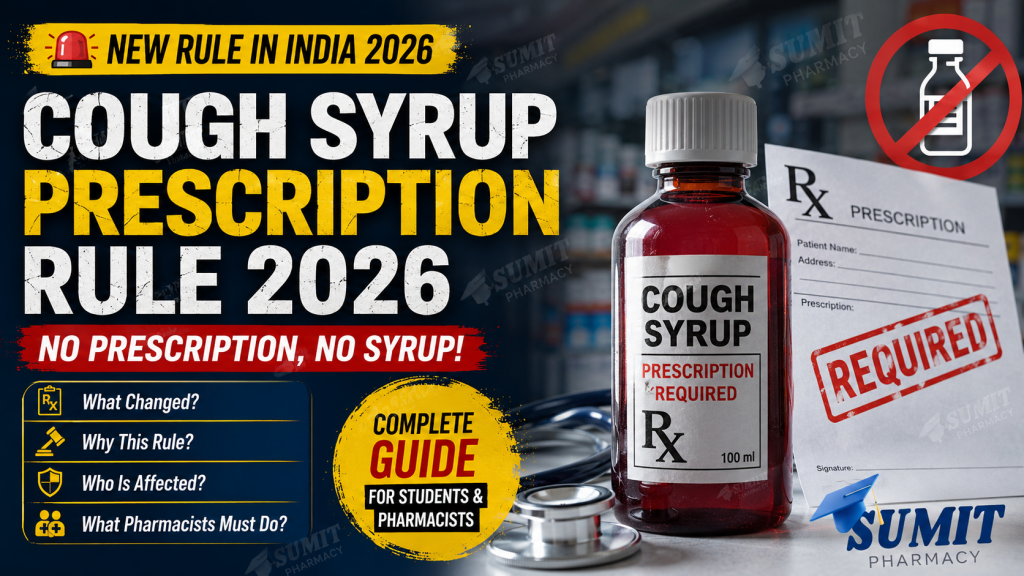
The cough syrup prescription rule India 2026 marks one of the biggest regulatory changes in Indian pharmacy practice. Under the Drugs (Fifth Amendment) Rules, 2026, cough syrups can no longer be sold over the counter and now require a valid medical prescription.
From June 2026, every cough syrup in India has moved from “grab it off the shelf” to “prescription-only.” No prescription, no syrup — not even for a mild cold. If you’re a pharmacy student, a practicing pharmacist, or someone who runs a medical store, this is one of the most consequential regulatory shifts to hit community pharmacy in years.
This guide covers not just what changed, but why, who it affects, how it compares globally, and what it means for your career or business going forward.
Quick Answer
Cough syrups can no longer be sold over the counter in India. As of 9 June 2026, the Drugs (Fifth Amendment) Rules, 2026 removed “Syrups” from the Schedule K exemption list under the Drugs Rules, 1945. A valid prescription from a registered medical practitioner is now mandatory for every syrup-based medicine — cough syrups included. Tablets and lozenges for cough remain OTC.
What Exactly Changed
The Union Ministry of Health and Family Welfare amended the Drugs Rules, 1945 through the Drugs (Fifth Amendment) Rules, 2026, notified in the Gazette of India on 9 June 2026.
The change itself is a single deleted word — but its impact is massive.
Previously, Schedule K, Serial No. 13, Entry No. 7 exempted “syrups, lozenges, pills, and tablets for cough” from requiring a prescription. This exemption is what allowed cough syrups to be sold over the counter (OTC) like any household remedy.
The amendment removes the word “Syrups” from that entry. The operative line in the notification states that the word “Syrups” under item (7) of serial number 13 in Schedule K “shall be omitted.”
The result: all syrup-based medicines, including cough syrups, are now prescription-only, nationwide, with immediate effect.
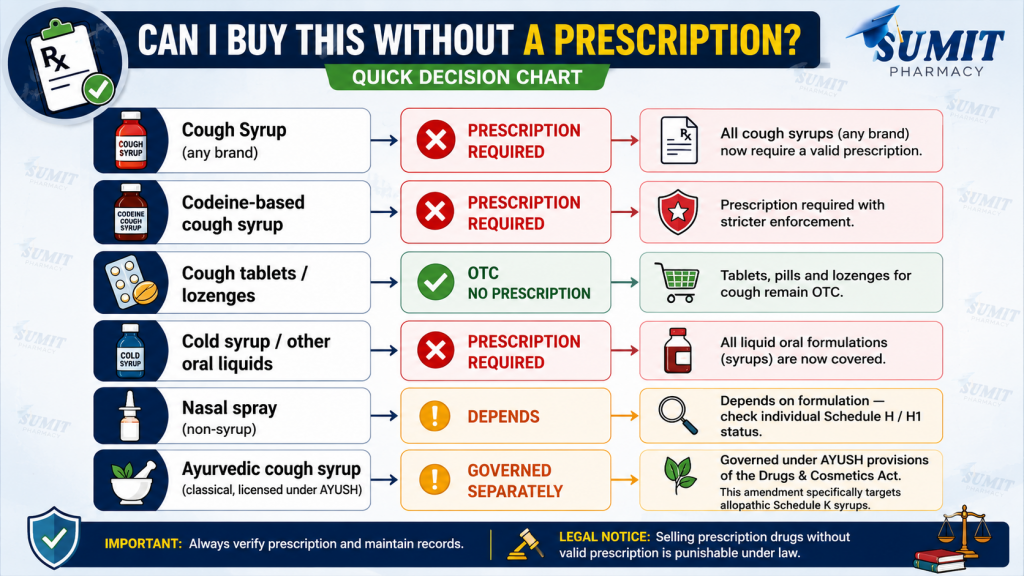
Important nuance: Tablets, pills, and lozenges for cough remain exempt and can still be sold OTC. Only the liquid/syrup formulation has lost its exemption.
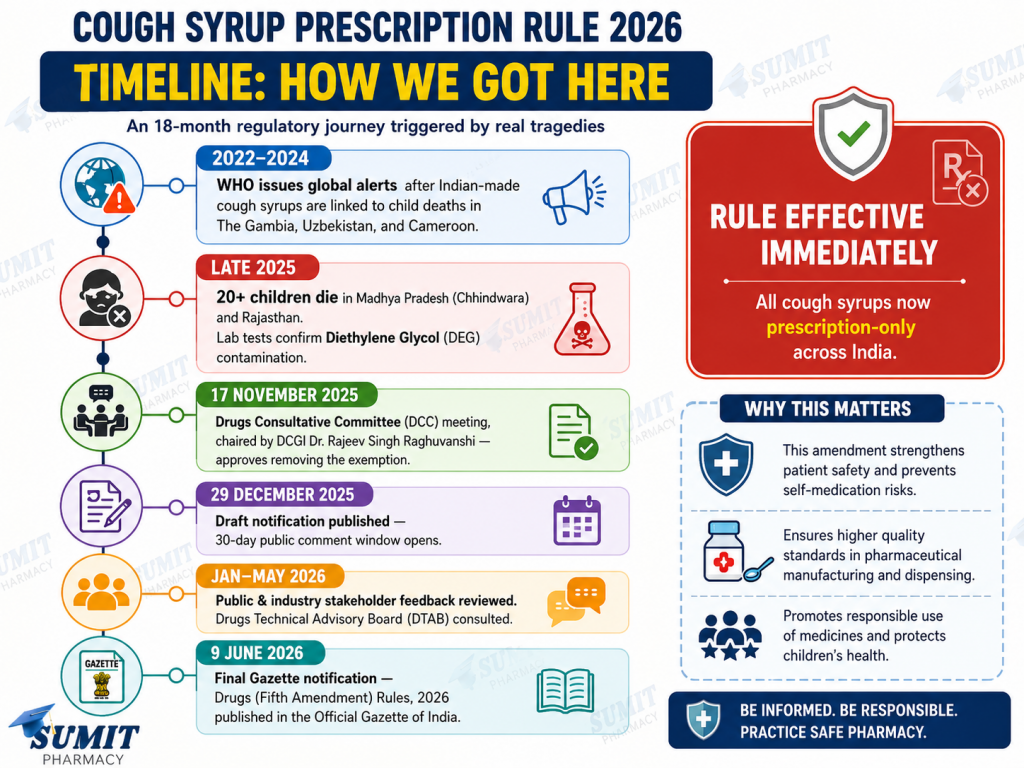
Timeline: How We Got Here
This rule didn’t appear overnight — it’s the result of an 18-month regulatory process triggered by real tragedies.
Why This Happened
This wasn’t a routine policy tweak — it followed a well-documented chain of failures.
The trigger: contaminated syrups killing children
In 2025, laboratory testing confirmed diethylene glycol (DEG) contamination in cough syrup batches linked to child deaths in Madhya Pradesh and Rajasthan. DEG is a toxic industrial solvent that causes acute kidney failure and is fatal to children even in small quantities.
This wasn’t India’s first brush with the problem. Indian-manufactured cough syrups have previously been linked to child deaths in The Gambia, Uzbekistan, and Cameroon, drawing sustained global scrutiny of India’s oral liquid manufacturing standards.
The deeper scientific concern
CDSCO has separately flagged the continued use of propylene glycol and similar excipients in paediatric oral liquids, given the risk of cross-contamination with DEG and ethylene glycol (EG) during manufacturing — a quality-control failure point, not a formulation design flaw.
This ties directly into the parallel Schedule M GMP overhaul happening across Indian pharma manufacturing through 2026, which is tightening batch documentation, electronic batch records, and quality risk management across the board.
Old Rule vs New Rule
| Aspect | Before (Old Rule) | After (New Rule, June 2026) |
|---|---|---|
| Cough syrup purchase | OTC, no prescription needed | Prescription mandatory |
| Legal basis | Schedule K, Sr. No. 13, Entry 7 exemption | Exemption removed via Drugs (Fifth Amendment) Rules, 2026 |
| Codeine-based cough syrups | Loosely controlled at retail level | Brought under stricter prescription enforcement |
| Cough tablets/lozenges | OTC | Still OTC (unchanged) |
| Pharmacist’s role | Point-of-sale, minimal verification | Must verify & record valid prescription |
| Consumer behaviour | Self-medication common | Doctor consultation required first |
Can I Buy This Without a Prescription? (Quick Decision Chart)
Impact on B.Pharm & Pharm.D Students
If you’re currently studying pharmacy, this rule isn’t just “news” — it’s now part of your syllabus, your viva questions, and your future practice.
Pharmacy Law and Ethics: Schedule K amendments are a classic exam topic in Pharmaceutical Jurisprudence. Expect this exact amendment — the omission of “Syrups” from Serial No. 13, Entry 7 — to show up in university exams, GPAT-style MCQs, and viva questions for the next few academic cycles. Understanding why Schedule K exists (as an exemption category under the Drugs and Cosmetics Act) and how amendments are legally enacted (DCC → draft notification → DTAB consultation → Gazette notification) is exactly the kind of process-based question examiners love.
GPAT and competitive exams: Regulatory affairs and pharmaceutical jurisprudence sections increasingly draw from current events rather than only textbook law. A question like “Which Schedule was amended to make cough syrups prescription-only in 2026?” is a realistic GPAT-style application question.
Hospital Pharmacy practice: For students heading into hospital pharmacy internships, this rule reinforces the importance of prescription verification protocols — something hospital pharmacies already do rigorously, unlike many retail counters. It’s a good discussion point to bring up in hospital pharmacy vivas or PSM (Pharmacy Practice) rotations.
Community Pharmacy practice: This is where the rule bites hardest. Community pharmacy coursework typically underemphasizes prescription-verification friction with real customers — this rule creates a live, relatable case study on patient counseling, refusal-of-sale conversations, and documentation discipline.
Interviews and viva prep: If you’re interviewing for a Drug Inspector post, a QA/RA role, or even a hospital pharmacist position in the next year, expect this topic to come up as a current-affairs question. Being able to explain the legal mechanism (not just “cough syrup ban ho gaya”) will set you apart from candidates who only know the headline.
Impact on Retail Pharmacy Business
Independent medical stores face the most immediate operational disruption. A large share of walk-in cough-syrup sales — especially for common cold symptoms — previously required no paperwork. Store owners now need a system to record and retain prescriptions, and staff need to be trained to politely but firmly decline sales without one. Expect short-term revenue dips in this category and customer pushback until habits adjust.
Organized pharmacy chains (Apollo Pharmacy, Wellness Forever, MedPlus, and similar) are generally better positioned to absorb this change — many already have digital prescription-capture systems and standard operating procedures from handling Schedule H/H1 drugs. This rule may accelerate their competitive advantage over unorganized retail, since compliance infrastructure is already partly in place.
Jan Aushadhi Kendras, which operate under the same Drugs and Cosmetics Act framework, are equally bound by this amendment. Given their focus on affordable generics for price-sensitive patients, expect friction — many customers visiting Jan Aushadhi stores for cough syrups will now need to first visit a doctor, adding cost and time that undermines the “affordable and accessible” positioning these stores are built on.
Across all retail formats, licence risk is now real: selling syrups without a prescription is a compliance violation that state drug control departments are expected to actively inspect for, especially given the heightened political attention on this issue after the child deaths.
Impact on Pharmaceutical Companies
For manufacturers, this amendment cascades into several operational areas:
- Labelling changes: Packaging and inserts will likely need updated language reflecting prescription-only status, in line with how Schedule H/H1 drugs are labelled.
- Marketing and promotion: Direct-to-consumer advertising of cough syrups (a long-standing practice in India) becomes far more legally sensitive once a product is prescription-only — companies will need to review promotional compliance under the Drugs and Magic Remedies Act as well.
- Supply chain and distribution: Distributors and stockists will need updated SOPs for tracking sales against prescriptions, similar to controlled-substance distribution chains.
- Regulatory documentation: This sits alongside the broader 2026 Schedule M GMP overhaul — companies are already dealing with revised electronic batch manufacturing records (eBMR), Product Quality Review (PQR) systems, and stricter change-control documentation. Cough syrup manufacturers specifically will face added scrutiny on excipient sourcing certificates for propylene glycol and glycerin, given the DEG/EG contamination history.
- Stability studies: No change to core stability testing requirements, but expect increased CDSCO audit attention on paediatric oral liquid formulations specifically.
- Pharmacovigilance: Updated CDSCO rules already require Periodic Safety Update Reports (PSURs) from actual market launch date rather than approval date — cough syrup manufacturers will need particularly clean adverse-event reporting given the regulatory spotlight on this category.
How Other Countries Regulate Cough Syrups
India’s move brings it closer to — though not identical with — how several developed markets already treat cough and cold medicines, especially for children.
United States (FDA): The FDA does not require a prescription for most adult cough syrups containing dextromethorphan, which remains OTC for those aged 12 and older, though several states have added age restrictions (18+) at point of sale to curb misuse. However, since 2008, following safety reviews, the FDA has recommended against using OTC cough and cold medicines in children under 2 years of age — a labelling-based caution rather than an outright prescription requirement.
United Kingdom (MHRA): Following a formal safety review completed around 2009, the MHRA concluded that OTC cough and cold medicines should not be used in children younger than 6 years, and codeine-containing cough linctuses specifically were later restricted from use in anyone under 18 due to metabolism risks in children. The UK approach has leaned on age-based restriction and pharmacist-mediated sale rather than a blanket prescription-only rule for all syrups.
European Union (national agencies under EMA coordination): Regulatory action across EU member states has similarly focused on restricting use of cough and cold medicines in young children rather than removing OTC status entirely for adults, with individual countries like the Netherlands showing measurable declines in paediatric cough-medicine prescribing following coordinated safety warnings.
India’s approach is comparatively broader — rather than an age-based restriction or a codeine-specific control, India has removed the OTC exemption for the entire syrup category, for all age groups. This is a more sweeping intervention than the US, UK, or EU models, largely because the trigger event (DEG-contamination deaths) was a manufacturing quality failure rather than a therapeutic-safety-in-children issue alone. It’s a supply-chain integrity response as much as a clinical-safety response.
Frequently Asked Questions
1. Can I still buy cough syrup without a prescription in an emergency? No. The rule applies uniformly — there is no emergency or OTC exception now that “Syrups” has been removed from the Schedule K exemption list.
2. Does this rule apply to all syrups, or only cough syrups? It applies to all syrup-based formulations, not just cough syrups — though cough syrups were the direct trigger for the change.
3. Are cough tablets and lozenges also banned from OTC sale? No. Tablets, pills, and lozenges for cough remain exempt under Schedule K and can still be sold without a prescription.
4. Why were children dying from cough syrups? Lab tests confirmed contamination with diethylene glycol (DEG), a toxic solvent that can enter formulations during manufacturing if quality controls on excipients like propylene glycol fail, leading to acute kidney failure in children.
5. When did this rule come into effect? The Drugs (Fifth Amendment) Rules, 2026 were notified on 9 June 2026 and came into force immediately upon publication in the Official Gazette.
6. Can pharmacists legally refuse to sell cough syrup without a prescription? Yes — and they are now legally required to. Selling without a valid prescription is a compliance violation that can attract licence action under the Drugs and Cosmetics Act.
7. Can hospitals dispense cough syrup to inpatients without a separate prescription slip? Hospital pharmacies operate under prescription/medication-order systems as standard practice, so in-hospital dispensing to admitted patients already meets the prescription requirement through the treating doctor’s order.
8. Can Jan Aushadhi Kendras sell cough syrups without a prescription? No. Jan Aushadhi stores operate under the same Drugs and Cosmetics Act framework and are equally bound by this amendment.
9. Does this rule affect antibiotic syrups too? Antibiotic syrups were already prescription-only under Schedule H/H1 in most cases; this amendment specifically closes the exemption that applied to cough-related syrups under Schedule K. Check individual product scheduling for confirmation.
10. What about Ayurvedic or herbal cough syrups? Classical Ayurvedic formulations are licensed separately under the Ayurvedic provisions of the Drugs and Cosmetics Act and are not automatically covered by this specific Schedule K amendment — but always verify the exact licensing category of the individual product.
11. Can old stock (manufactured before June 2026) still be sold without a prescription? The amendment took effect immediately on Gazette publication with no stated grace period for existing stock, meaning retailers should treat all syrup stock — old or new — as prescription-only from the effective date. Pharmacists should confirm current state drug-control guidance if in doubt.
12. What is the penalty for selling cough syrup without a prescription now? Violations fall under the broader enforcement provisions of the Drugs and Cosmetics Act, 1940, which can include licence suspension or cancellation for the retail/wholesale establishment, in addition to other penalties applicable for contravening Schedule K conditions. Exact penalty action is determined by the State Licensing Authority on inspection.
The Bigger Picture
This rule isn’t an isolated event — it’s one piece of a broader regulatory overhaul reshaping Indian pharmacy through 2026: revised Schedule M GMP norms, updated NDCT Rules, tighter pharmacovigilance (PSUR) reporting, and an active debate over AI-generated prescriptions from unregulated e-pharmacies. Pharmacy students entering the workforce over the next few years will practice under a meaningfully stricter, more accountable regulatory environment than the one their seniors trained under.
For pharmacists on the ground, the message is simple: the era of casual OTC syrup sales is over. Compliance isn’t optional — and neither is staying informed.
Official Sources & References
- Ministry of Health and Family Welfare — Drugs (Fifth Amendment) Rules, 2026, Gazette of India, notified 9 June 2026
- Central Drugs Standard Control Organisation (CDSCO) — official circulars on Schedule K and excipient consultations
- WHO — global alerts on diethylene glycol contamination in cough syrups (2022–2023)
- US FDA — public health advisory on OTC cough and cold products in children under 2 (2008)
About the Author
Reviewed by: Sumit Singh, M.Pharm (Pharmaceutics), Founder — Sumit Pharmacy Last Updated: 7 July 2026
Sumit Pharmacy publishes evidence-based pharmacy education content, career guides, and regulatory updates for B.Pharm, M.Pharm, and Pharm.D students across India.
Stay Updated: Every week, Sumit Pharmacy publishes evidence-based pharmacy news, career guides, and regulatory updates. Bookmark this page and check back — this article will be updated if the rule changes further.