
🌐 यह Guide हिंदी में भी उपलब्ध है।
अगर आप इस जानकारी को हिंदी में पढ़ना चाहते हैं, तो यहां जाएं:
👉 पढ़ें: PCI New B.Pharm Syllabus 2026: NEP 2020 के बाद B.Pharm में क्या-क्या बदला? (Complete Guide)
Quick Summary
| Feature | Details |
|---|---|
| Effective From | 2026-27 |
| Credits | 193 |
| Internship | Mandatory |
| AI | Yes |
| Python | Yes |
| CBCS | Yes |
Introduction
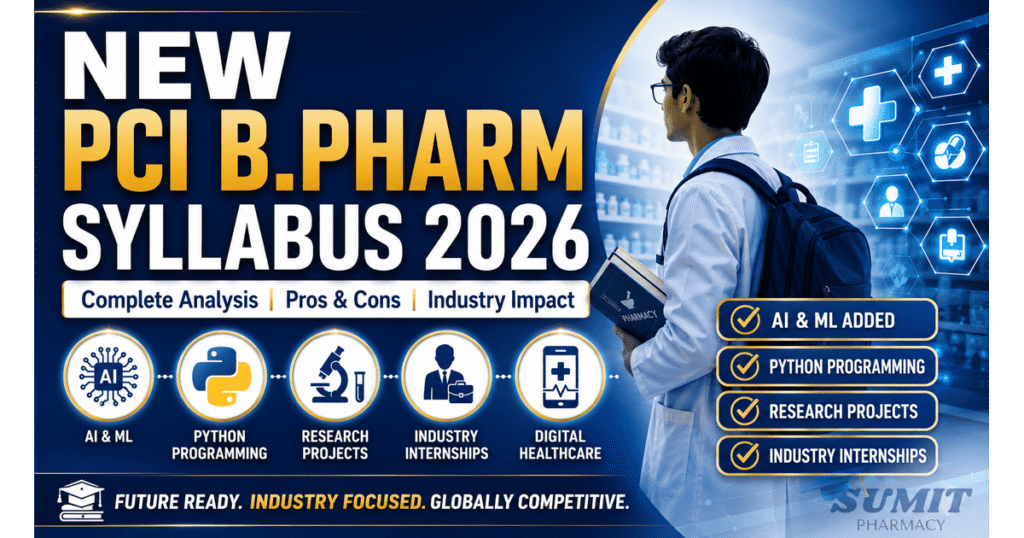
The PCI B.Pharm Syllabus 2026 introduced under the National Education Policy (NEP) 2020 represents one of the biggest reforms in pharmacy education in India. The revised curriculum introduces Python Programming, Artificial Intelligence (AI), mandatory internships, research projects, and a Choice Based Credit System (CBCS). This guide explains every major change, compares the old and new syllabus, and analyzes its impact on pharmacy students, colleges, GPAT preparation, and future careers.
The Pharmacy Council of India (PCI) has introduced one of the most significant reforms in the history of pharmacy education in India. Starting from the academic session 2026–27, the traditional B.Pharm curriculum will be replaced with a completely redesigned program aligned with the National Education Policy (NEP) 2020.
For many students, this may appear to be just another syllabus revision. However, the reality is very different.
This is not merely a syllabus update.
It is a complete transformation of how pharmacy education will be delivered in India over the next decade.
For the first time, pharmacy students will study topics such as:
- Python Programming
- Artificial Intelligence (AI)
- Machine Learning (ML)
- Data Analytics
- Biostatistics
- Entrepreneurship
- Research Projects
- Advanced Industry-Oriented Training
At the same time, PCI has introduced internships, elective courses, skill enhancement modules, and competency-based learning models.
The objective is clear:
To transform pharmacy graduates from traditional degree holders into industry-ready healthcare professionals equipped with both pharmaceutical and digital skills.
However, an important question remains:
Will these changes actually improve the future of pharmacy students, or will they simply increase academic burden?
This article explores the new PCI curriculum from every possible angle, including student benefits, implementation challenges, industry impact, employability, and future opportunities.
Download PCI B.Pharm Syllabus 2026 PDF
Students can download the latest PCI B.Pharm syllabus PDF for semester-wise subjects, credit structure, internships and curriculum details.
Why Did PCI Introduce the New B.Pharm Syllabus 2026?
PCI B.Pharm Syllabus 2026: Major Changes at a Glance
To understand the new curriculum, we must first understand why PCI felt the need to change the old one.
The pharmaceutical industry of 2026 is completely different from the pharmaceutical industry of 2014.
Ten years ago, most pharmacy graduates were primarily expected to work in:
- Production
- Quality Assurance
- Quality Control
- Community Pharmacy
- Pharmaceutical Sales
Today, the pharmaceutical ecosystem has expanded dramatically.
New career opportunities now exist in:
- Regulatory Affairs
- Pharmacovigilance
- Clinical Research
- Medical Writing
- Drug Safety
- Healthcare Analytics
- Digital Health
- Biotechnology
- Research & Development
At the same time, modern pharmaceutical companies increasingly rely on:
- Data Analytics
- Automation
- Artificial Intelligence
- Predictive Modeling
- Digital Healthcare Platforms
Unfortunately, the old B.Pharm curriculum was largely designed for a pharmaceutical industry that existed a decade ago.
As a result, many graduates entered the job market with strong theoretical knowledge but limited exposure to modern industry requirements.
PCI recognized this growing gap.
The new curriculum is an attempt to bridge that gap.
Influence of NEP 2020
The National Education Policy (NEP) 2020 introduced several important educational reforms.
These include:
- Skill-based learning
- Flexible curriculum structures
- Interdisciplinary education
- Digital literacy
- Research orientation
- Industry integration
The new B.Pharm curriculum directly reflects these principles.
Rather than focusing solely on examinations and memorization, the new syllabus aims to develop practical competencies that students can apply in real-world situations.
This is why the curriculum now emphasizes:
- Practical learning
- Internships
- Research projects
- Technology exposure
- Communication skills
- Entrepreneurship
Old vs New PCI B.Pharm Syllabus 2026
The easiest way to understand the reform is to compare both curricula side by side.
PCI B.Pharm Syllabus 2026 Credit Structure
| Parameter | Old Curriculum | New Curriculum |
|---|---|---|
| Total Credits | Around 208 | 193 |
| Curriculum Type | Fixed Structure | CBCS Based |
| Flexibility | Low | High |
| Electives | Very Limited | Multiple Options |
| Industry Exposure | Moderate | High |
The reduction in total credits may initially appear to reduce workload.
However, this interpretation is misleading.
Although credits have decreased, practical activities have increased substantially.
Students will now spend significantly more time in:
- Internships
- Research projects
- Industry visits
- Skill development activities
Therefore, the new curriculum may actually feel more demanding than the old one.
Practical Learning Comparison
Old Curriculum
The previous curriculum emphasized:
- Classroom lectures
- Laboratory practicals
- End-semester examinations
Students generally completed only one major industrial training activity during the program.
New Curriculum
The new curriculum emphasizes:
- Experiential learning
- Research exposure
- Industry engagement
- Continuous assessment
Practical learning now becomes a core component of pharmacy education rather than an additional activity.
Digital Competency Comparison
Perhaps the biggest difference between the two curricula is the emphasis on digital skills.
Old Curriculum
Students primarily learned:
- Pharmaceutical sciences
- Human anatomy
- Pharmacology
- Pharmaceutical chemistry
Technology-related exposure was extremely limited.
New Curriculum
Students will now encounter:
- Python Programming
- Artificial Intelligence
- Machine Learning
- Data Analytics
- Digital Healthcare Concepts
This represents a major shift in educational philosophy.
Semester-wise PCI B.Pharm Syllabus 2026
The revised curriculum introduces several completely new subjects that were absent from the previous program.
Some of these additions have the potential to significantly influence the future direction of pharmacy education.
Python Programming in B.Pharm
One of the most surprising additions to the curriculum is Python Programming.
Many students were shocked to discover that coding has become part of a pharmacy degree.
The immediate reaction was:
“Why does a pharmacist need programming?”
The answer lies in the future of healthcare.
Why Python?
Python is currently one of the world’s most widely used programming languages.
It is extensively used in:
- Artificial Intelligence
- Data Science
- Healthcare Analytics
- Scientific Computing
- Research
Unlike many programming languages, Python is relatively easy for beginners to learn.
This makes it suitable for pharmacy students with no technical background.
Potential Benefits
Learning Python may help students develop:
- Logical thinking
- Data handling skills
- Basic automation capabilities
- Research analysis skills
Students pursuing careers in clinical research, pharmacovigilance, and healthcare analytics may benefit significantly.
Reality Check
Students should not misunderstand the purpose of Python.
The goal is not to transform B.Pharm graduates into software engineers.
A few semesters of programming cannot compete with a four-year Computer Science degree.
Instead, the objective is to create pharmacists who can effectively interact with technology-driven healthcare systems.
Artificial Intelligence & Machine Learning
Another major addition is Artificial Intelligence (AI) and Machine Learning (ML).
This is arguably the most futuristic component of the new curriculum.
Why AI Matters in Pharmacy
Artificial Intelligence is already transforming pharmaceutical research.
Applications include:
- Drug discovery
- Pharmacovigilance
- Clinical trial optimization
- Personalized medicine
- Disease prediction
Large pharmaceutical companies increasingly rely on AI-driven technologies.
PCI wants future pharmacists to understand these developments.
Benefits of AI Exposure
Students will gain:
- Awareness of emerging technologies
- Understanding of AI applications
- Exposure to future healthcare trends
This can improve long-term adaptability.
Reality Check
The majority of pharmacy graduates still enter:
- Production
- QA
- QC
- Sales
These roles currently require limited AI expertise.
Therefore, students should not expect immediate placement benefits solely because AI has been added to the syllabus.
The impact will likely become more visible over the next decade.
Biostatistics & Data Analytics
Biostatistics is one of the most practical additions to the curriculum.
Although it may not appear exciting initially, it has enormous importance in modern healthcare.
Why Biostatistics Matters
Every clinical trial, research project, and drug approval process depends on statistical analysis.
Without statistics:
- Clinical trials cannot be interpreted
- Drug efficacy cannot be evaluated
- Research conclusions cannot be validated
This makes biostatistics a foundational skill for future pharmacists.
Benefits for Students
Students interested in:
- GPAT
- M.Pharm
- Clinical Research
- PhD
- Regulatory Affairs
will particularly benefit.
The ability to interpret scientific literature becomes significantly stronger.
Healthcare Psychology: An Underrated Addition
One of the less discussed additions is Healthcare Psychology.
At first glance, many students may underestimate this subject.
However, healthcare professionals interact with people every day.
Understanding:
- Patient behavior
- Communication
- Treatment adherence
- Mental health influences
can significantly improve professional effectiveness.
This subject aligns with the growing emphasis on patient-centered healthcare.
Artificial Intelligence, Biostatistics, and Healthcare Psychology reflects this broader vision.
However, whether these reforms succeed will depend largely on how effectively colleges implement them in the coming years.
In the next section, we will examine internships, research projects, CBCS, electives, infrastructure requirements, and faculty challenges—the areas where the real impact of the new syllabus will become visible.
The Internship Revolution: The Most Practical Change in the New PCI Syllabus
Among all the changes introduced by PCI, the internship reforms may have the greatest impact on students’ careers.
Many students are focusing on AI, Python, and Machine Learning because these subjects sound modern and exciting.
However, when it comes to actual employability, internships may prove far more valuable than any newly introduced subject.
The Biggest Weakness of the Old B.Pharm Curriculum
One of the most common complaints from pharmaceutical companies was that fresh graduates possessed theoretical knowledge but lacked practical exposure.
Many students completed four years of B.Pharm without understanding:
- How a pharmaceutical company actually functions
- GMP documentation systems
- Quality assurance procedures
- Regulatory requirements
- Manufacturing operations
- Hospital pharmacy practices
As a result, fresh graduates often required extensive training after recruitment.
This increased costs for employers and reduced job readiness.
The Old Practice School Model
Under the previous curriculum, students completed a Practice School or industrial training component.
Although the concept was useful, implementation varied significantly.
In many cases:
- Training periods were short
- Students received limited responsibilities
- Industrial exposure remained superficial
- Learning outcomes were inconsistent
Some students gained excellent experience.
Others completed training with very little practical learning.
What Has Changed in the New Curriculum?
PCI has significantly expanded experiential learning.
The new curriculum introduces:
Internship I
Generally focused on:
- Community Pharmacy
- Industry Exposure
- Healthcare Settings
Internship II
Focused on:
- Advanced Clinical Exposure
- Industry Training
- Specialized Professional Experience
Combined with research projects and field visits, students will now spend substantially more time outside traditional classrooms.
Why This Change Is Important
A classroom can teach concepts.
A workplace teaches reality.
There is a major difference between:
Learning GMP in a classroom
Seeing GMP implementation inside a manufacturing facility
The second experience creates far deeper understanding.
Similarly, learning pharmacovigilance theoretically is very different from observing how adverse drug reactions are documented and reported in real healthcare environments.
This practical exposure may significantly improve student confidence.
Potential Benefits for Students
Better Industry Understanding
Students will gain exposure to:
- Production departments
- Quality control laboratories
- Quality assurance systems
- Regulatory documentation
Better Professional Communication
Internships help students interact with:
- Pharmacists
- Doctors
- Regulatory professionals
- Industry managers
This develops communication skills that cannot be taught through lectures alone.
Improved Placement Readiness
Students who already understand workplace operations generally adapt faster after recruitment.
This can improve employability.
Reality Check: Will Every Internship Be Useful?
This is where the situation becomes more complicated.
The quality of internships will depend heavily on the institution.
Top Colleges
Colleges with strong industry connections may provide:
- Structured internships
- Industry mentors
- Practical assignments
- Real learning opportunities
Students from such institutions may benefit greatly.
Average Colleges
Some institutions may struggle to secure sufficient internship opportunities for large batches.
Possible challenges include:
- Limited industry contacts
- Geographic limitations
- Capacity constraints
Smaller Colleges
The biggest challenge may arise in colleges located far from pharmaceutical hubs.
If proper partnerships are not developed, internships may become a formality rather than a meaningful learning experience.
This remains one of the biggest implementation risks.
Research Projects: A Major Shift Towards Research-Oriented Education
Another significant reform is the introduction of structured research projects.
This may prove to be one of the most important long-term changes in the entire curriculum.
What Was Missing Earlier?
Traditionally, many B.Pharm students completed their degree without conducting any serious research activity.
Students learned:
- Pharmaceutical concepts
- Laboratory techniques
- Drug formulation basics
But many never developed experience in:
- Scientific investigation
- Experimental design
- Data interpretation
- Research writing
Why Research Skills Matter
Modern healthcare increasingly relies on evidence-based practice.
Professionals must understand:
- Research methodology
- Scientific literature
- Data interpretation
Without these skills, it becomes difficult to evaluate new scientific developments critically.
Benefits of Research Projects
Development of Analytical Thinking
Students learn how to:
- Identify problems
- Design solutions
- Analyze outcomes
These skills are valuable in every career path.
Better Preparation for M.Pharm
Students entering postgraduate education often struggle with research methodology.
Prior project experience can make this transition much easier.
Better Understanding of Scientific Literature
Research projects encourage students to read:
- Journal articles
- Clinical studies
- Review papers
This improves scientific awareness significantly.
Enhanced Industry Value
Pharmaceutical companies increasingly appreciate candidates who can:
- Solve problems
- Analyze data
- Think scientifically
Research projects help develop these capabilities.
Reality Check: Not All Projects Will Be High Quality
Simply adding research projects to the syllabus does not automatically guarantee research competence.
The quality of projects will depend on:
- Faculty guidance
- Institutional support
- Laboratory facilities
- Student commitment
Some projects may produce meaningful outcomes.
Others may become routine documentation exercises.
This challenge must not be ignored.
What is CBCS in the New PCI B.Pharm Syllabus?
One of the most important structural reforms is the adoption of the Choice Based Credit System (CBCS).
Many students find this term confusing.
However, the concept itself is straightforward.
What Was the Earlier System?
Previously, almost every student studied the same subjects.
The curriculum was highly standardized.
There was very little flexibility.
Regardless of career interests, most students followed nearly identical academic pathways.
What Is CBCS?
CBCS allows students to earn credits through different types of courses.
The curriculum now consists of:
- Core Courses
- Elective Courses
- Skill Enhancement Courses
- Value Addition Courses
This structure introduces flexibility that was largely absent earlier.
Advantages of CBCS
Greater Choice
Students can explore areas that align with their interests.
Interdisciplinary Learning
The curriculum now encourages learning beyond traditional pharmacy boundaries.
Better Career Customization
Students interested in:
- Regulatory Affairs
- Entrepreneurship
- Digital Health
- Research
can gradually build relevant competencies.
AEC, SEC and VAC: What Do These Terms Actually Mean?
One of the biggest sources of confusion for students is the introduction of new course categories.
Let’s simplify them.
AEC: Ability Enhancement Courses
These courses focus on improving fundamental professional abilities.
Examples include:
- Communication
- Professional Skills
- Workplace Readiness
The objective is to improve employability.
SEC: Skill Enhancement Courses
These courses focus on practical competencies.
Examples may include:
- Pharmaceutical Automation
- Digital Tools
- Technical Applications
The goal is skill development rather than theoretical knowledge.
VAC: Value Added Courses
These courses broaden student perspectives.
Examples may include:
- Entrepreneurship
- Emerging Technologies
- Healthcare Innovations
These subjects may help students explore opportunities beyond traditional pharmacy careers.
Infrastructure Requirements: The Hidden Challenge
Students often focus on syllabus changes.
However, colleges face an even bigger challenge.
Infrastructure.
Why Infrastructure Matters
Introducing new subjects requires more than updating textbooks.
Modern education requires:
- Computers
- Software
- Advanced laboratories
- Research facilities
Without these resources, implementation quality may suffer.
New Facilities Expected Under the Curriculum
Many institutions will need:
Computer Laboratories
Required for:
- Programming
- Data Analytics
- Digital Learning
Advanced Instrumentation Facilities
Required for:
- Research activities
- Analytical training
- Industry-relevant practical work
Biotechnology and Microbiology Facilities
Needed for modern pharmaceutical education.
Community Pharmacy Models
Designed to improve patient-centered learning.
Financial Impact on Colleges
Infrastructure upgrades require significant investment.
Institutions may need to spend on:
- Equipment
- Software
- Renovation
- Maintenance
For many colleges, this will be a major challenge.
Faculty Challenges: The Most Critical Factor
Even if infrastructure is upgraded successfully, another question remains.
Who will teach the new subjects?
Traditional Faculty Expertise
Most pharmacy faculty specialize in areas such as:
- Pharmaceutics
- Pharmacology
- Pharmaceutical Chemistry
- Pharmacognosy
New Requirements
The revised curriculum introduces topics such as:
- Python Programming
- Artificial Intelligence
- Machine Learning
- Data Analytics
- Modern Regulatory Sciences
These areas require specialized knowledge.
Faculty Training Becomes Essential
Many institutions will need:
- Faculty development programs
- Interdisciplinary collaborations
- Industry experts
- Guest lecturers
Without faculty development, implementation quality may remain poor.
The Biggest Reality Check
A good syllabus does not automatically create good education.
The success of the new PCI curriculum depends on four factors:
- College Infrastructure
- Faculty Competence
- Industry Collaboration
- Student Participation
If any one of these fails, the effectiveness of the reform may be reduced significantly.
Impact of PCI B.Pharm Syllabus 2026
Until now, we have discussed what has changed in the new PCI syllabus.
Now comes the most important question:
How will these changes actually affect students?
This is the section where theory meets reality.
Because ultimately students are not studying B.Pharm to learn AI or Python.
They are studying B.Pharm for:
- Better career opportunities
- Higher studies
- Placements
- Industry exposure
- Professional growth
Therefore, the real success of the new curriculum will be judged by its impact on student outcomes.
Impact on Students
The new syllabus will influence students in both positive and negative ways.
Many students are focusing only on the advantages.
However, a realistic analysis requires examining both sides.
Positive Impact
Better Industry Awareness
Under the old curriculum, many students completed B.Pharm without understanding how the pharmaceutical industry actually works.
The new curriculum introduces:
- Internships
- Research projects
- Industry visits
- Skill development courses
This can significantly improve industry awareness.
Improved Practical Skills
Students will gain more exposure to:
- Documentation
- Data analysis
- Research methodology
- Digital tools
- Professional communication
These skills are increasingly valued by employers.
Better Confidence
One of the biggest challenges faced by fresh graduates is workplace anxiety.
Students often feel uncomfortable during interviews because they have never interacted with real pharmaceutical environments.
Internships and projects can reduce this gap.
Stronger Research Foundation
Students interested in:
- M.Pharm
- PhD
- Research careers
will likely benefit from early exposure to research methodology.
Negative Impact
While the new curriculum has many strengths, students should also understand its challenges.
Increased Academic Workload
The number of activities has increased substantially.
Students now have to manage:
- Theory classes
- Practicals
- Internships
- Projects
- Assignments
- Presentations
This may increase academic pressure.
Learning Curve for Non-Technical Students
Not every pharmacy student is comfortable with:
- Mathematics
- Statistics
- Programming
Subjects such as Python and Data Analytics may initially feel difficult.
Quality Gap Between Colleges
Students from well-equipped institutions may receive excellent training.
Students from poorly equipped colleges may not receive the same benefits.
This may create unequal outcomes despite having the same syllabus.
Impact on GPAT Preparation
Many students are worried about GPAT.
One common question is:
Will the new syllabus make GPAT preparation easier or harder?
The answer is both.
How the New Syllabus Can Help GPAT Aspirants
Better Conceptual Understanding
Research-oriented learning encourages deeper understanding rather than rote memorization.
This can strengthen fundamentals.
Improved Analytical Skills
Subjects such as:
- Biostatistics
- Data Analytics
- Research Methodology
can improve problem-solving ability.
This may help in competitive examinations.
Better Scientific Reading Skills
Students involved in projects and literature reviews become more comfortable reading scientific content.
This skill is valuable for GPAT preparation.
The Challenge for GPAT Aspirants
The new curriculum introduces additional responsibilities.
Students must now balance:
- Academics
- Internships
- Projects
- Competitive exam preparation
Time management will become more important than ever.
Impact on M.Pharm and Higher Education
One of the strongest aspects of the new curriculum is its alignment with postgraduate education.
Better Research Readiness
Many students entering M.Pharm struggle with:
- Research design
- Literature review
- Scientific writing
- Statistical analysis
The new curriculum attempts to address these weaknesses.
Smoother Transition to M.Pharm
Students who complete internships and projects during B.Pharm may adapt more easily to:
- Research work
- Thesis writing
- Laboratory investigations
during postgraduate studies.
Better Preparation for PhD Programs
Although most students do not immediately pursue a PhD, early research exposure can build a stronger academic foundation.
This may encourage more students to consider research careers.
Impact on Industry Jobs
Now we come to the most important section.
Will the new syllabus actually improve job opportunities?
The answer depends on the career path.
Different sectors will be affected differently.
Impact on Quality Assurance (QA)
Quality Assurance remains one of the most popular career options after B.Pharm.
QA professionals are responsible for:
- Documentation
- Compliance
- GMP implementation
- Quality systems
How the New Syllabus Helps
Students will gain greater exposure to:
- Documentation practices
- Regulatory concepts
- Quality systems
- Industry operations
This may improve readiness for QA roles.
Impact on Quality Control (QC)
QC involves:
- Analytical testing
- Instrumentation
- Laboratory operations
Positive Impact
Research projects and analytical training may improve:
- Laboratory confidence
- Problem-solving skills
- Scientific thinking
Remaining Challenges
Practical competence still depends heavily on laboratory quality.
Students from colleges with poor instrumentation facilities may remain disadvantaged.
Impact on Production Jobs
Production remains one of the largest employment sectors for pharmacy graduates.
How the New Curriculum Helps
Internships can provide exposure to:
- Manufacturing operations
- GMP compliance
- Batch documentation
- Process understanding
This may reduce the training required after recruitment.
Impact on Regulatory Affairs
Regulatory Affairs is expected to benefit significantly from the new curriculum.
This field is growing rapidly in India.
Why Regulatory Affairs Matters
Regulatory professionals handle:
- Drug approvals
- Compliance
- Global submissions
- Documentation
The work is knowledge-intensive and detail-oriented.
Positive Impact of the New Curriculum
Students will receive greater exposure to:
- Regulations
- Documentation
- Research
- Data interpretation
These competencies align well with Regulatory Affairs careers.
Long-Term Potential
Among all career pathways, Regulatory Affairs may benefit the most from the new curriculum.
Impact on Pharmacovigilance
Pharmacovigilance is becoming increasingly important worldwide.
The industry relies heavily on:
- Adverse drug reaction monitoring
- Safety databases
- Data analysis
How the New Curriculum Helps
The combination of:
- Data Analytics
- Research Skills
- Digital Literacy
may strengthen preparation for pharmacovigilance careers.
Future Outlook
As drug safety regulations become stricter globally, demand for trained professionals is expected to increase.
Impact on Clinical Research
Clinical Research is another field expected to benefit substantially.
Why Clinical Research Is Growing
Modern drug development depends on:
- Clinical trials
- Patient data
- Statistical analysis
- Regulatory compliance
New Curriculum Advantages
Students will gain exposure to:
- Biostatistics
- Research methodology
- Data interpretation
- Clinical concepts
This creates stronger alignment with industry requirements.
Which Career Paths Benefit the Most?
Based on current trends, the biggest beneficiaries may be:
High Benefit
- Regulatory Affairs
- Pharmacovigilance
- Clinical Research
- Drug Safety
- Research & Development
Moderate Benefit
- QA
- QC
- Community Pharmacy
Limited Immediate Impact
- Traditional Production Roles
- Sales & Marketing
These sectors may benefit indirectly but not dramatically.
Can B.Pharm Students Now Compete Better with B.Sc, Biotechnology and B.Tech Graduates?
This is probably the most controversial question surrounding the new PCI curriculum.
Ever since PCI introduced subjects such as:
- Python Programming
- Artificial Intelligence
- Data Analytics
- Machine Learning
many students started asking:
“Will B.Pharm graduates now be able to compete directly with B.Tech students?”
Others believe:
“Will B.Pharm now have an advantage over B.Sc and Biotechnology graduates?”
To answer these questions honestly, we need a reality-based analysis.
B.Pharm vs B.Sc Graduates
Traditionally, B.Sc graduates and B.Pharm graduates compete in several sectors:
- Clinical Research
- Medical Writing
- Drug Safety
- Pharmacovigilance
- Research Assistant Roles
The Old Situation
Under the previous curriculum:
B.Pharm Strengths
- Drug knowledge
- Pharmacology
- Formulation science
- Pharmaceutical chemistry
B.Sc Strengths
- Strong fundamental sciences
- Better specialization in certain subjects
- Stronger theoretical foundation in some domains
In many healthcare-related jobs, B.Pharm already possessed an advantage because of its professional nature.
How the New Curriculum Changes Things
The introduction of:
- Research Projects
- Biostatistics
- Data Analytics
- Internships
may further strengthen the B.Pharm profile.
Students will now graduate with:
- More practical exposure
- Better research understanding
- Greater industry awareness
Verdict
Against general B.Sc graduates, B.Pharm may gain a stronger competitive position if the curriculum is implemented properly.
However, implementation quality remains the key factor.
B.Pharm vs Biotechnology Graduates
This comparison is much more interesting.
Biotechnology graduates traditionally have strengths in:
- Molecular biology
- Genetics
- Biotechnology techniques
- Research methodologies
The Old Situation
Biotechnology students often had stronger exposure to:
- Research
- Data interpretation
- Experimental design
while B.Pharm students had stronger exposure to:
- Drug development
- Pharmacology
- Pharmaceutical industry operations
What Changes Now?
The new curriculum introduces:
- Research projects
- Data analytics
- Modern healthcare technologies
This reduces some of the previous gaps.
Areas Where Biotechnology Still Holds an Advantage
Many biotechnology programs still provide deeper exposure to:
- Molecular biology
- Genetic engineering
- Advanced biotechnology techniques
Therefore, B.Pharm does not completely replace biotechnology expertise.
Areas Where B.Pharm Remains Stronger
- Drug development
- Pharmaceutical manufacturing
- Regulatory Affairs
- Pharmacovigilance
- Community pharmacy
- Clinical pharmacy
Verdict
The gap between B.Pharm and Biotechnology may become smaller, but each degree still serves different purposes.
Neither completely replaces the other.
B.Pharm vs B.Tech Students
This is where expectations must be controlled.
Many students see:
- Python
- AI
- Machine Learning
and assume B.Pharm is becoming similar to B.Tech.
That conclusion is incorrect.
What a Typical B.Tech Student Studies
A Computer Science student spends four years studying:
- Programming
- Data Structures
- Algorithms
- Databases
- Operating Systems
- Software Engineering
- Artificial Intelligence
- Machine Learning
This is their primary focus.
What a B.Pharm Student Studies
A pharmacy student still spends most of the degree studying:
- Pharmaceutics
- Pharmacology
- Pharmaceutical Chemistry
- Pharmacognosy
- Regulatory Affairs
- Drug Development
Technology subjects represent only a small portion of the curriculum.
The Most Realistic Outcome
The future may create professionals who combine:
Pharmacy Knowledge
Basic Technology Skills
This combination can become valuable in areas such as:
- Digital Health
- Clinical Data Management
- Pharmacovigilance
- Healthcare Analytics
Advantages and Disadvantages of PCI B.Pharm Syllabus 2026
After analyzing the curriculum in detail, let’s summarize the advantages and disadvantages.
Major Advantages
1. Better Industry Alignment
The curriculum reflects current industry requirements more closely than the old syllabus.
2. Increased Practical Exposure
Internships and projects can significantly improve job readiness.
3. Research Orientation
Students gain early exposure to research activities.
4. Improved Digital Literacy
Students become familiar with:
- AI
- Data Analytics
- Python
- Digital Healthcare
5. More Flexibility
CBCS and electives provide greater academic freedom.
6. Better Preparation for Emerging Careers
The curriculum supports fields such as:
- Pharmacovigilance
- Regulatory Affairs
- Clinical Research
- Digital Health
Major Disadvantages
1. Faculty Shortage
Many colleges currently lack expertise in:
- AI
- Machine Learning
- Data Analytics
2. Infrastructure Challenges
Advanced implementation requires:
- Computer laboratories
- Software
- Modern equipment
Not every college possesses these resources.
3. Increased Student Workload
Projects, internships, and additional subjects may increase pressure.
4. Uneven Implementation
The biggest concern is that implementation quality may vary drastically between colleges.
5. Risk of Superficial Learning
If colleges focus only on theory, students may learn definitions without acquiring practical skills.
Ground Reality: Will Colleges Actually Implement the New Curriculum Properly?
This is the most important question in the entire article.
Because the success of the curriculum depends less on the syllabus document and more on implementation.
What Will Likely Happen in Top Colleges?
Top institutions will probably:
- Upgrade infrastructure
- Train faculty
- Develop industry collaborations
- Implement internships effectively
Students from these colleges may benefit significantly.
What Will Likely Happen in Average Colleges?
Many institutions will attempt implementation but may face:
- Resource limitations
- Faculty shortages
- Infrastructure gaps
Results may be mixed.
What Will Likely Happen in Smaller Colleges?
Some colleges may struggle substantially.
Potential challenges include:
- Lack of industry access
- Limited funding
- Limited faculty expertise
This may reduce the effectiveness of reforms.
The Biggest Risk
There is a difference between:
Teaching AI
and
Teaching students how to actually use AI.
If implementation becomes purely theoretical, many benefits may never materialize.
Future Predictions: What Will Happen Between 2026 and 2030?
Let’s examine likely developments.
2026–2027
Transition Phase
Expected Challenges:
- Faculty training
- Infrastructure preparation
- Curriculum adaptation
Confusion is likely during the initial years.
2027–2028
Stabilization Phase
Colleges begin improving implementation.
Faculty become more comfortable with new subjects.
2028–2029
Improvement Phase
Internship systems become stronger.
Industry collaborations increase.
Research activities become more structured.
2029–2030
Maturity Phase
The first batches trained entirely under the new curriculum enter the workforce.
Industry begins evaluating actual outcomes.
At this stage, the true success of the reform will become visible.
Final Verdict
The new PCI B.Pharm curriculum is unquestionably the most ambitious pharmacy education reform introduced in India in recent decades.
Its strengths are clear:
- Modernization
- Industry relevance
- Research orientation
- Digital integration
- Practical exposure
However, the curriculum itself is not a guarantee of success.
The future impact will depend on:
- Institutional commitment
- Faculty competence
- Industry collaboration
- Student participation
If implemented effectively, the new syllabus can produce more capable, confident, and industry-ready pharmacists.
If implemented poorly, many reforms may remain limited to official documents.
Therefore, the syllabus should be viewed as an opportunity rather than a guarantee.
Students who actively develop skills, pursue internships seriously, and engage with research will benefit the most from this transformation.
Is the New PCI B.Pharm Syllabus Better Than the Previous One?
| Parameter | Rating |
|---|---|
| Industry Relevance | 9/10 |
| Research Focus | 9/10 |
| Digital Readiness | 8/10 |
| Student Flexibility | 8/10 |
| Employability Potential | 8/10 |
| Ease of Implementation | 5/10 |
| Faculty Readiness | 4/10 |
| Infrastructure Readiness | 5/10 |
| Overall Potential | 8.5/10 |
Conclusion
The new PCI B.Pharm syllabus has the potential to transform pharmacy education in India, but its success will depend far more on implementation quality than on the curriculum document itself.
Frequently Asked Questions (FAQs)
Is the new PCI syllabus compulsory?
Yes, PCI has mandated implementation from the 2026–27 academic session.
Will Python Programming help in placements?
It can strengthen digital skills, but it will not make a pharmacy graduate equivalent to a software engineer.
Is AI important for pharmacy students?
Yes, especially for future careers in pharmacovigilance, clinical research, healthcare analytics, and drug discovery.
Will the new syllabus increase workload?
Yes. Internships, projects, and skill-based learning will increase overall academic responsibility.
Is the new curriculum better than the old one?
On paper, yes. However, actual success depends on implementation quality.
Which career fields benefit the most?
Regulatory Affairs, Pharmacovigilance, Clinical Research, Drug Safety, and Research & Development.
Will GPAT preparation become more difficult?
Not necessarily. The curriculum may improve analytical and research skills, but students will need better time management.
Can B.Pharm students compete with B.Tech graduates now?
Not directly. The purpose of technology subjects is to create digitally aware pharmacists, not software engineers.
Download PCI B.Pharm Syllabus 2026 PDF
Students can download the latest PCI B.Pharm syllabus PDF for semester-wise subjects, credit structure, internships and curriculum details.
What Should Pharmacy Students Do Now?
First Year Students
Focus on communication skills and digital literacy.
Second Year Students
Learn Excel, basic statistics and research fundamentals.
Third Year Students
Take internships seriously and build industry exposure.
Final Year Students
Develop a professional resume, LinkedIn profile and practical skills.
Students interested in Regulatory Affairs can read our detailed Regulatory Affairs Career Guide.
https://sumitpharmacy.com/regulatory-affairs-career-india/
About Author
Sumit Singh is a pharmacy educator and founder of Sumit Pharmacy. He is currently pursuing M.Pharm (Pharmaceutics) and creates evidence-based content on pharmacy education, PCI updates, pharmaceutical careers, regulatory affairs and higher education opportunities for pharmacy students.
Official References
1. Pharmacy Council of India (PCI). SYLLABUS BACHELOR OF PHARMACY (B. Pharm) (2026) As per NEP 2020.
Link: Official B.Pharm Syllabus 2026 (NEP 2020) – PCI
2. Pharmacy Council of India (PCI). Implementation of New B.Pharm Syllabus from Academic Session 2026–27.
Link: Implementation Notification (Academic Session 2026–27)
3. Pharmacy Council of India (PCI). Official Circular: Implementation of New B.Pharm Syllabus (Ref. No. 14-154/2025-PCI).
Link: Official Circular PDF (Ref. 14-154/2025-PCI)
4. Pharmacy Council of India (PCI). Gazette Notification – B.Pharm Syllabus Published on 09 June 2026.
Link: Gazette Notification – B.Pharm Syllabus 2026
5. Pharmacy Council of India (PCI). Bachelor of Pharmacy (B.Pharm) Syllabus 2026 (Official PDF).
Link: Official B.Pharm Syllabus PDF (2026)
6. Pharmacy Council of India. Statutory Scheme, Rules and Syllabus for B.Pharm and M.Pharm Courses.
Link: Statutory Scheme & Syllabus Rules
Official Resources
- 📘 PCI Official Website
- 📄 Official B.Pharm Syllabus (NEP 2020)
- 📢 Implementation Notification (2026–27)
- 📑 Official Gazette Notification
The pharmacy profession is changing rapidly with the introduction of AI, research-focused education, and industry-oriented learning.
For regular updates on:
✓ PCI Notifications
✓ B.Pharm & M.Pharm Notes
✓ GPAT Preparation
✓ Career Guidance
✓ Regulatory Affairs
✓ Pharmacovigilance
✓ Pharmaceutical Industry Updates
Follow Sumit Pharmacy and bookmark this website.
Prepared by:
Sumit Pharmacy – Pharmacy Education, Career Guidance & Industry Insights