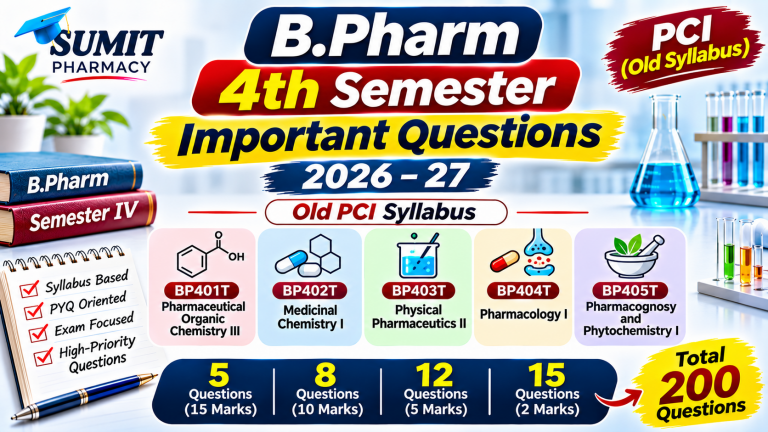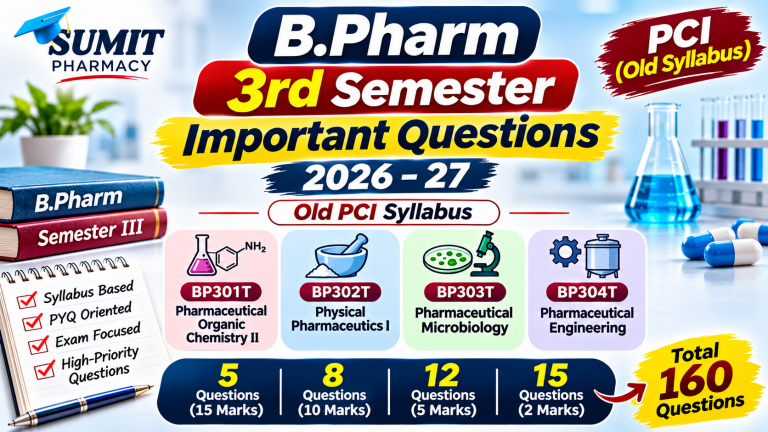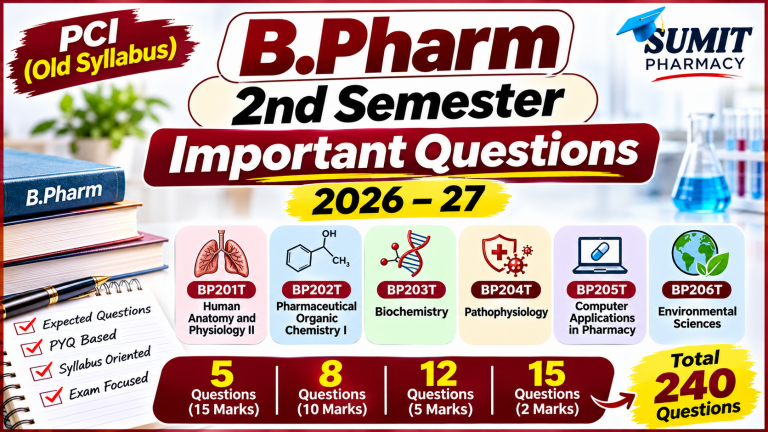
Preparing for your B.Pharm 1st Semester examination 2026–27? This subject-wise question bank will help you identify the important topics and practise exam-oriented questions according to the revised Pharmacy Council of India (PCI) syllabus under NEP 2020.
The new B.Pharm syllabus introduces updated subjects, including Python programming for pharmaceutical sciences and healthcare psychology, along with core pharmacy subjects. Therefore, students following the 2026–27 curriculum should prepare from the revised syllabus rather than relying entirely on old question banks.
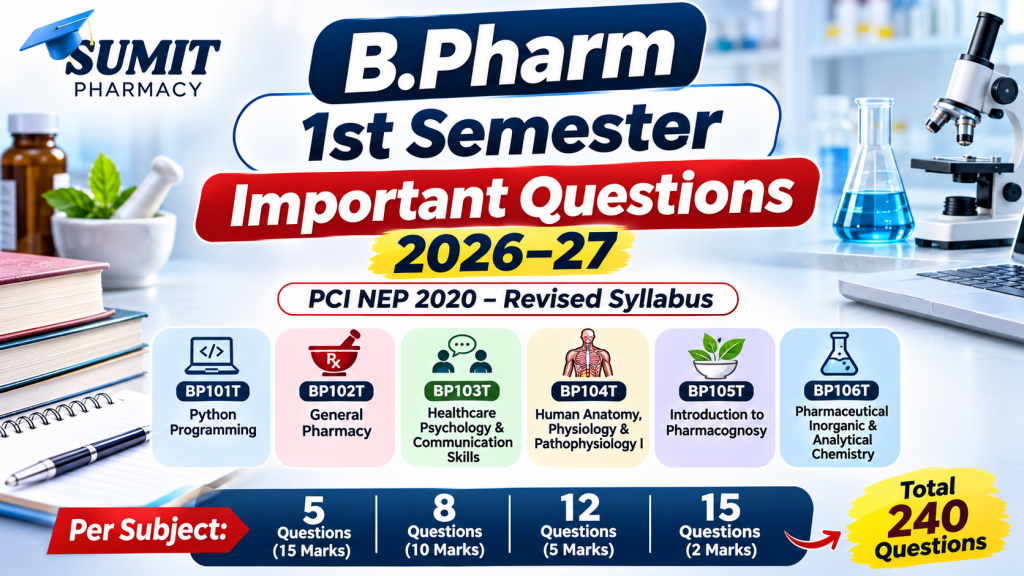
In this article, you will find 240 important questions covering all six B.Pharm 1st Semester theory subjects. Questions are organised according to 15-mark, 10-mark, 5-mark and 2-mark categories to make exam preparation and revision easier.
B.Pharm 1st Semester Subjects 2026–27
According to the revised PCI B.Pharm syllabus, Semester I includes six theory subjects and five practical subjects.
| Subject Code | Subject Name |
|---|---|
| BP101T | Basics of Python Programming for Pharmaceutical Sciences |
| BP102T | General Pharmacy |
| BP103T | Healthcare Psychology and Communication Skills |
| BP104T | Human Anatomy, Physiology and Pathophysiology I |
| BP105T | Introduction to Pharmacognosy |
| BP106T | Pharmaceutical Inorganic and Analytical Chemistry |
Note: This question bank covers the six theory subjects. Practical viva questions and experiment-based questions should be prepared separately using the respective practical syllabus.
Question Distribution
Each subject contains 40 selected questions.
| Question category | Number of questions per subject |
|---|---|
| Long-answer questions | 5 (15 marks) |
| Descriptive questions | 8 (10 marks) |
| Short-answer questions | 12 (5 marks) |
| Very short-answer questions | 15 (2 marks) |
| Total | 40 |
The marks categories are a preparation framework. Your university or examining authority may use a different question-paper pattern.
1. BP101T – Basics of Python Programming for Pharmaceutical Sciences
Python programming is a new and important addition to the revised B.Pharm curriculum. The subject introduces programming fundamentals, data structures, data handling and the use of Python libraries in pharmaceutical data analysis.
A. Important 15-Mark Questions
- Explain the fundamentals of Python programming. Discuss its features, advantages and applications in pharmaceutical sciences with suitable examples.
- Explain Python variables, data types, type casting and operators. Illustrate their use with suitable Python code.
- Explain decision-making and looping statements in Python. Discuss
if,if-else,forandwhilestatements with suitable examples. - Explain Python functions in detail. Discuss function definition, arguments, return statements and the importance of reusable functions in pharmaceutical calculations.
- Explain the applications of NumPy and Pandas in pharmaceutical data analysis. Discuss how pharmaceutical datasets can be organised, processed and analysed using these libraries.
B. Important 10-Mark Questions
- Explain the installation of Python and the role of IDEs such as Jupyter Notebook, PyCharm and VS Code.
- Differentiate between different Python data types with suitable examples.
- Explain arithmetic, comparison and logical operators in Python with examples.
- Discuss conditional statements in Python and explain their applications.
- Explain different looping statements in Python with suitable examples.
- Describe Python lists, tuples, sets and dictionaries with examples.
- Explain file handling in Python and discuss reading and writing data files.
- Explain the basic features and applications of Matplotlib for pharmaceutical data visualisation.
C. Important 5-Mark Questions
- Define Python programming and mention its major applications in pharmacy.
- Differentiate between an interpreter and a compiler.
- Explain variables and rules for naming variables in Python.
- Write a short note on type casting with examples.
- Explain input and output functions in Python.
- Differentiate between
forandwhileloops. - Explain the use of
break,continueandpassstatements. - Differentiate between lists and tuples.
- Write a short note on Python dictionaries.
- Explain user-defined functions in Python.
- Write a short note on NumPy arrays.
- Explain the importance of data visualisation in pharmaceutical research.
D. Important 2-Mark Questions
- Define Python programming.
- What is an IDE?
- Give two examples of Python IDEs.
- Define a variable in Python.
- What is type casting?
- Name four basic Python data types.
- What is the purpose of the
print()function? - What is the purpose of the
input()function? - Define a conditional statement.
- What is a loop?
- Define a function in Python.
- What is a list?
- What is a dictionary?
- Expand NumPy and Pandas.
- What is data visualisation?
2. BP102T – General Pharmacy
General Pharmacy introduces the pharmacy profession, its history, healthcare system, pharmaceutical services and the responsibilities of pharmacists. It provides the foundation for understanding the role of pharmacy in healthcare.
A. Important 15-Mark Questions
- Describe the history and development of pharmacy in India. Discuss major milestones in the development of pharmaceutical education and the pharmacy profession.
- Explain the development of the pharmacy profession and discuss the major pharmacy organisations and their roles in India.
- Discuss the different areas of pharmacy practice, including community pharmacy, hospital pharmacy, industrial pharmacy and clinical pharmacy.
- Explain the healthcare system in India. Discuss its different levels and the role of pharmacists in healthcare delivery.
- Describe the responsibilities of a pharmacist in patient care. Explain prescription handling, dispensing, patient counselling and the importance of rational use of medicines.
B. Important 10-Mark Questions
- Explain the evolution of pharmacy education in India and discuss its present status.
- Describe the role and functions of the Pharmacy Council of India (PCI).
- Explain the role of the Indian Pharmaceutical Association (IPA) and other important pharmacy organisations.
- Discuss the structure and functions of primary, secondary and tertiary healthcare services.
- Explain the role of a community pharmacist in healthcare delivery.
- Describe the functions and responsibilities of a hospital pharmacist.
- Explain the importance of prescription handling and dispensing in pharmacy practice.
- Discuss the importance of professional ethics and responsibilities in the pharmacy profession.
C. Important 5-Mark Questions
- Define pharmacy and explain its importance in healthcare.
- Write a short note on the history of pharmacy in India.
- Explain the role of the Pharmacy Council of India.
- Write a short note on the Indian Pharmaceutical Association.
- Differentiate between community pharmacy and hospital pharmacy.
- Explain the functions of an industrial pharmacist.
- Write a short note on clinical pharmacy.
- Explain the role of pharmacists in patient counselling.
- What is rational use of medicines? Explain its importance.
- Write a short note on prescription handling.
- Explain the importance of professional ethics in pharmacy.
- Describe the role of pharmacists in public health.
D. Important 2-Mark Questions
- Define pharmacy.
- Who is known as the Father of Pharmacy Education in India?
- Expand PCI.
- Expand IPA.
- What is community pharmacy?
- Define hospital pharmacy.
- What is clinical pharmacy?
- Define industrial pharmacy.
- What is patient counselling?
- Define rational use of medicines.
- What is a prescription?
- Define dispensing.
- What is primary healthcare?
- What is tertiary healthcare?
- What is professional ethics?
3. BP103T – Healthcare Psychology and Communication Skills
Healthcare Psychology and Communication Skills focuses on human behaviour, psychological factors affecting health, patient interaction and effective communication in healthcare settings.
A. Important 15-Mark Questions
- Explain the concept of psychology and discuss its importance and applications in healthcare and pharmacy practice.
- Describe the different factors influencing human behaviour. Explain the role of biological, psychological and social factors in health and illness.
- Explain the process of communication in detail. Discuss its elements, types, barriers and methods of effective communication in healthcare.
- Discuss the importance of patient counselling. Explain the principles, steps and essential skills required for effective patient counselling.
- Explain the concepts of stress, anxiety and coping mechanisms. Discuss their effects on health and the role of healthcare professionals in supporting patients.
B. Important 10-Mark Questions
- Explain the scope and importance of healthcare psychology.
- Discuss the major theories of learning and their applications in healthcare.
- Explain the concepts of motivation, perception and personality.
- Describe the different types of communication used in healthcare settings.
- Explain verbal and non-verbal communication with suitable examples.
- Discuss the common barriers to effective communication and methods to overcome them.
- Explain the principles and techniques of effective patient counselling.
- Describe the importance of empathy, active listening and interpersonal skills in pharmacist-patient communication.
C. Important 5-Mark Questions
- Define psychology and explain its importance in healthcare.
- Differentiate between sensation and perception.
- Write a short note on motivation.
- Explain the concept of personality.
- Define learning and mention its major types.
- Explain the role of memory in human behaviour.
- Differentiate between verbal and non-verbal communication.
- Write a short note on active listening.
- Explain the importance of empathy in patient care.
- List the common barriers to communication.
- Explain the importance of body language in healthcare communication.
- Write a short note on stress management.
D. Important 2-Mark Questions
- Define psychology.
- What is healthcare psychology?
- Define perception.
- What is motivation?
- Define personality.
- What is learning?
- Define memory.
- What is communication?
- Define verbal communication.
- What is non-verbal communication?
- Define empathy.
- What is active listening?
- Define patient counselling.
- What is stress?
- Define coping mechanism.
4. BP104T – Human Anatomy, Physiology and Pathophysiology I
Human Anatomy, Physiology and Pathophysiology I is a core subject that introduces the structure and functions of the human body, along with the basic mechanisms of disease. Students should focus on diagrams, physiological processes and the relationship between normal body functions and disease conditions.
A. Important 15-Mark Questions
- Describe the structure and functions of the cell. Explain the structure of the plasma membrane and different mechanisms of transport across the cell membrane.
- Explain the structure and functions of different types of tissues in the human body. Discuss epithelial, connective, muscular and nervous tissues.
- Describe the structure and functions of blood. Explain the composition of blood, formation of blood cells and the mechanism of blood coagulation.
- Explain the anatomy and physiology of the cardiovascular system. Describe the structure of the heart, cardiac cycle and regulation of blood pressure.
- Describe the anatomy and physiology of the respiratory system. Explain the mechanism of respiration, transport of respiratory gases and regulation of breathing.
B. Important 10-Mark Questions
- Explain the organisation of the human body and different levels of structural organisation.
- Describe the structure and functions of cell organelles.
- Explain the different types of epithelial and connective tissues with suitable examples.
- Describe the composition and functions of blood.
- Explain the process of erythropoiesis and factors affecting red blood cell formation.
- Describe the structure of the human heart with a labelled diagram.
- Explain the cardiac cycle and its different phases.
- Describe the mechanism of respiration and exchange of gases in the lungs.
C. Important 5-Mark Questions
- Define anatomy and physiology.
- Explain the different levels of organisation of the human body.
- Write a short note on the plasma membrane.
- Explain the functions of mitochondria and nucleus.
- Differentiate between mitosis and meiosis.
- Describe the characteristics of epithelial tissue.
- Write a short note on connective tissue.
- Explain the composition of blood.
- Differentiate between RBCs and WBCs.
- Explain the functions of platelets.
- Write a short note on blood groups.
- Explain the mechanism of gaseous exchange.
D. Important 2-Mark Questions
- Define anatomy.
- Define physiology.
- What is a cell?
- What is a tissue?
- Name the four basic types of tissues.
- Define plasma membrane.
- What is diffusion?
- Define osmosis.
- What is haemoglobin?
- Define erythropoiesis.
- What are platelets?
- Define cardiac cycle.
- What is blood pressure?
- Define pulmonary ventilation.
- What is gaseous exchange?
5. BP105T – Introduction to Pharmacognosy
Introduction to Pharmacognosy deals with crude drugs obtained from natural sources, including plants, animals and minerals. It covers the identification, classification, evaluation and importance of natural drugs in pharmaceutical sciences.
A. Important 15-Mark Questions
- Define pharmacognosy and explain its history, scope and importance in pharmaceutical sciences.
- Explain the classification of crude drugs in detail. Discuss alphabetical, taxonomical, morphological, chemical and pharmacological classifications with examples.
- Describe the cultivation, collection, processing and storage of medicinal plants. Explain the factors affecting the quality of crude drugs.
- Explain the methods used for evaluation of crude drugs. Discuss organoleptic, microscopic, physical, chemical and biological evaluation.
- Explain the different plant cell constituents and their pharmaceutical importance. Discuss carbohydrates, proteins, lipids, alkaloids, glycosides, tannins and volatile oils.
B. Important 10-Mark Questions
- Explain the development and historical background of pharmacognosy.
- Describe the different sources of crude drugs with suitable examples.
- Discuss the advantages and limitations of different methods of crude drug classification.
- Explain the role of medicinal plant cultivation in maintaining the quality of crude drugs.
- Describe the methods of collection and processing of medicinal plants.
- Explain the different types of adulteration of crude drugs and methods of their detection.
- Discuss the importance of microscopy in pharmacognostic evaluation.
- Explain the major applications of pharmacognosy in modern medicine and pharmaceutical research.
C. Important 5-Mark Questions
- Define pharmacognosy and mention its scope.
- Write a short note on crude drugs.
- Differentiate between organised and unorganised drugs.
- Explain alphabetical classification of crude drugs.
- Write a short note on taxonomical classification.
- Explain morphological classification with examples.
- Define adulteration and explain its common types.
- Write a short note on drug evaluation.
- Explain organoleptic evaluation.
- Describe the importance of microscopic evaluation.
- Explain the factors affecting cultivation of medicinal plants.
- Write a short note on storage of crude drugs.
D. Important 2-Mark Questions
- Define pharmacognosy.
- What is a crude drug?
- Define organised drugs.
- What are unorganised drugs?
- What is adulteration?
- Define drug evaluation.
- What is organoleptic evaluation?
- Define microscopy.
- What is cultivation?
- What is collection of crude drugs?
- Define drying.
- What are medicinal plants?
- What is a volatile oil?
- Define alkaloids.
- What are glycosides?
6. BP106T – Pharmaceutical Inorganic and Analytical Chemistry
Pharmaceutical Inorganic and Analytical Chemistry deals with pharmaceutical inorganic compounds, impurities, errors, limit tests, buffer systems and analytical techniques used for the identification and quality evaluation of pharmaceutical substances.
A. Important 15-Mark Questions
- Explain the sources and types of impurities in pharmaceutical substances. Discuss the importance of purity and the methods used for controlling impurities.
- Explain the principle, procedure and chemical reactions involved in the limit tests for chloride, sulphate, iron, arsenic and heavy metals.
- Explain the concept of errors in pharmaceutical analysis. Discuss systematic and random errors, accuracy, precision and methods of minimising analytical errors.
- Describe buffer solutions in detail. Explain buffer capacity, buffer action and the pharmaceutical applications of buffer systems.
- Explain the principles of acid-base titrations. Discuss different types of acid-base titrations, indicators and their applications in pharmaceutical analysis.
B. Important 10-Mark Questions
- Explain the importance of pharmaceutical inorganic chemistry and discuss the pharmaceutical applications of inorganic compounds.
- Describe the sources of impurities in pharmaceutical substances and methods of preventing contamination.
- Explain the principle and procedure of the limit test for chloride and sulphate.
- Describe the principle and procedure of the limit test for iron.
- Explain the limit test for arsenic with a suitable chemical reaction.
- Discuss the different types of errors in pharmaceutical analysis.
- Explain buffer solutions and the Henderson–Hasselbalch equation.
- Describe the principle and applications of redox titrations.
C. Important 5-Mark Questions
- Define pharmaceutical analysis and explain its importance.
- Differentiate between accuracy and precision.
- Explain systematic and random errors.
- Write a short note on sources of impurities.
- Explain the principle of the limit test for chloride.
- Explain the principle of the limit test for sulphate.
- Write a short note on the limit test for iron.
- Explain the principle of the limit test for arsenic.
- Define buffer solution and explain its pharmaceutical importance.
- Write a short note on buffer capacity.
- Explain the selection of indicators in acid-base titrations.
- Differentiate between acid-base and redox titrations.
D. Important 2-Mark Questions
- Define pharmaceutical analysis.
- What is an impurity?
- Define accuracy.
- Define precision.
- What is a systematic error?
- What is a random error?
- Define limit test.
- What is the principle of the chloride limit test?
- What is the principle of the sulphate limit test?
- Define buffer solution.
- What is buffer capacity?
- Define titration.
- What is an indicator?
- Define acid-base titration.
- What is redox titration?
How to Prepare for B.Pharm 1st Semester Exams
Preparing all six subjects requires a planned approach. Instead of memorising every question, focus on understanding the important concepts and practising answers according to the marks allotted.
1. Prepare 15-Mark Questions First
Long-answer questions require detailed explanations. For each topic:
- Start with a clear definition.
- Explain the principle or basic concept.
- Divide the answer into suitable headings and subheadings.
- Include a labelled diagram or flowchart wherever relevant.
- Add examples, applications and a conclusion.
For anatomy, practise labelled diagrams. For chemistry, learn principles, reactions and procedures. For Python, practise writing and explaining code.
2. Prepare 10-Mark Questions
For 10-mark answers, focus on the main concept and its important components. Use comparison tables, diagrams and examples where possible. Avoid writing unrelated information just to increase the length.
3. Practise 5-Mark Questions
A 5-mark answer should be focused and properly structured. Include the definition, key points and a relevant example or diagram when needed.
4. Revise 2-Mark Questions
Prepare short definitions and basic concepts carefully. These questions are useful for quick revision and checking whether you understand the fundamentals.
5. Do Not Ignore Practical Subjects
The first semester also includes five practical courses:
- BP107P – General Pharmacy Practical
- BP108P – Healthcare Psychology and Communication Skills Practical
- BP109P – Human Anatomy, Physiology and Pathophysiology I Practical
- BP110P – Introduction to Pharmacognosy Practical
- BP111P – Pharmaceutical Inorganic and Analytical Chemistry Practical
Prepare practical records, experiments, observations, calculations and viva questions separately. Theory preparation alone is not sufficient.
Frequently Asked Questions (FAQs)
1. What are the important questions for B.Pharm 1st Semester 2026–27?
The important questions are organised in this article for all six Semester I theory subjects: BP101T, BP102T, BP103T, BP104T, BP105T and BP106T. Each subject includes 15-mark, 10-mark, 5-mark and 2-mark questions.
2. How many subjects are there in B.Pharm 1st Semester under the new PCI syllabus?
There are six theory subjects and five practical subjects in the revised B.Pharm Semester I curriculum under the PCI NEP 2020 syllabus.
3. Is the B.Pharm 1st Semester 2026–27 syllabus different from the old syllabus?
Yes. The revised syllabus introduces updated subjects, including Basics of Python Programming for Pharmaceutical Sciences and Healthcare Psychology and Communication Skills. Students should follow the applicable revised PCI syllabus rather than depending entirely on older question banks.
4. Are these B.Pharm 1st Semester important questions guaranteed to appear in the examination?
No. These are selected high-priority practice questions based on the syllabus. The actual examination paper is decided by the respective examining authority or university. Students should use these questions for focused revision, not as a replacement for the complete syllabus.
5. Where can I download B.Pharm 1st Semester notes?
You can explore subject-wise pharmacy study material and notes on Sumit Pharmacy.
6. Where can I check the official B.Pharm 2026 syllabus?
Students should refer to the official Pharmacy Council of India website for the revised B.Pharm syllabus and related notifications.
Official syllabus: https://pci.gov.in/en/syllabus-bachelor-of-pharmacy-b-pharm-2026-as-per-nep-2020/
Final Advice
The best way to prepare for B.Pharm 1st Semester examinations is to combine syllabus-based study, important-question practice, diagrams, numerical problems and practical revision.
Do not depend only on predicted questions. Use this question bank to prioritise your preparation, but cover the prescribed units and concepts before the examination.
For more B.Pharm notes, syllabus updates, pharmacy career guidance and examination preparation resources, visit Sumit Pharmacy.