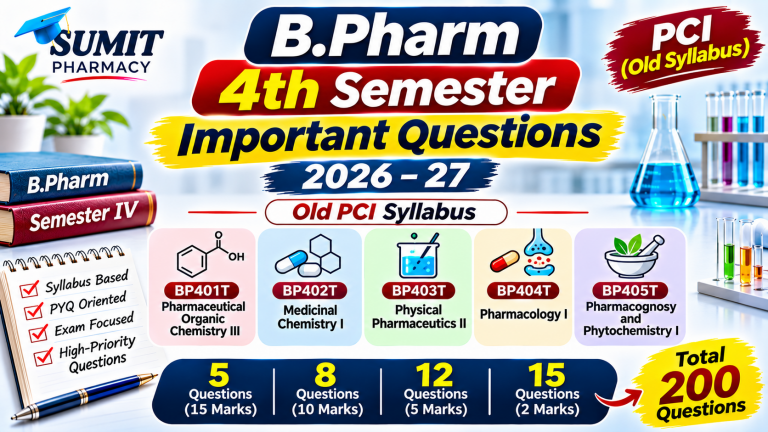
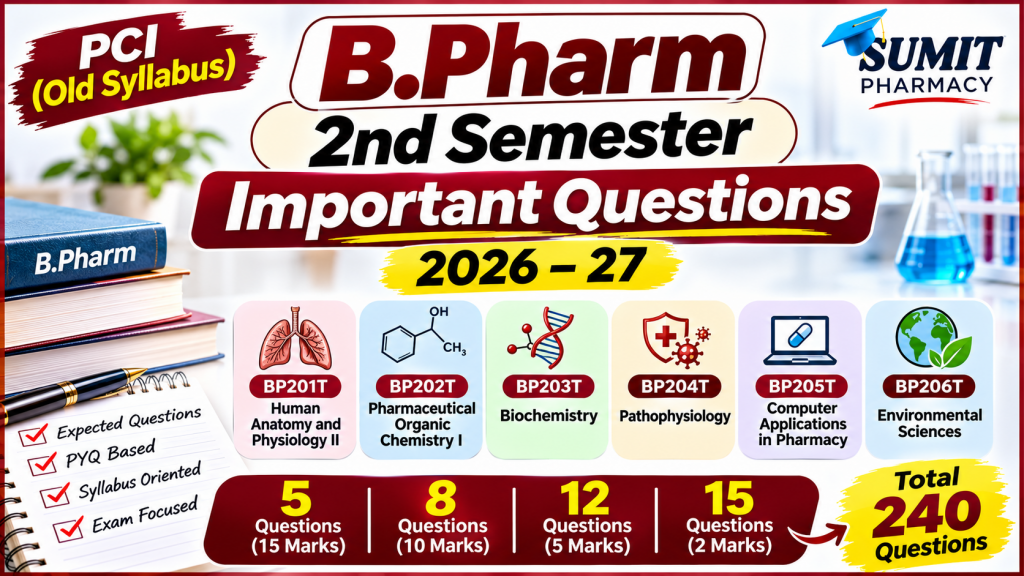
Are you preparing for your B.Pharm 2nd Semester examinations and looking for important questions to revise before the exams? This subject-wise question bank will help you focus on important topics from the old PCI B.Pharm syllabus.
In this article, you will find 240 selected important and expected questions covering all six B.Pharm 2nd Semester theory subjects. The questions are arranged according to marks so that you can prepare long-answer, descriptive, short-answer and very short-answer questions systematically.
The selection focuses on important syllabus topics, commonly tested concepts and question patterns found in available previous-year examination papers. It is designed to help B.Pharm students identify high-priority topics without wasting time on unnecessary questions.
This question bank follows the old PCI B.Pharm syllabus. Students following a different or revised curriculum should first check their applicable syllabus.
B.Pharm 2nd Semester Subjects and Subject Codes
The old PCI B.Pharm Semester II curriculum includes the following six theory subjects:
| Subject code | Subject name |
|---|---|
| BP201T | Human Anatomy and Physiology II |
| BP202T | Pharmaceutical Organic Chemistry I |
| BP203T | Biochemistry |
| BP204T | Pathophysiology |
| BP205T | Computer Applications in Pharmacy |
| BP206T | Environmental Sciences |
B.Pharm 2nd Semester Important Questions – Marks-Wise Distribution
This question bank contains 40 questions for each subject.
| Question type | Number of questions |
|---|---|
| Long-answer questions (15 marks) | 5 |
| Descriptive questions (10 marks) | 8 |
| Short-answer questions (5 marks) | 12 |
| Very short-answer questions (2 marks) | 15 |
| Total per subject | 40 |
| Total for six subjects | 240 |
Note: Marks distribution is provided as a preparation format. The actual examination pattern may differ between universities and colleges.
1. BP201T – Human Anatomy and Physiology II Important Questions
Human Anatomy and Physiology II deals with the structure and functions of major body systems, including the nervous, digestive, respiratory, urinary, endocrine and reproductive systems. Students should focus on physiological mechanisms, labelled diagrams and the functions of important organs.
A. Important 15-Mark Questions
- Explain the structure and functions of the brain with a neat labelled diagram. Describe the functions of the cerebrum, cerebellum, thalamus and hypothalamus.
- Describe the formation, circulation, composition and functions of cerebrospinal fluid (CSF). Explain its clinical importance.
- Explain the anatomy and physiology of the digestive system. Describe the mechanism of digestion and absorption of carbohydrates, proteins and fats.
- Describe the structure and functions of the kidney. Explain the mechanism of urine formation, including glomerular filtration, tubular reabsorption and tubular secretion.
- Explain the anatomy and physiology of the female reproductive system. Describe the menstrual cycle and its hormonal regulation.
B. Important 10-Mark Questions
- Describe the structure and functions of the spinal cord. Explain the spinal reflex arc.
- Explain the structure and functions of the autonomic nervous system. Differentiate between sympathetic and parasympathetic nervous systems.
- Describe the mechanism of gastric acid secretion and explain the role of hydrochloric acid and pepsin in digestion.
- Explain the anatomy and physiology of the respiratory system. Describe the mechanism of inspiration and expiration.
- Describe the structure and functions of the endocrine glands, with special reference to the pituitary and thyroid glands.
- Explain the physiology of hearing and describe the structure of the ear.
- Describe the physiology of vision and explain the structure and functions of the eye.
- Explain the composition and functions of urine. Describe the process of micturition.
C. Important 5-Mark Questions
- Write a short note on the functions of the cerebellum.
- Explain the functions of the hypothalamus.
- Describe the structure and functions of the meninges.
- Explain the functions of cerebrospinal fluid.
- Write a short note on the gastric juice.
- Explain the functions of the liver.
- Differentiate between inspiration and expiration.
- Explain the functions of the thyroid gland.
- Write a short note on the functions of the adrenal gland.
- Explain the process of glomerular filtration.
- Describe the functions of the urinary bladder.
- Explain the different phases of the menstrual cycle.
D. Important 2-Mark Questions
- Define cerebrospinal fluid.
- What is a reflex action?
- Define synapse.
- What is the function of the cerebellum?
- Define gastric juice.
- What is peristalsis?
- Define tidal volume.
- What is vital capacity?
- Define glomerular filtration.
- What is nephron?
- Define micturition.
- What is insulin?
- Name the hormones secreted by the thyroid gland.
- Define ovulation.
- What is the menstrual cycle?
2. BP202T – Pharmaceutical Organic Chemistry I Important Questions
Pharmaceutical Organic Chemistry I introduces the fundamental concepts of organic chemistry, including nomenclature, isomerism, reaction mechanisms and the chemistry of different classes of organic compounds. Understanding reaction mechanisms and practising chemical structures are particularly important for examination preparation.
A. Important 15-Mark Questions
- Explain the classification and nomenclature of organic compounds. Discuss the IUPAC rules for naming organic compounds with suitable examples.
- Define isomerism and explain its different types. Discuss structural and stereoisomerism with suitable examples.
- Explain the mechanism of nucleophilic substitution reactions. Differentiate between SN1 and SN2 reactions with suitable examples.
- Explain elimination reactions in organic chemistry. Discuss E1 and E2 mechanisms and differentiate between them.
- Explain the chemistry of aldehydes and ketones. Discuss their important nucleophilic addition reactions with suitable mechanisms and examples.
B. Important 10-Mark Questions
- Explain the hybridisation of carbon and discuss the structures of sp, sp2 and sp3 hybridised carbon atoms.
- Discuss the preparation, properties and important reactions of alkanes.
- Explain the preparation and chemical reactions of alkenes with suitable examples.
- Describe the preparation, properties and reactions of alkynes.
- Explain the mechanism of free-radical substitution reactions with suitable examples.
- Discuss the preparation and chemical properties of alkyl halides.
- Explain the preparation and chemical reactions of alcohols.
- Describe the preparation and important reactions of carboxylic acids.
C. Important 5-Mark Questions
- Define organic chemistry and explain its importance in pharmacy.
- Write a short note on IUPAC nomenclature.
- Differentiate between structural and stereoisomerism.
- Explain chain isomerism and position isomerism with examples.
- Write a short note on geometrical isomerism.
- Explain the concept of hybridisation in carbon.
- Differentiate between alkanes, alkenes and alkynes.
- Explain Markovnikov’s rule with an example.
- Write a short note on peroxide effect.
- Differentiate between SN1 and SN2 reactions.
- Explain the Diels–Alder reaction.
- Write a short note on the acidity of carboxylic acids.
D. Important 2-Mark Questions
- Define organic chemistry.
- What is a homologous series?
- Define functional group.
- What is IUPAC nomenclature?
- Define structural isomerism.
- What is stereoisomerism?
- Define hybridisation.
- What is an electrophile?
- Define nucleophile.
- What is a free radical?
- State Markovnikov’s rule.
- What is an elimination reaction?
- Define nucleophilic substitution.
- What is an aldehyde?
- Define carboxylic acid.
3. BP203T – Biochemistry Important Questions
Biochemistry deals with the chemical processes occurring in living organisms. Important areas include carbohydrates, proteins, lipids, enzymes, biological oxidation, metabolism and nucleic acids. Students should practise metabolic pathways with properly labelled diagrams and understand the role of enzymes in biochemical reactions.
A. Important 15-Mark Questions
- Explain glycolysis in detail with a pathway diagram. Discuss its energy yield and biological significance.
- Describe the citric acid cycle (Krebs cycle) with a neat diagram. Explain its energetics and importance in cellular metabolism.
- Explain oxidative phosphorylation and the electron transport chain. Discuss the chemiosmotic hypothesis and ATP synthesis.
- Define enzymes and explain their classification, mechanism of action and factors affecting enzyme activity. Discuss enzyme inhibition.
- Explain the metabolism of lipids with special reference to beta-oxidation of fatty acids. Discuss the energy yield from palmitic acid.
B. Important 10-Mark Questions
- Explain the classification and biological functions of carbohydrates.
- Describe the digestion and absorption of carbohydrates.
- Explain the structure and classification of proteins. Discuss their biological functions.
- Describe the structure and biological importance of lipids.
- Explain gluconeogenesis with a suitable pathway diagram.
- Describe glycogenesis and glycogenolysis with their regulation.
- Explain the different types of enzyme inhibition with suitable examples.
- Describe the structure and functions of DNA and RNA.
C. Important 5-Mark Questions
- Define biochemistry and explain its importance in pharmacy.
- Classify carbohydrates with suitable examples.
- Differentiate between monosaccharides and disaccharides.
- Write a short note on essential amino acids.
- Explain the primary and secondary structure of proteins.
- Differentiate between saturated and unsaturated fatty acids.
- Define enzymes and explain their nomenclature.
- Explain the factors affecting enzyme activity.
- Write a short note on competitive enzyme inhibition.
- Explain the biological importance of ATP.
- Write a short note on the sodium-potassium pump.
- Explain the Cori cycle with its significance.
D. Important 2-Mark Questions
- Define biochemistry.
- What is a carbohydrate?
- Define monosaccharide.
- What is glycogen?
- Define amino acid.
- What is a peptide bond?
- Define enzyme.
- What is an active site?
- Define enzyme inhibition.
- What is ATP?
- Expand NAD and FAD.
- Define glycolysis.
- What is gluconeogenesis?
- Define beta-oxidation.
- What is oxidative phosphorylation?
4. BP204T – Pathophysiology Important Questions
Pathophysiology explains the functional changes that occur in the body during disease. It includes cellular injury, inflammation, immunity, infectious diseases and the mechanisms of common disorders. Students should focus on causes, mechanisms, signs, symptoms and complications of diseases.
A. Important 15-Mark Questions
- Define pathophysiology and explain the causes and mechanisms of cell injury. Describe reversible and irreversible cell injury with examples.
- Explain acute and chronic inflammation in detail. Discuss the vascular and cellular events involved in inflammation.
- Explain the pathophysiology of diabetes mellitus. Discuss its types, causes, clinical manifestations and complications.
- Describe the pathophysiology of hypertension. Explain its causes, mechanisms, clinical manifestations and complications.
- Explain the pathophysiology of atherosclerosis and myocardial infarction. Discuss their causes, development and major clinical features.
B. Important 10-Mark Questions
- Explain the different types of cellular adaptations with suitable examples.
- Describe the mechanisms of cell death, including apoptosis and necrosis.
- Explain the process of wound healing and the factors affecting wound repair.
- Discuss the pathophysiology of oedema and its major causes.
- Explain the pathophysiology of bronchial asthma.
- Describe the pathophysiology of peptic ulcer disease.
- Explain the causes, pathogenesis and clinical manifestations of tuberculosis.
- Describe the pathophysiology of rheumatoid arthritis.
C. Important 5-Mark Questions
- Define pathophysiology and explain its importance.
- Differentiate between apoptosis and necrosis.
- Explain cellular adaptation.
- Write a short note on inflammation.
- Differentiate between acute and chronic inflammation.
- Explain the causes of oedema.
- Write a short note on wound healing.
- Explain the major complications of diabetes mellitus.
- Differentiate between type 1 and type 2 diabetes mellitus.
- Explain the risk factors for hypertension.
- Write a short note on atherosclerosis.
- Explain the causes and clinical features of bronchial asthma.
D. Important 2-Mark Questions
- Define pathophysiology.
- What is cellular injury?
- Define necrosis.
- What is apoptosis?
- Define inflammation.
- What is oedema?
- Define wound healing.
- What is diabetes mellitus?
- Define hypertension.
- What is atherosclerosis?
- Define myocardial infarction.
- What is bronchial asthma?
- Define peptic ulcer.
- What is tuberculosis?
- Define rheumatoid arthritis.
5. BP205T – Computer Applications in Pharmacy Important Questions
Computer Applications in Pharmacy introduces the use of computers and information technology in pharmaceutical education, research, manufacturing and healthcare. Students should understand basic computer concepts, operating systems, software applications, databases and the role of computers in pharmacy.
A. Important 15-Mark Questions
- Explain the basic organisation and functional components of a computer system. Describe the functions of the CPU, memory, input devices and output devices.
- Explain different types of computer software. Differentiate between system software and application software with suitable examples.
- Describe the role of computers in pharmaceutical research and development. Explain their applications in drug discovery, formulation development and data analysis.
- Explain database management systems (DBMS). Discuss their components, advantages and applications in pharmacy.
- Describe the applications of computers in hospital and clinical pharmacy. Explain how computerised systems help in patient records, prescription processing and drug information management.
B. Important 10-Mark Questions
- Explain the generations of computers and their major characteristics.
- Describe different input and output devices of a computer system.
- Explain primary and secondary memory with suitable examples.
- Describe the functions and types of operating systems.
- Explain the basic features and applications of MS Word and MS Excel in pharmacy.
- Discuss the applications of computers in pharmaceutical manufacturing and quality control.
- Explain the use of the internet and information technology in pharmacy education and research.
- Describe the importance of computerised information systems in drug information and hospital management.
C. Important 5-Mark Questions
- Define a computer and explain its major characteristics.
- Differentiate between hardware and software.
- Write a short note on the central processing unit.
- Differentiate between RAM and ROM.
- Explain primary and secondary memory.
- Write a short note on operating systems.
- Explain the functions of MS Excel.
- Describe the applications of MS Word in pharmacy.
- Define database management system.
- Explain the importance of the internet in pharmaceutical research.
- Write a short note on computer applications in drug discovery.
- Explain the role of computers in hospital pharmacy.
D. Important 2-Mark Questions
- Define a computer.
- What is hardware?
- Define software.
- Expand CPU.
- What is RAM?
- What is ROM?
- Define an operating system.
- What is an input device?
- Give two examples of output devices.
- Define database.
- Expand DBMS.
- What is MS Excel?
- Define the internet.
- What is a computer network?
- State one application of computers in pharmacy.
6. BP206T – Environmental Sciences Important Questions
Environmental Sciences introduces the relationship between humans and the environment. It covers natural resources, ecosystems, biodiversity, pollution, environmental protection and sustainable development. Students should focus on definitions, classifications, causes, effects and control measures.
A. Important 15-Mark Questions
- Define environmental science and explain its scope and importance. Discuss the relationship between humans and the environment.
- Explain the structure and functions of an ecosystem. Describe food chains, food webs, ecological pyramids and energy flow.
- Discuss the different types of natural resources. Explain the causes of depletion and methods of conservation of forest, water and mineral resources.
- Explain air pollution in detail. Discuss its sources, types, effects on human health and methods of prevention and control.
- Explain water pollution and its major causes. Discuss the effects of water pollution and methods of water conservation and pollution control.
B. Important 10-Mark Questions
- Explain the importance of environmental studies and discuss major environmental issues.
- Describe the different components of an ecosystem and their interactions.
- Explain the types and conservation methods of biodiversity.
- Discuss the causes and effects of deforestation.
- Explain soil pollution, its causes, effects and control measures.
- Describe noise pollution and discuss its effects on human health.
- Explain the causes and consequences of global warming and climate change.
- Discuss the importance of solid waste management and different methods of waste disposal.
C. Important 5-Mark Questions
- Define environment and environmental science.
- Write a short note on natural resources.
- Differentiate between renewable and non-renewable resources.
- Explain the components of an ecosystem.
- Define food chain and food web.
- Write a short note on biodiversity.
- Explain the causes of deforestation.
- Write a short note on air pollution.
- Explain the effects of water pollution.
- Write a short note on noise pollution.
- Explain the causes of global warming.
- Describe the importance of environmental conservation.
D. Important 2-Mark Questions
- Define environment.
- What is an ecosystem?
- Define biodiversity.
- What is a food chain?
- Define food web.
- What are natural resources?
- Define deforestation.
- What is air pollution?
- Define water pollution.
- What is soil pollution?
- Define noise pollution.
- What is global warming?
- Define climate change.
- What is solid waste?
- Define sustainable development.
B.Pharm 2nd Semester Exam Preparation Strategy
Preparing six subjects together can be difficult, especially when examinations are approaching. A structured revision strategy helps students cover important topics without spending too much time on low-priority material.
1. Start with 15-Mark Important Questions
Long-answer questions require detailed preparation. For every major topic:
- Begin with a proper definition.
- Explain the concept under clear headings.
- Include a labelled diagram wherever applicable.
- Add mechanisms, pathways or chemical reactions where required.
- Include examples and applications.
- End with a brief conclusion.
For Human Anatomy and Physiology, practise labelled diagrams. For Organic Chemistry, practise reaction mechanisms and structures. For Biochemistry, learn metabolic pathways. For Pathophysiology, prepare causes, mechanisms, symptoms and complications.
2. Prepare 10-Mark Questions
For descriptive questions, focus on the main concept and its important components. Use tables, flowcharts and diagrams to make answers organised and easy to understand.
3. Revise 5-Mark Questions
Prepare short, focused answers containing definitions, important points and examples. Avoid unnecessary explanations.
4. Do Not Ignore 2-Mark Questions
Revise basic definitions, important terms, functions and differences. These questions are useful for quick revision before the examination.
5. Practise Previous-Year Question Papers
Reading important questions is not enough. Solve previous-year question papers to understand the examination pattern and improve time management.
You can also refer to B.Pharm previous-year question papers and examination resources to practise subject-wise questions.
Frequently Asked Questions (FAQs)
1. What are the important questions for B.Pharm 2nd Semester?
This article provides 240 subject-wise important questions for all six subjects of the old PCI B.Pharm Semester II syllabus. Questions are divided into 15-mark, 10-mark, 5-mark and 2-mark categories.
2. How many subjects are there in B.Pharm 2nd Semester?
The old PCI B.Pharm Semester II syllabus contains six theory subjects: Human Anatomy and Physiology II, Pharmaceutical Organic Chemistry I, Biochemistry, Pathophysiology, Computer Applications in Pharmacy and Environmental Sciences.
3. Which questions are important for B.Pharm 2nd Semester exams?
Topics such as the brain, CSF, urine formation, organic reaction mechanisms, glycolysis, Krebs cycle, enzyme inhibition, cellular injury, inflammation, diabetes mellitus, computer applications and environmental pollution are useful high-priority revision areas.
4. Are these B.Pharm 2nd Semester expected questions guaranteed to appear in the examination?
No. These questions are selected for focused preparation using syllabus coverage and available previous-year examination trends. No question bank can guarantee the exact questions in an upcoming examination.
5. Where can I download B.Pharm 2nd Semester notes?
You can explore subject-wise study material and pharmacy notes on Sumit Pharmacy.
6. Is this question bank based on the old PCI syllabus?
Yes. This article follows the old PCI B.Pharm Semester II syllabus, which includes BP201T to BP206T. Students should check their applicable curriculum before using the question bank.
7. How should I prepare for B.Pharm 2nd Semester examinations in less time?
Start with high-priority long-answer topics, then revise 10-mark and 5-mark questions. Finish with definitions and short questions. Practise previous-year papers and focus on diagrams, reaction mechanisms and metabolic pathways.
Final Advice for B.Pharm Students
Do not depend entirely on expected questions. Use this question bank to prioritise your preparation, but revise the complete prescribed syllabus wherever possible.
Focus on understanding concepts rather than memorising answers. Practise diagrams in Anatomy and Physiology, chemical reactions in Organic Chemistry, metabolic pathways in Biochemistry and disease mechanisms in Pathophysiology.
For more pharmacy notes, syllabus updates, examination resources and career guidance, visit Sumit Pharmacy.