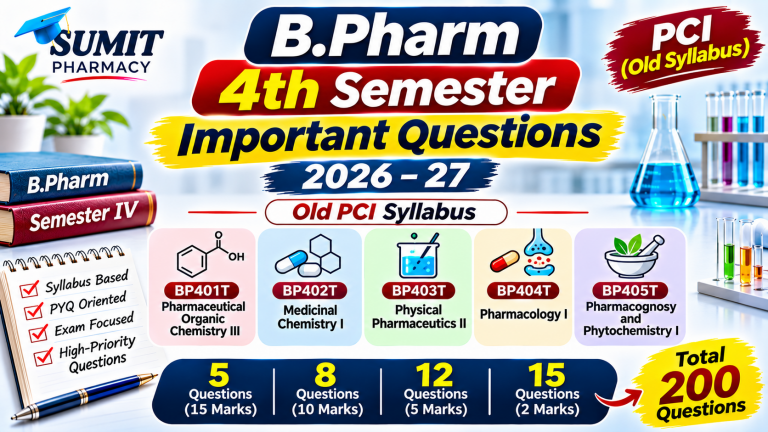
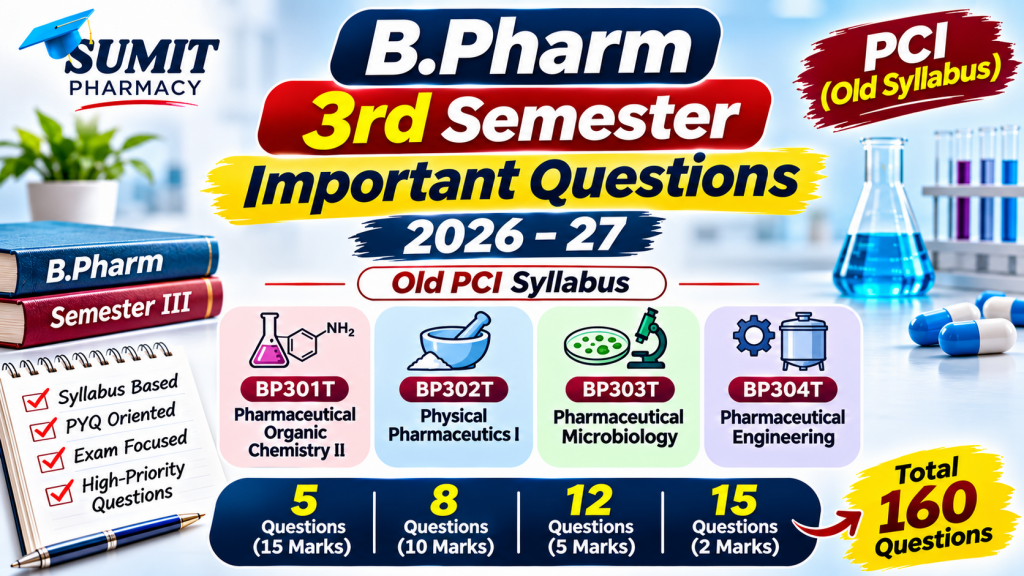
Preparing for your B.Pharm 3rd Semester examinations? This subject-wise question bank will help you focus on important topics from the old PCI B.Pharm syllabus.
In this article, you will find 160 selected important and expected questions covering all four theory subjects of B.Pharm Semester III. Questions are arranged according to 15-mark, 10-mark, 5-mark and 2-mark categories to make examination preparation and revision easier.
The question selection focuses on important syllabus topics, commonly tested concepts and patterns available in previous-year examination papers. It is designed to help students identify high-priority topics instead of spending equal time on every small topic.
This question bank follows the old PCI B.Pharm syllabus (BP301T–BP304T). Students following a revised curriculum should check their applicable syllabus before using this question bank.
B.Pharm 3rd Semester Subjects and Subject Codes
The old PCI B.Pharm Semester III curriculum includes four theory subjects and four practical subjects.
| Subject code | Subject name |
|---|---|
| BP301T | Pharmaceutical Organic Chemistry II |
| BP302T | Physical Pharmaceutics I |
| BP303T | Pharmaceutical Microbiology |
| BP304T | Pharmaceutical Engineering |
B.Pharm 3rd Semester Important Questions – Marks-Wise Distribution
Each subject contains 40 selected questions.
| Question type | Number of questions |
|---|---|
| Long-answer questions (15 marks) | 5 |
| Descriptive questions (10 marks) | 8 |
| Short-answer questions (5 marks) | 12 |
| Very short-answer questions (2 marks) | 15 |
| Total per subject | 40 |
| Total for four subjects | 160 |
Note: This marks-wise structure is a preparation format. The actual question-paper pattern may vary between universities.
1. BP301T – Pharmaceutical Organic Chemistry II Important Questions
Pharmaceutical Organic Chemistry II deals with the chemistry of aromatic compounds, phenols, aromatic amines, aromatic acids, fats and oils, and related organic compounds. Students should focus on chemical structures, preparation methods, reactions, mechanisms and pharmaceutical applications.
A. Important 15-Mark Questions
- Explain the structure of benzene and discuss its stability using resonance theory. Describe the mechanism of electrophilic aromatic substitution reactions.
- Describe the preparation, properties and chemical reactions of phenols. Explain the acidity of phenols and the factors affecting it.
- Explain the preparation, properties and chemical reactions of aromatic amines. Discuss the basicity of aromatic amines and factors affecting it.
- Discuss the chemistry of fats and oils. Explain their classification, properties, chemical constants and methods of evaluation.
- Explain the preparation and chemical reactions of aromatic carboxylic acids. Discuss the important reactions of benzoic acid and its derivatives.
B. Important 10-Mark Questions
- Explain the directing influence of substituents in electrophilic aromatic substitution reactions. Differentiate between ortho-para and meta directors.
- Describe the preparation and chemical reactions of benzene and its important derivatives.
- Explain the preparation, properties and pharmaceutical applications of cresols and naphthols.
- Discuss the preparation and reactions of aromatic aldehydes and ketones.
- Explain the preparation and chemical properties of aniline.
- Describe diazotisation and coupling reactions of aromatic amines with suitable examples.
- Explain the different chemical constants of fats and oils, including acid value, saponification value, iodine value and peroxide value.
- Discuss the rancidity of fats and oils, its types, causes and methods of prevention.
C. Important 5-Mark Questions
- Define aromaticity and explain the characteristics of aromatic compounds.
- Write a short note on resonance in benzene.
- Explain the mechanism of nitration of benzene.
- Differentiate between ortho-para and meta directing groups.
- Write a short note on the acidity of phenols.
- Explain the preparation of phenol by the Dow process.
- Differentiate between phenols and alcohols.
- Explain the basicity of aromatic amines.
- Write a short note on diazotisation.
- Explain the iodine value and its pharmaceutical importance.
- Differentiate between acid value and saponification value.
- Write a short note on rancidity of fats and oils.
D. Important 2-Mark Questions
- Define aromaticity.
- What is resonance?
- Define electrophilic substitution.
- What is nitration?
- Define phenol.
- What are cresols?
- Define aromatic amine.
- What is diazotisation?
- Define coupling reaction.
- What are fats and oils?
- Define acid value.
- What is iodine value?
- Define saponification value.
- What is peroxide value?
- Define rancidity.
2. BP302T – Physical Pharmaceutics I Important Questions
Physical Pharmaceutics I deals with the physical and chemical principles involved in pharmaceutical formulations. Important topics include solubility, states of matter, surface and interfacial phenomena, complexation, protein binding, pH, buffers and isotonic solutions.
Students should give special attention to definitions, equations, numerical problems, graphs and pharmaceutical applications.
A. Important 15-Mark Questions
- Explain solubility and the factors affecting the solubility of drugs. Discuss different methods used to enhance the solubility of poorly soluble drugs.
- Explain the physicochemical properties of solutions. Discuss ideal and non-ideal solutions, Raoult’s law and colligative properties with pharmaceutical applications.
- Explain surface tension and interfacial tension. Discuss methods of measurement and the pharmaceutical applications of surface-active agents.
- Explain complexation and its pharmaceutical importance. Discuss different types of complexes, methods of analysis and applications in drug formulation.
- Explain pH and buffer solutions. Derive the Henderson–Hasselbalch equation and discuss buffer capacity and pharmaceutical applications of buffers.
B. Important 10-Mark Questions
- Explain the different theories of solubility and the factors affecting drug solubility.
- Discuss distribution law and explain its pharmaceutical applications.
- Explain the different states of matter and describe the pharmaceutical importance of polymorphism.
- Describe the properties of crystalline and amorphous substances.
- Explain adsorption at solid-liquid and liquid-gas interfaces with suitable examples.
- Discuss the types, properties and pharmaceutical applications of surfactants.
- Explain protein binding of drugs and discuss the factors affecting drug-protein binding.
- Explain isotonic solutions and discuss the methods used for their adjustment.
C. Important 5-Mark Questions
- Define solubility and explain its importance in pharmacy.
- Differentiate between solubility and dissolution.
- Write a short note on partition coefficient.
- Explain the pharmaceutical importance of polymorphism.
- Differentiate between crystalline and amorphous forms.
- Define surface tension and interfacial tension.
- Explain the HLB system and its applications.
- Write a short note on micelles.
- Differentiate between adsorption and absorption.
- Explain the pharmaceutical importance of complexation.
- Define buffer capacity and mention the factors affecting it.
- Write a short note on isotonic solutions.
D. Important 2-Mark Questions
- Define solubility.
- What is dissolution?
- Define partition coefficient.
- What is polymorphism?
- Define crystalline state.
- What is an amorphous substance?
- Define surface tension.
- What is interfacial tension?
- Define surfactant.
- What is HLB?
- Define adsorption.
- What is complexation?
- Define protein binding.
- What is buffer capacity?
- Define isotonic solution.
3. BP303T – Pharmaceutical Microbiology Important Questions
Pharmaceutical Microbiology deals with microorganisms and their importance in pharmaceutical sciences. It covers bacterial structure, microbial growth, sterilisation, disinfection, culture techniques, microbial spoilage, antibiotics and microbiological quality control.
Students should focus on sterilisation methods, microbial growth, bacterial classification, culture techniques and pharmaceutical applications of microbiology.
A. Important 15-Mark Questions
- Explain the structure and classification of bacteria. Describe the differences between Gram-positive and Gram-negative bacteria with suitable diagrams.
- Explain the different methods of sterilisation in detail. Discuss moist heat, dry heat, filtration and radiation sterilisation, including their principles and pharmaceutical applications.
- Describe the growth curve of bacteria with a neat diagram. Explain the different phases of bacterial growth and the factors affecting microbial growth.
- Explain the methods used for the cultivation, isolation and preservation of microorganisms. Discuss different culture media and their applications.
- Explain the different methods used for the evaluation of disinfectants and antiseptics. Discuss their mechanisms of action and factors affecting antimicrobial activity.
B. Important 10-Mark Questions
- Explain the history, scope and importance of pharmaceutical microbiology.
- Describe the structure and functions of bacterial cell components.
- Explain the differences between prokaryotic and eukaryotic cells.
- Discuss the different types of culture media and their pharmaceutical applications.
- Explain the principle, procedure and applications of the autoclave.
- Describe the different methods used for the determination of microbial growth.
- Explain the sources and methods of control of microbial contamination in pharmaceutical products.
- Discuss the different methods of preservation of microbial cultures.
C. Important 5-Mark Questions
- Define microbiology and explain its importance in pharmacy.
- Differentiate between prokaryotic and eukaryotic cells.
- Write a short note on Gram staining.
- Explain the structure of a bacterial cell.
- Differentiate between Gram-positive and Gram-negative bacteria.
- Write a short note on bacterial growth curve.
- Explain the different types of culture media.
- Differentiate between sterilisation and disinfection.
- Write a short note on autoclave.
- Explain the principle of hot-air oven.
- Write a short note on membrane filtration.
- Explain the factors affecting the effectiveness of disinfectants.
D. Important 2-Mark Questions
- Define microbiology.
- What is a microorganism?
- Define sterilisation.
- What is disinfection?
- Define antiseptic.
- What is a culture medium?
- Define inoculation.
- What is Gram staining?
- Define bacterial growth.
- What is an autoclave?
- Define pasteurisation.
- What is aseptic technique?
- Define microbial contamination.
- What is a bacterial spore?
- Define antibiotic.
4. BP304T – Pharmaceutical Engineering Important Questions
Pharmaceutical Engineering deals with the engineering principles and equipment used in pharmaceutical manufacturing. It includes size reduction, size separation, mixing, filtration, heat transfer, evaporation, distillation, drying and other unit operations.
Students should prepare the working principles, construction, diagrams, advantages, disadvantages and pharmaceutical applications of important equipment.
A. Important 15-Mark Questions
- Explain the principle, construction, working, advantages and disadvantages of different size-reduction equipment. Describe the hammer mill and ball mill with labelled diagrams.
- Explain the principle and working of size-separation equipment. Describe sieve analysis and the different types of industrial sieves.
- Explain the principles of mixing and discuss different types of mixers used for solids, liquids and semisolids with suitable diagrams.
- Explain filtration in detail. Discuss the mechanism of filtration and describe the construction and working of plate-and-frame filter press and rotary drum filter.
- Explain drying in pharmaceutical engineering. Discuss the principle, construction and working of tray dryer, fluidised-bed dryer and spray dryer.
B. Important 10-Mark Questions
- Explain the laws of size reduction and discuss the factors affecting the efficiency of size-reduction equipment.
- Describe the construction and working of a hammer mill with a labelled diagram.
- Explain the construction and working of a ball mill and discuss its pharmaceutical applications.
- Describe the principles and methods of heat transfer. Explain conduction, convection and radiation.
- Explain the construction and working of shell-and-tube heat exchangers.
- Describe the process of evaporation and explain the construction and working of a multiple-effect evaporator.
- Explain the principles and methods of distillation. Describe simple and fractional distillation.
- Discuss the factors affecting drying and explain the mechanism of moisture removal from pharmaceutical materials.
C. Important 5-Mark Questions
- Define size reduction and explain its importance in pharmacy.
- State and explain the laws of size reduction.
- Write a short note on hammer mill.
- Explain the principle of ball mill.
- Define size separation and explain sieve analysis.
- Differentiate between mixing and blending.
- Write a short note on double-cone blender.
- Define filtration and explain filter aids.
- Differentiate between filtration and centrifugation.
- Explain the three modes of heat transfer.
- Write a short note on evaporation.
- Explain the factors affecting drying.
D. Important 2-Mark Questions
- Define size reduction.
- What is comminution?
- State Kick’s law.
- State Rittinger’s law.
- What is sieve analysis?
- Define mixing.
- What is a blender?
- Define filtration.
- What is a filter aid?
- Define centrifugation.
- What is heat transfer?
- Define evaporation.
- What is distillation?
- Define drying.
- What is a fluidised-bed dryer?
B.Pharm 3rd Semester Exam Preparation Strategy
Preparing four theory subjects together requires a focused revision plan. Each subject has different types of questions, so students should adjust their preparation according to the nature of the subject.
1. Prepare Long-Answer Questions First
Start with the major 15-mark topics from each subject.
- Pharmaceutical Organic Chemistry II: Learn chemical structures, preparation methods, reactions and mechanisms.
- Physical Pharmaceutics I: Understand equations, numerical problems, graphs and pharmaceutical applications.
- Pharmaceutical Microbiology: Practise diagrams, sterilisation methods, microbial growth and culture techniques.
- Pharmaceutical Engineering: Learn equipment construction, working principles, labelled diagrams and applications.
2. Practise Diagrams and Flowcharts
Diagrams make technical answers easier to understand.
Important diagrams to practise include:
- Benzene resonance structures and electrophilic substitution mechanisms.
- Solubility and phase-related graphs.
- Bacterial cell structure and bacterial growth curve.
- Autoclave and hot-air oven.
- Hammer mill and ball mill.
- Plate-and-frame filter press.
- Tray dryer and fluidised-bed dryer.
3. Revise Numerical Problems
Physical Pharmaceutics I requires special attention to numerical problems. Practise calculations involving solubility, partition coefficient, surface tension, pH, buffer capacity and isotonicity according to your prescribed syllabus.
4. Practise Previous-Year Question Papers
Solve previous-year papers to understand the way questions are framed. Look for repeated concepts, important equipment, reaction mechanisms and numerical problems.
You can also explore B.Pharm previous-year question papers and study resources for Semester III practice material.
5. Prepare Practical Viva Separately
The old PCI Semester III also includes four practical subjects:
| Practical code | Subject |
|---|---|
| BP305P | Pharmaceutical Organic Chemistry II Practical |
| BP306P | Physical Pharmaceutics I Practical |
| BP307P | Pharmaceutical Microbiology Practical |
| BP308P | Pharmaceutical Engineering Practical |
Prepare experiments, apparatus, principles, calculations, observations and viva questions separately. Theory preparation alone is not sufficient for practical examinations.
Frequently Asked Questions (FAQs)
1. What are the important questions for B.Pharm 3rd Semester?
This article provides 160 selected important questions covering all four theory subjects of the old PCI B.Pharm Semester III syllabus. Questions are arranged into 15-mark, 10-mark, 5-mark and 2-mark categories.
2. How many subjects are there in B.Pharm 3rd Semester?
The old PCI B.Pharm Semester III curriculum contains four theory subjects and four practical subjects.
3. What are the subject codes for B.Pharm 3rd Semester?
The four theory subject codes are BP301T, BP302T, BP303T and BP304T.
4. Which topics are important in Pharmaceutical Organic Chemistry II?
Important revision topics include benzene and its reactions, phenols, aromatic amines, aromatic acids, fats and oils, chemical constants and rancidity.
5. Which topics are important in Physical Pharmaceutics I?
Students should focus on solubility, partition coefficient, states of matter, surface and interfacial phenomena, surfactants, complexation, protein binding, buffers and isotonic solutions.
6. Which topics are important in Pharmaceutical Microbiology?
Important topics include bacterial structure, Gram staining, microbial growth, culture media, sterilisation, disinfection, microbial contamination and preservation of microbial cultures.
7. Which topics are important in Pharmaceutical Engineering?
Focus on size reduction, size separation, mixing, filtration, centrifugation, heat transfer, evaporation, distillation and drying equipment.
8. Are these B.Pharm 3rd Semester expected questions guaranteed to appear in examinations?
No. These are high-priority practice questions selected using syllabus coverage and available previous-year question-paper trends. Actual examination questions are decided by the respective examining authority.
9. Where can I download B.Pharm 3rd Semester notes?
You can explore subject-wise pharmacy notes and study material on Sumit Pharmacy.
10. Is this question bank based on the old PCI syllabus?
Yes. This question bank follows the old PCI B.Pharm Semester III syllabus, covering BP301T to BP304T. Students following a revised syllabus should check their applicable curriculum before preparing from this list.
Final Advice for B.Pharm Students
Do not prepare only the expected questions. Use this question bank to prioritise your revision, but cover all prescribed units before the examination.
For Organic Chemistry, practise structures and reactions. For Physical Pharmaceutics, understand formulas and numerical problems. For Microbiology, prepare sterilisation methods and microbial growth. For Pharmaceutical Engineering, practise equipment diagrams and working principles.
For more B.Pharm notes, syllabus updates, examination resources and pharmacy career guidance, visit Sumit Pharmacy.