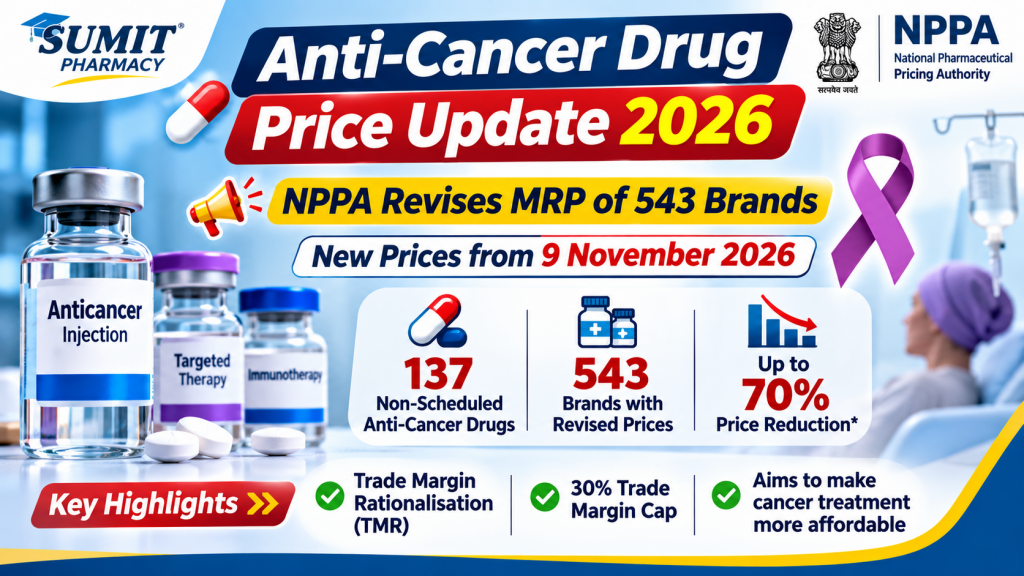
India is preparing for a major change in anti-cancer drug pricing. Under the anti cancer drug price update 2026, the National Pharmaceutical Pricing Authority (NPPA) has introduced Trade Margin Rationalisation (TMR) for 137 identified non-scheduled anti-cancer drugs. The revised prices are scheduled to become effective from 9 November 2026.
The initiative aims to reduce excessive trade margins in the medicine distribution chain and improve the affordability of cancer treatment. NPPA has published revised Maximum Retail Prices (MRPs) for hundreds of anti-cancer medicine brands, with the published list being updated as manufacturers submit their revised prices.
The changes are particularly relevant for cancer patients, hospitals, pharmacists, pharmaceutical manufacturers, distributors and healthcare professionals.
In this article, we will explain the NPPA decision, the 30% trade margin cap, medicines covered, examples of revised prices, implementation requirements and the possible impact on India’s pharmaceutical industry.
Key Highlights of the NPPA Anti-Cancer Drug Price Update 2026
| Particular | Details |
|---|---|
| Regulatory authority | National Pharmaceutical Pricing Authority (NPPA) |
| Ministry | Ministry of Chemicals and Fertilizers |
| Policy | Trade Margin Rationalisation (TMR) |
| Medicines covered | 137 identified non-scheduled anti-cancer drugs |
| Initial revised brand list | 543 brands, as reported by PIB on 28 October 2026 |
| Trade margin cap | 30% under the TMR intervention |
| Regulatory provision | Paragraph 19 of DPCO, 2013 |
| Announcement date | 17 October 2026 |
| Revised price announcement | 28 October 2026 |
| Implementation date | 9 November 2026 |
Important: The number of brands in the revised price list is not the same as the number of drug molecules. A single medicine may have several brands, strengths, dosage forms and pack sizes.
1. What Is the NPPA Anti-Cancer Drug Price Update 2026?
The National Pharmaceutical Pricing Authority (NPPA) is the government body responsible for regulating medicine prices in India under the Department of Pharmaceuticals.
On 17 October 2026, NPPA announced Trade Margin Rationalisation for 137 identified non-scheduled anti-cancer drugs.
The decision was taken to address excessive trade margins in the supply and distribution of selected cancer medicines. According to the government’s announcement, the intervention is expected to reduce the MRP of affected medicines by up to 70%, depending on their existing price structures.
The revised price lists are being published brand-wise, allowing patients, hospitals and retailers to identify the new MRP applicable to a particular product.
The government subsequently announced that revised MRPs for 543 brands had been released based on information submitted by manufacturers up to 27 October 2026. NPPA’s portal continues to publish updated lists as additional information is received.
The revised prices are scheduled to apply from 9 November 2026.
2. What Is Trade Margin Rationalisation (TMR)?
Trade Margin Rationalisation is a regulatory approach used to control excessive margins earned at different stages of the medicine distribution chain.
A medicine generally passes through several stages before reaching the patient:
Manufacturer → Stockist/Distributor → Wholesaler/Retailer or Hospital → Patient
Each stage may involve a commercial margin. When these margins become excessively high, the final selling price can become difficult for patients to afford.
Under the TMR intervention, NPPA has applied a 30% trade margin cap to the identified non-scheduled anti-cancer medicines under Paragraph 19 of the Drugs (Prices Control) Order (DPCO), 2013.
Why was TMR introduced?
The major reasons include:
- High medicine prices: Some non-scheduled anti-cancer medicines have very high MRPs.
- Excessive trade margins: Large margins across the distribution chain can increase the price paid by patients.
- Financial burden: Cancer treatment often involves repeated cycles of expensive medicines and supportive therapies.
- Limited affordability: High medicine costs can restrict access to treatment.
- Public health interest: The government aims to improve access to important cancer medicines without creating artificial shortages.
How does the 30% trade margin cap work?
The intervention places a limit on the trade margin applicable to the identified medicines. It is intended to restrict excessive mark-ups between the relevant supply-chain stages.
However, the 30% figure should not be interpreted as a guaranteed 30% reduction in every medicine’s MRP. The final revised price depends on the applicable pricing calculation and the product’s existing price structure.
For this reason, the actual revised MRP must be checked for the specific brand, strength, dosage form and pack size.
3. Which Anti-Cancer Drugs Are Covered?
The TMR intervention covers 137 identified non-scheduled anti-cancer drugs.
The government has highlighted several important categories, including:
- Immunotherapy medicines used in the treatment of different cancers.
- Medicines used in breast and prostate cancer.
- Medicines used to prevent or manage treatment-related complications.
- Targeted therapies used in different types of cancer.
- Other identified anti-cancer medicines recommended by the expert committee.
Some examples of medicines mentioned in the government’s announcement include:
| Medicine | Therapeutic relevance |
|---|---|
| Pembrolizumab | Immunotherapy used in several cancers |
| Durvalumab | Immunotherapy used in selected cancers |
| Osimertinib | Targeted therapy used in certain lung cancers |
| Denosumab | Used in selected patients with breast or prostate cancer |
| Pegfilgrastim | Helps prevent chemotherapy-associated neutropenia |
| Bevacizumab | Targeted therapy used in selected cancers |
Note: Mentioning a drug in the government’s policy announcement does not mean that every brand or pack of that medicine will necessarily receive a price reduction. Patients and pharmacists should verify the applicable product-specific MRP in the latest NPPA list.
4. Revised MRP of Anti-Cancer Medicines: Examples
One of the most important parts of this update is the publication of revised MRPs for individual medicine brands.
The following examples were included in the Government of India’s PIB release dated 28 October 2026. They represent the information available in that release, based on manufacturer submissions up to 27 October 2026.
Examples of old and revised MRPs
| Drug | Brand | Pack | Old MRP | Revised MRP |
|---|---|---|---|---|
| Anastrozole 1 mg | Anarzole | 10 tablets | ₹695.76 | ₹73.00 |
| Azacitidine 100 mg | Azacytin | 1 injection | ₹6,337.00 | ₹1,495.04 |
| Bevacizumab 100 mg/4 ml | Bevacizab | 4 ml vial | ₹21,767.70 | ₹5,930.13 |
| Dasatinib 20 mg | Dasanat 20 | 60 tablets | ₹2,812.50 | ₹1,085.93 |
| Denosumab 60 mg | Debrumab 60 mg | 1 ml PFS | ₹22,031.25 | ₹5,941.00 |
| Enzalutamide 40 mg | Enuta | 28 capsules | ₹6,578.20 | ₹2,232.00 |
| Erlotinib 150 mg | Erlib | 30 tablets | ₹4,637.45 | ₹2,008.00 |
| Fludarabine 50 mg | Fludanox | 1 vial | ₹14,235.00 | ₹2,432.00 |
| Fulvestrant 50 mg | Fulbreca | 5 ml vial | ₹26,072.16 | ₹5,491.00 |
These examples show that some listed products have experienced substantial reductions in their published MRPs.
However, the table should not be treated as the complete or latest price list. NPPA has continued updating its revised-price information. Always check the latest official entry before using a price for purchasing, dispensing or billing.
5. Will Every Anti-Cancer Medicine Become Cheaper?
No. This is an important point that patients and healthcare professionals should understand.
The government has introduced TMR for 137 identified non-scheduled anti-cancer drugs. It does not mean that every cancer medicine available in India is covered.
Even among medicines included in the exercise, the extent of price reduction can differ.
There are several reasons for this:
- Different manufacturers may market the same drug under different brands.
- The strength and dosage form may differ.
- Pack sizes may be different.
- Existing MRPs and trade-margin structures may vary.
- The revised MRP is determined at the product level.
Some published entries may show substantial reductions, while others may show a smaller reduction or no change in the listed MRP.
Therefore, patients should not assume that a medicine’s price has fallen simply because its active pharmaceutical ingredient is included in the TMR exercise.
The correct approach is to check the exact brand, strength, dosage form and pack size.
6. Why Are Some Cancer Medicine Prices Still Unchanged?
A common misunderstanding is that all medicines mentioned in the broader government announcement must receive a price reduction.
That is not necessarily the case.
The published lists contain product-specific revised MRPs. Some high-cost branded therapies have been reported with unchanged listed MRPs in particular published snapshots.
This is why it is important to distinguish between:
- A drug being discussed or included in the broader policy announcement.
- A particular brand being listed in the revised-price document.
- The actual revised MRP applicable to that brand and pack.
For example, the reported price entries for certain brands of pembrolizumab and osimertinib have not shown a reduction in some published snapshots.
This does not establish the price status of every brand or pack of those medicines. The latest NPPA entry should be consulted before drawing a conclusion.
7. What Are the Responsibilities of Pharmaceutical Companies?
The TMR intervention also creates compliance responsibilities for pharmaceutical manufacturers.
Manufacturers are required to:
- Submit revised price information to NPPA within the prescribed timeline.
- Ensure that revised MRPs are communicated to relevant stakeholders.
- Display revised price lists on their websites.
- Disseminate revised prices to retailers and hospitals.
- Maintain current production and supply levels of the notified formulations.
- Avoid actions that could create artificial shortages or disrupt patient access.
The government has also emphasised the importance of maintaining the availability of affected medicines.
This is particularly important for oncology medicines because interruption in treatment can have serious consequences for patients.
8. What Must Retailers, Pharmacists and Hospitals Do?
The revised MRPs are scheduled to become effective from 9 November 2026.
Retailers, pharmacies and hospitals dealing with the affected medicines will need to ensure that their prices and billing systems reflect the applicable revised MRPs.
Responsibilities of retailers and pharmacists
- Check the latest NPPA revised-price list.
- Identify affected brands, strengths and pack sizes.
- Update billing and inventory systems.
- Ensure that patients are charged according to the applicable revised MRP.
- Display revised price information as required.
- Avoid charging above the permitted MRP.
Responsibilities of hospitals
Hospitals have an important role because a substantial quantity of anti-cancer medicines is supplied directly to hospitals and medical institutions.
They must ensure that the revised prices are implemented for affected products from the applicable date.
The government has also directed hospitals to prominently display revised prices on their websites.
State Drug Controllers will take necessary steps to monitor compliance by manufacturers, dealers, retailers, hospitals and medical institutions.
9. How Can Patients Check the Revised Prices of Anti-Cancer Medicines?
Patients do not need to depend entirely on information provided by a retailer or hospital.
They can verify the applicable prices through NPPA’s official resources.
Method 1: NPPA Revised Price List
- Visit the official NPPA website.
- Open the section for revised prices of anti-cancer drugs.
- Select the latest available price-list document.
- Search for the medicine or brand name.
- Confirm the strength, dosage form and pack size.
- Compare the old and revised MRP.
Official link: https://nppa.gov.in/en/revised-prices
Method 2: Pharma Sahi Daam Portal
NPPA also provides the Pharma Sahi Daam portal for checking medicine prices.
Patients can use the portal to search for revised anti-cancer medicine prices.
Official portal: https://nppaipdms.gov.in/NPPA/PharmaSahiDaam/searchMedicine
The portal provides a dedicated option for TMR anti-cancer drug prices. Users can search using the brand name, drug name or company name and apply available filters.
Method 3: Pharma Sahi Daam Mobile App
Patients can also use the Pharma Sahi Daam mobile application to check medicine prices.
The platform provides medicine-price search facilities and options for reporting certain pricing-related issues.
Practical advice: Always match the medicine’s brand, strength, dosage form and pack size. Comparing only the generic drug name can lead to an incorrect price comparison.
10. What Should Patients Do If a Pharmacy Charges an Incorrect Price?
If a patient believes that a retailer or hospital is charging more than the applicable revised MRP, the patient should first verify the product details and the latest NPPA price entry.
The following steps are useful:
- Keep the medicine bill or invoice.
- Note the brand name, strength and pack size.
- Check the applicable revised MRP on the NPPA portal.
- Compare the billed amount with the applicable MRP.
- Contact the pharmacy or hospital billing department for clarification.
- If the issue remains unresolved, use the complaint facility available through NPPA’s official portal.
The Pharma Sahi Daam platform provides options for reporting overpricing, sale without price approval, non-availability and refusal of supply or sale.
Official portal: https://nppaipdms.gov.in/NPPA/PharmaSahiDaam/searchMedicine
Patients should retain supporting documents, particularly the invoice and medicine packaging, when raising a complaint.
11. Impact of the NPPA Decision on India’s Pharmaceutical Industry
The decision is expected to affect multiple stakeholders across the pharmaceutical supply chain.
A. Impact on cancer patients
The primary objective is to reduce the financial burden associated with selected anti-cancer medicines.
Patients using affected brands may benefit from lower MRPs, particularly where the previous trade margins were high.
However, the actual benefit will depend on the prescribed medicine and the price previously paid by the patient.
B. Impact on pharmaceutical manufacturers
Manufacturers will need to review their pricing, product information and distribution arrangements.
They may also need to update:
- Product price lists.
- Packaging and price declarations, as applicable.
- Distributor communication systems.
- Hospital supply contracts.
- Billing and commercial records.
Companies must also maintain adequate supply of the affected formulations.
C. Impact on distributors and stockists
Distributors may need to revise their pricing and inventory processes.
Old inventory, revised MRP information and the effective date will require careful handling to avoid billing errors and confusion.
D. Impact on retail pharmacies
Retail pharmacies will need to identify the affected products and ensure that the correct MRP is applied.
This will require accurate product-level information rather than relying on general announcements about cancer medicine price reductions.
E. Impact on hospitals
Hospitals may need to update procurement records, pharmacy billing systems and medicine-price information displayed to patients.
Since many oncology medicines are supplied directly to hospitals, correct implementation at the hospital level will be particularly important.
12. What Is the Difference Between Scheduled and Non-Scheduled Drugs?
The NPPA announcement specifically concerns identified non-scheduled anti-cancer medicines.
Understanding this distinction is important.
| Basis | Scheduled drugs | Non-scheduled drugs |
|---|---|---|
| Price regulation | Subject to applicable scheduled formulation price controls | Not automatically subject to the same scheduled ceiling-price mechanism |
| Regulatory framework | DPCO scheduled formulation provisions | Applicable DPCO provisions, including relevant monitoring or intervention mechanisms |
| Price intervention | Ceiling prices and other applicable controls | Specific interventions may be introduced where permitted |
| Present TMR update | Not the main category targeted by this announcement | 137 identified non-scheduled anti-cancer drugs |
Non-scheduled does not mean that a medicine is completely free from price regulation.
Under Paragraph 19 of DPCO, 2013, the government has powers to intervene in the pricing of drugs in public interest in the circumstances provided by the order.
The current anti-cancer drug TMR intervention is an example of such regulatory action.
13. What Is Paragraph 19 of DPCO, 2013?
Paragraph 19 of the Drugs (Prices Control) Order, 2013 provides the government with powers to regulate the prices of drugs in public interest, subject to the provisions of the order.
This provision is important because it allows the government to intervene in specific pricing situations beyond routine scheduled formulation price fixation.
In the present case, NPPA has used Paragraph 19 as the regulatory basis for the Trade Margin Rationalisation intervention covering the identified non-scheduled anti-cancer drugs.
For pharmacy students and regulatory affairs professionals, this is an important example of how medicine-price regulation operates in India.
14. How Is This Different from the 2019 Anti-Cancer Drug TMR Exercise?
The current intervention builds upon an earlier Trade Margin Rationalisation exercise introduced in 2019.
| Basis | 2019 exercise | 2026 exercise |
|---|---|---|
| Main objective | Control excessive trade margins in selected anti-cancer drugs | Extend TMR to a larger identified group |
| Medicines covered | 42 anti-cancer drugs | 137 non-scheduled anti-cancer drugs |
| Regulatory approach | Trade margin control | Trade margin control under Paragraph 19 of DPCO, 2013 |
| Focus | Improve affordability | Improve affordability and access across a wider group |
According to the Department of Pharmaceuticals, the earlier exercise resulted in reductions in the MRPs of hundreds of brands.
The 2026 intervention expands the scope of this approach.
15. What Does This Update Mean for Pharmacy Students and Regulatory Affairs Professionals?
This development is not only relevant to patients and pharmaceutical companies. It is also an important regulatory update for pharmacy students and professionals.
The NPPA decision demonstrates how pharmaceutical pricing regulations can directly affect medicine affordability and market operations.
Important concepts to understand
1. National Pharmaceutical Pricing Authority (NPPA)
The authority responsible for implementing and monitoring medicine-price regulation in India.
2. Drugs (Prices Control) Order, 2013
The regulatory framework governing medicine price control in India.
3. Trade Margin Rationalisation
A mechanism to control excessive trade margins in the medicine supply chain.
4. Scheduled and non-scheduled formulations
Two important categories used in the Indian drug-pricing framework.
5. Maximum Retail Price (MRP)
The maximum retail price declared for a product, subject to applicable legal requirements.
6. Regulatory compliance
Manufacturers, distributors, retailers and hospitals must follow the applicable pricing requirements.
Why is this important for Regulatory Affairs?
Regulatory Affairs professionals working in pharmaceutical companies may be involved in:
- Monitoring NPPA notifications.
- Reviewing drug-pricing requirements.
- Coordinating revised price information.
- Maintaining regulatory documentation.
- Communicating regulatory changes to internal departments.
- Supporting compliance with applicable pricing orders.
Therefore, understanding DPCO and NPPA notifications is useful for students planning a career in Regulatory Affairs, pharmaceutical compliance and market access.
16. Challenges and Limitations of the Price-Control Initiative
Although the initiative is intended to improve affordability, its practical success will depend on implementation.
Some important challenges include:
1. Correct implementation across the supply chain
Manufacturers, distributors, pharmacies and hospitals must use the correct revised price information.
2. Continuous price-list updates
The published lists are being updated as additional manufacturer submissions are received. Stakeholders must refer to the latest version rather than relying on an older PDF.
3. Availability of medicines
Price regulation should not result in supply disruptions. Maintaining production and availability is essential for patients who depend on regular treatment.
4. Difference between MRP reduction and actual patient savings
A reduction in MRP does not necessarily translate into an identical reduction in every patient’s expenditure. The actual saving depends on the previous purchase price, the applicable revised MRP and the way the medicine is supplied.
5. Awareness among patients
Patients may not know that a revised price applies to their prescribed brand. Hospitals and pharmacies will need to communicate the changes clearly.
6. Product-level verification
The same generic medicine may be marketed under different brands and pack sizes. Correct product matching is necessary to avoid incorrect billing or price comparisons.
17. Frequently Asked Questions (FAQs)
Q1. When will the new anti-cancer drug prices become effective in India?
The revised MRPs are scheduled to become effective from 9 November 2026.
Q2. How many anti-cancer drugs are covered under the NPPA TMR decision?
The initiative covers 137 identified non-scheduled anti-cancer drugs.
Q3. How many brands have received revised MRPs?
The PIB announcement dated 28 October 2026 reported revised MRPs for 543 brands. NPPA’s published lists are updated as further manufacturer information is received.
Q4. Will cancer medicine prices decrease by 70%?
Not necessarily. The government has indicated that the intervention may reduce MRPs by up to 70%, depending on existing price structures. Individual products can have different levels of reduction.
Q5. What is the 30% trade margin cap?
It is the trade-margin control applied to the identified medicines under the TMR intervention. It should not be interpreted as a guaranteed 30% reduction in every medicine’s MRP.
Q6. Which authority regulates medicine prices in India?
The National Pharmaceutical Pricing Authority (NPPA), under the Department of Pharmaceuticals, is responsible for medicine-price regulation.
Q7. Can patients check revised anti-cancer medicine prices online?
Yes. Patients can use the NPPA website and the Pharma Sahi Daam portal to check applicable revised prices.
Q8. Are all cancer medicines included in this decision?
No. The intervention applies to the 137 identified non-scheduled anti-cancer drugs. It does not automatically cover every cancer medicine marketed in India.
Q9. What happens if a retailer charges more than the applicable MRP?
Patients can verify the product-specific price and raise a complaint through the NPPA’s official complaint facilities if overcharging is established.
Q10. What is the role of Paragraph 19 of DPCO, 2013?
Paragraph 19 provides the government with powers to intervene in drug prices in public interest under the conditions specified in the DPCO.
Conclusion
The NPPA anti-cancer drug price update 2026 represents an important intervention in India’s pharmaceutical pricing system.
By introducing Trade Margin Rationalisation for 137 identified non-scheduled anti-cancer drugs, the government aims to address excessive trade margins and improve the affordability of selected cancer medicines.
The publication of revised MRPs for hundreds of brands is an important step, but the real impact will depend on correct implementation from 9 November 2026.
Patients should verify the revised price of their exact medicine rather than assuming that every anti-cancer drug will become cheaper. Manufacturers, distributors, pharmacies and hospitals must also ensure that the updated prices are implemented correctly.
For the pharmaceutical industry, this development highlights the growing importance of drug-pricing compliance, regulatory monitoring and transparent medicine distribution in India.
Stay updated with Sumit Pharmacy for the latest pharmaceutical regulations, drug-price updates, pharmacy education and healthcare developments.
Official References and Further Reading
- National Pharmaceutical Pricing Authority (NPPA): Revised Prices of 137 Anti-Cancer Drugs
https://nppa.gov.in/en/revised-prices - Press Information Bureau (PIB): NPPA releases revised MRP for 543 brands of anti-cancer medicines; new prices effective from 9 November 2026
https://www.pib.gov.in/PressReleasePage.aspx?PRID=2329698&lang=1®=3 - Press Information Bureau (PIB): Trade Margin Rationalisation on 137 Anti-Cancer Drugs
https://www.pib.gov.in/PressReleasePage.aspx?PRID=2324743&lang=1®=3 - Pharma Sahi Daam Portal: Official medicine-price search and complaint facility
https://nppaipdms.gov.in/NPPA/PharmaSahiDaam/searchMedicine
Editorial note: The product-wise examples in this article are taken from the PIB price information published on 28 October 2026. NPPA’s price lists may be updated. Readers should consult the latest official list for the price applicable to a specific brand and pack.