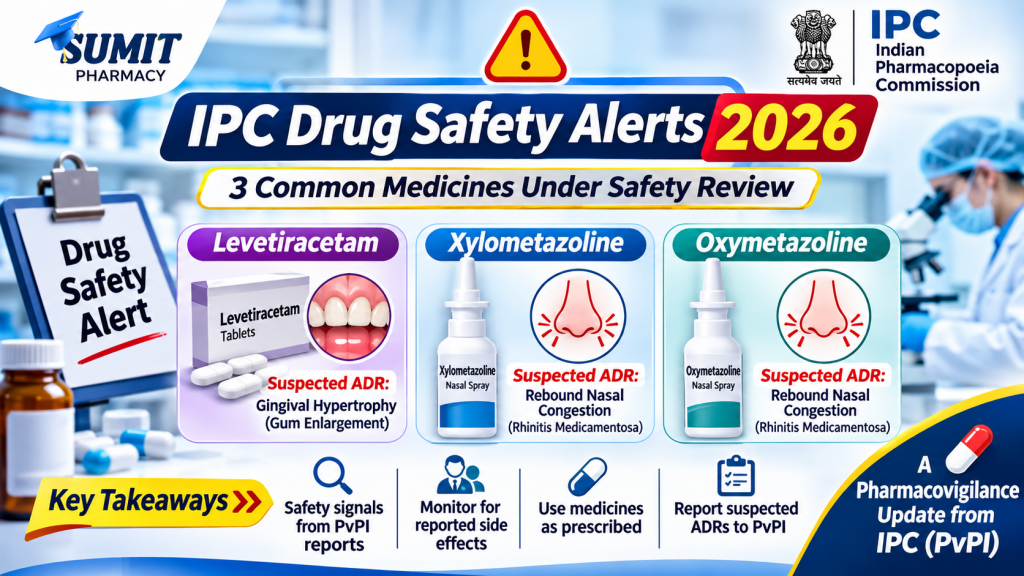
The Indian Pharmacopoeia Commission (IPC) has flagged three commonly used medicines for suspected adverse drug reactions (ADRs): levetiracetam, xylometazoline and oxymetazoline. The reported safety concerns include gingival hypertrophy (abnormal enlargement of gum tissue) associated with levetiracetam and rebound nasal congestion associated with the nasal decongestants xylometazoline and oxymetazoline.
The alerts are important because these medicines are used in different healthcare settings. Levetiracetam is an anti-epileptic medicine prescribed for seizure management, while xylometazoline and oxymetazoline are commonly used in nasal drops and sprays for temporary relief from nasal blockage.
The safety concerns were identified through the Pharmacovigilance Programme of India (PvPI), which collects and analyses reports of suspected adverse drug reactions. IPC has advised healthcare professionals and patients to remain vigilant, monitor for these reactions and report suspected cases.
This article explains the three medicines, their therapeutic uses, the reported safety signals, possible clinical implications, patient precautions and the role of pharmacists in pharmacovigilance.
Key Highlights of IPC Drug Safety Alerts 2026
| Particular | Details |
|---|---|
| Regulatory authority | Indian Pharmacopoeia Commission (IPC) |
| Programme | Pharmacovigilance Programme of India (PvPI) |
| National Coordination Centre | IPC, Ghaziabad |
| Medicines flagged | Levetiracetam, xylometazoline and oxymetazoline |
| Suspected ADR 1 | Gingival hypertrophy |
| Suspected ADR 2 | Rebound nasal congestion |
| Safety information source | PvPI adverse drug reaction reports |
| Reporting facility | ADR Monitoring Centres, PvPI forms, mobile app and helpline |
Important: These are suspected safety signals. An alert does not mean that every person taking these medicines will experience the reported reaction. Patients should not stop prescribed treatment without consulting their healthcare professional.
1. What Has IPC Reported in Its Drug Safety Alert?
The Indian Pharmacopoeia Commission, under the Ministry of Health and Family Welfare, coordinates the National Coordination Centre of the Pharmacovigilance Programme of India.
After analysing adverse drug reaction reports received through PvPI, the Commission highlighted two safety concerns involving three medicines.
Summary of the reported safety signals
| Medicine | Therapeutic use | Suspected adverse drug reaction |
|---|---|---|
| Levetiracetam | Anti-epileptic medicine | Gingival hypertrophy |
| Xylometazoline hydrochloride | Nasal decongestant | Rebound nasal congestion |
| Oxymetazoline hydrochloride | Nasal decongestant | Rebound nasal congestion |
The two safety concerns are clinically different.
- Gingival hypertrophy involves abnormal enlargement of gum tissue and may affect oral hygiene.
- Rebound nasal congestion refers to the return or worsening of nasal blockage after the effect of a topical nasal decongestant wears off, particularly with prolonged or excessive use.
The alert is intended to increase awareness among patients and healthcare professionals so that suspected reactions can be recognised and reported.
2. Levetiracetam and Gingival Hypertrophy
What is levetiracetam?
Levetiracetam is an antiepileptic drug (AED), also known as an antiseizure medication. It is used to control different types of epileptic seizures.
It is available in several dosage forms, including:
- Tablets
- Oral solution
- Injectable formulation
Levetiracetam is used as monotherapy or as add-on treatment depending on the seizure type, patient characteristics and prescribing indication.
Mechanism of action of levetiracetam
Levetiracetam has a different mechanism of action from several traditional antiepileptic medicines.
Its primary pharmacological target is synaptic vesicle protein 2A (SV2A), a protein involved in the regulation of neurotransmitter release.
Levetiracetam binds to SV2A and modulates synaptic neurotransmission. This action helps reduce abnormal neuronal activity associated with seizures.
Simplified mechanism:
Levetiracetam administration → Binding to SV2A → Modulation of neurotransmitter release → Reduction in abnormal neuronal activity → Improved seizure control
What is gingival hypertrophy?
Gingival hypertrophy refers to an abnormal increase in the size of gum tissue.
It may appear as swollen, enlarged or overgrown gums around the teeth. In some patients, the enlarged tissue can interfere with normal brushing, chewing and oral hygiene.
Common signs that may require dental assessment include:
- Visible enlargement of the gums
- Swelling around the teeth
- Difficulty maintaining oral hygiene
- Bleeding during brushing
- Gum tenderness or discomfort
- Changes in the appearance of the gum line
These symptoms are not specific to drug-induced gingival hypertrophy. Gum inflammation, periodontal disease and other oral conditions can produce similar findings.
Why is the levetiracetam alert important?
Epilepsy often requires long-term treatment. Patients may continue antiseizure medicines for extended periods to maintain seizure control.
If a patient develops an unusual gum-related reaction during treatment, it may remain unnoticed unless the patient or healthcare professional recognises the change.
The IPC safety signal highlights the need for greater awareness of oral health in patients receiving levetiracetam.
However, the alert does not establish that levetiracetam will cause gingival hypertrophy in every patient, nor does it establish the frequency of this reaction.
What should patients taking levetiracetam do?
Patients should:
- Maintain regular oral hygiene.
- Brush their teeth regularly using an appropriate technique.
- Monitor unusual changes in gum size or appearance.
- Seek dental assessment if persistent gum enlargement or swelling develops.
- Inform their neurologist and dentist about all medicines they are taking.
- Avoid changing the dose or stopping levetiracetam without medical advice.
Important safety advice: Abruptly stopping an antiseizure medicine can increase the risk of breakthrough seizures. Patients should not discontinue levetiracetam independently because of this safety alert.
3. Xylometazoline and Oxymetazoline: Risk of Rebound Nasal Congestion
The second safety concern involves two commonly used topical nasal decongestants:
- Xylometazoline hydrochloride
- Oxymetazoline hydrochloride
These medicines are used to provide temporary relief from nasal blockage associated with conditions such as the common cold, allergic rhinitis and other causes of nasal congestion.
They are available in nasal drops and sprays, depending on the product.
What is the mechanism of action of xylometazoline and oxymetazoline?
Xylometazoline and oxymetazoline act as topical sympathomimetic nasal decongestants.
They stimulate alpha-adrenergic receptors in the blood vessels of the nasal mucosa. This produces vasoconstriction, meaning that the blood vessels become narrower.
The resulting reduction in blood flow and swelling helps open the nasal passages and temporarily improves airflow.
Mechanism of action:
Nasal administration → Alpha-adrenergic receptor stimulation → Vasoconstriction of nasal blood vessels → Reduced mucosal swelling → Improved nasal airflow
The medicines provide symptomatic relief. They do not necessarily treat the underlying cause of nasal congestion.
What is rebound nasal congestion?
Rebound nasal congestion is the return or worsening of nasal blockage after the effect of a topical nasal decongestant wears off.
It is also associated with a condition known as rhinitis medicamentosa.
This condition is particularly associated with prolonged or excessive use of topical nasal vasoconstrictors.
A patient may initially experience good relief after using the nasal spray. However, repeated use beyond the recommended duration can lead to a cycle in which nasal congestion returns and the patient feels the need to use the spray again.
How does rebound nasal congestion develop?
The following flowchart explains the basic process:
Step 1: Patient experiences nasal congestion.
↓
Step 2: Xylometazoline or oxymetazoline is administered.
↓
Step 3: Alpha-adrenergic receptor stimulation causes vasoconstriction.
↓
Step 4: Nasal mucosal swelling decreases and breathing improves.
↓
Step 5: With prolonged or excessive use, the decongestant effect may become associated with recurrent congestion.
↓
Step 6: The patient experiences repeated nasal blockage and may continue using the spray.
↓
Possible outcome: Persistent nasal congestion and rhinitis medicamentosa.
The exact mechanisms of rhinitis medicamentosa are not completely explained by a single pathway. Changes in vascular responsiveness, local mucosal regulation and other factors may contribute.
Symptoms of rebound nasal congestion
Patients may experience:
- Recurrent nasal blockage
- Reduced nasal airflow
- A sensation of persistent stuffiness
- Temporary relief after using the nasal spray
- Repeated need to use the decongestant
- Difficulty breathing comfortably through the nose
These symptoms can resemble the original condition for which the nasal spray was started.
Therefore, healthcare professionals should assess the duration and pattern of nasal decongestant use rather than assuming that every episode of congestion is due to a new infection.
Why should nasal decongestant sprays not be overused?
Topical nasal decongestants are intended for short-term symptomatic relief.
Using them more frequently or for longer than recommended can increase the risk of rebound congestion.
The recommended duration and frequency depend on the specific product, its concentration, patient age and approved product information.
Patients should therefore:
- Follow the dosage instructions on the product label.
- Avoid increasing the frequency of administration without medical advice.
- Avoid extending treatment beyond the recommended duration.
- Consult a healthcare professional if nasal congestion persists.
- Avoid repeatedly restarting the spray whenever congestion returns without assessing the underlying cause.
Important: Do not apply a universal treatment-duration limit to every nasal product. Follow the specific product’s approved instructions and professional advice.
4. Difference Between Xylometazoline and Oxymetazoline
Both medicines are topical nasal decongestants, but they are different active pharmaceutical ingredients.
| Parameter | Xylometazoline | Oxymetazoline |
|---|---|---|
| Drug class | Sympathomimetic nasal decongestant | Sympathomimetic nasal decongestant |
| Main action | Alpha-adrenergic vasoconstriction | Alpha-adrenergic vasoconstriction |
| Route | Intranasal | Intranasal |
| Dosage forms | Nasal drops and sprays | Nasal drops and sprays |
| Main therapeutic effect | Temporary relief from nasal congestion | Temporary relief from nasal congestion |
| Suspected ADR highlighted by IPC | Rebound nasal congestion | Rebound nasal congestion |
Both medicines can provide temporary symptomatic relief, but neither should be used indiscriminately or beyond the recommended duration.
5. What Is the Difference Between Nasal Congestion and Rebound Nasal Congestion?
This distinction is important for patients, pharmacists and pharmacy students.
| Basis | Ordinary nasal congestion | Rebound nasal congestion |
|---|---|---|
| Meaning | Blockage due to an underlying condition | Recurrent or worsening blockage associated with topical decongestant overuse |
| Common contributing factors | Common cold, allergy, sinus inflammation and other conditions | Prolonged or excessive use of topical nasal decongestants |
| Relationship with nasal spray | May improve temporarily after decongestant use | May return or worsen after the effect wears off |
| Management | Depends on the underlying cause | Requires assessment of decongestant use and appropriate clinical management |
A patient with persistent nasal congestion should not automatically assume that a stronger nasal spray or more frequent administration is the solution.
The underlying cause should be assessed by a healthcare professional.
6. Are These Medicines Banned or Withdrawn in India?
No such conclusion should be drawn from these safety alerts.
The reported IPC alerts identify suspected adverse drug reactions and ask healthcare professionals and patients to remain vigilant.
A pharmacovigilance alert is not automatically equivalent to:
- A nationwide drug ban
- Withdrawal of marketing authorisation
- A recall of every marketed brand
- A declaration that the medicine is unsafe for every patient
- An instruction to stop treatment immediately
The purpose of pharmacovigilance is to identify, assess, understand and prevent medicine-related safety problems.
Regulatory action, where necessary, depends on further evaluation of the available evidence and the benefit-risk profile of the medicine.
Patients should continue to follow their prescribing professional’s advice and consult them if they experience a suspected adverse reaction.
7. What Is Pharmacovigilance and Why Is It Important?
Pharmacovigilance is the science and set of activities concerned with detecting, assessing, understanding and preventing adverse effects or other medicine-related problems.
A medicine may undergo extensive clinical testing before approval. However, clinical trials cannot always identify every possible adverse reaction.
There are several reasons:
- Clinical trials involve selected patient populations.
- The number of participants may be insufficient to detect very rare reactions.
- Some adverse reactions may appear only after long-term exposure.
- Certain reactions may occur in patients with specific risk factors.
- Some interactions may become apparent only when medicines are used together in routine clinical practice.
After a medicine enters the market, it is used by a much larger and more diverse population.
Post-marketing surveillance helps identify safety concerns that may not have been apparent during clinical development.
Main objectives of pharmacovigilance
- Detect previously unrecognised adverse drug reactions.
- Identify changes in the frequency or severity of known reactions.
- Assess medicine-related safety signals.
- Improve the benefit-risk assessment of medicines.
- Support regulatory decisions.
- Promote rational and safer medicine use.
- Improve patient safety through continuous monitoring.
8. Role of the Pharmacovigilance Programme of India (PvPI)
The Pharmacovigilance Programme of India is the national medicine-safety monitoring programme coordinated through the National Coordination Centre at the Indian Pharmacopoeia Commission.
Its primary objective is to improve patient safety by collecting, analysing and evaluating adverse drug reaction information.
How does PvPI work?
The basic pharmacovigilance process can be represented as follows:
Patient or healthcare professional observes a suspected adverse reaction
↓
ADR is reported to an ADR Monitoring Centre or through an available reporting channel
↓
Relevant information is collected and assessed
↓
Reports are forwarded through the PvPI system
↓
Safety data are analysed for possible signals
↓
Further assessment and regulatory communication, where required
↓
Improved medicine-safety monitoring
An important point is that an individual ADR report does not automatically prove that a medicine caused the event.
The reports contribute to a larger body of safety information that can be assessed for possible patterns.
9. How Can Patients and Healthcare Professionals Report an Adverse Drug Reaction in India?
Reporting suspected adverse drug reactions is an important part of medicine safety.
Patients and healthcare professionals can report suspected reactions through the official PvPI system.
Who can report an ADR?
The reporting system is not restricted to doctors.
The following individuals can contribute to pharmacovigilance:
- Doctors
- Pharmacists
- Nurses
- Dentists
- Other healthcare professionals
- Patients and consumers
- Pharmaceutical companies through applicable reporting systems
Methods of ADR reporting
1. ADR Reporting Form
Healthcare professionals can use the Suspected Adverse Drug Reaction Reporting Form available through the IPC website.
2. Consumer Reporting Form
Patients can use the Medicines Side Effect Reporting Form. Forms are available in Hindi and several other Indian languages.
3. ADR-PvPI Mobile Application
The ADR-PvPI mobile application provides another route for reporting suspected adverse drug reactions.
4. ADR Monitoring Centres
Reports can be submitted through an appropriate ADR Monitoring Centre under PvPI.
5. PvPI Helpline
The official PvPI helpline provides assistance for ADR reporting.
| Reporting facility | Details |
|---|---|
| Official website | https://ipc.gov.in |
| ADR reporting forms | https://ipc.gov.in/PvPI/adr.html |
| Toll-free helpline | 1800 180 3024 |
| Helpline availability | Working days, 9:00 AM–5:30 PM |
| Reporting network | ADR Monitoring Centres under PvPI |
What information is generally required for an ADR report?
A report may include:
- Patient initials or identification details as required by the form
- Age and relevant patient information
- Suspected medicine name
- Dose and route of administration
- Date of starting the medicine, if known
- Description of the suspected reaction
- Date of onset of the reaction
- Relevant medical history
- Concomitant medicines
- Relevant laboratory or clinical findings
- Reporter information
Complete and accurate information improves the usefulness of a report. However, a suspected reaction should not be ignored merely because every detail is not immediately available.
10. Role of Pharmacists in Preventing and Reporting These Adverse Drug Reactions
Pharmacists are an important part of the pharmacovigilance system because they are directly involved in medicine dispensing, patient counselling and medication-use monitoring.
The current IPC safety alerts provide practical examples of how pharmacists can contribute to safer medicine use.
A. Counselling patients taking levetiracetam
Pharmacists should:
- Confirm that patients understand the prescribed dose and schedule.
- Encourage regular oral hygiene.
- Ask patients to report unusual gum enlargement.
- Advise dental assessment when persistent gum changes are observed.
- Remind patients not to discontinue antiseizure treatment independently.
- Communicate suspected adverse reactions to the treating healthcare professional.
B. Counselling patients using nasal decongestants
Pharmacists should:
- Explain the correct administration technique.
- Check how long the patient has already been using the nasal spray.
- Explain that topical decongestants are intended for short-term relief.
- Reinforce the product-specific dosage and duration instructions.
- Identify repeated or excessive use.
- Refer patients with persistent congestion for medical assessment.
C. Reporting suspected ADRs
Pharmacists should not assume that only severe reactions are worth reporting.
A suspected reaction can contribute useful information to pharmacovigilance, even when the causal relationship has not been established.
Practical pharmacist counselling table
| Situation | Appropriate pharmacist response |
|---|---|
| Patient taking levetiracetam reports gum enlargement | Recommend dental and medical assessment; do not advise abrupt discontinuation |
| Patient repeatedly uses nasal decongestant spray | Assess duration and frequency; explain the risk of rebound congestion |
| Patient reports persistent nasal blockage | Recommend clinical evaluation instead of escalating spray use |
| Suspected medicine-related reaction is identified | Document relevant details and report through the appropriate PvPI channel |
11. What Should Patients Do After Reading These Drug Safety Alerts?
A safety alert should encourage informed medicine use, not unnecessary fear.
Patients can follow these practical steps:
If you are taking levetiracetam:
- Continue the medicine as prescribed.
- Maintain oral hygiene.
- Watch for persistent gum enlargement or unusual swelling.
- Seek dental or medical advice if such changes occur.
- Do not stop treatment without consulting your neurologist.
If you are using xylometazoline or oxymetazoline:
- Follow the product’s instructions.
- Avoid prolonged or excessive use.
- Do not increase the dose or frequency on your own.
- Consult a healthcare professional if congestion continues.
- Seek advice if you feel unable to stop using the spray because your nose repeatedly becomes blocked.
For any suspected adverse reaction:
- Note the medicine name and dose.
- Record when the reaction started.
- Keep relevant prescriptions and medicine packaging.
- Inform the treating healthcare professional.
- Consider reporting the suspected reaction through PvPI.
12. Limitations of Pharmacovigilance Alerts: What Patients Should Understand
One of the most important aspects of interpreting drug safety alerts is understanding what they can and cannot establish.
A suspected ADR is not the same as a confirmed causal relationship
A suspected adverse drug reaction is an event that may be associated with the use of a medicine.
However, the event may also be influenced by:
- An underlying disease
- Other medicines
- Patient-specific risk factors
- Existing medical conditions
- Other environmental or clinical factors
For this reason, individual reports require assessment.
Safety signals require further evaluation
A safety signal is information that suggests a possible new association or a new aspect of a known association between a medicine and an adverse event.
It is a reason to investigate further, not automatic proof of causation.
The alert does not provide an individual patient’s risk
The reported safety concern does not, by itself, establish how frequently the reaction occurs or predict which patient will develop it.
The available alert information should therefore be interpreted as a reason for awareness, monitoring and reporting.
13. Recent Developments in India’s Pharmacovigilance System
India has continued to strengthen its medicine-safety monitoring infrastructure.
At the 6th National Pharmacovigilance Week in September 2026, the Ministry of Health and Family Welfare announced several initiatives.
These included:
- Launch of the 7th edition of the National Formulary of India (NFI 2026).
- Introduction of the ADR-PvPI 2.0 mobile application for iOS users.
- Approval of the Biovigilance Programme of India.
- Expansion of medicine-safety monitoring and digital reporting.
- Plans to expand ADR reporting capabilities towards the primary healthcare level.
The government also reported that approximately 1,150 ADR reporting centres were operational across public and private hospitals and medical colleges.
These developments demonstrate that pharmacovigilance is expanding beyond conventional adverse drug reaction reporting.
India is also strengthening monitoring related to medical devices and biological products used in organ and tissue transplantation.
This broader approach is important because patient safety depends on the quality and safety of the entire healthcare system, not only medicines.
14. Pharmacovigilance, Materiovigilance and Biovigilance: Key Differences
| Programme | What it monitors |
|---|---|
| Pharmacovigilance | Safety of medicines and pharmaceutical products |
| Materiovigilance | Safety and adverse events associated with medical devices |
| Biovigilance | Safety monitoring of biological products and relevant transplantation-related products |
These programmes serve different purposes but share the common objective of improving patient safety.
For pharmacy students, understanding these terms is useful for academic examinations, industrial practice and careers in pharmacovigilance and Regulatory Affairs.
15. Career Opportunities in Pharmacovigilance and Drug Safety
The growing importance of post-marketing drug safety has increased the relevance of pharmacovigilance-related skills in the pharmaceutical industry.
Pharmacy graduates can explore several career roles, including:
- Drug Safety Associate
- Pharmacovigilance Associate
- Case Processing Associate
- Safety Data Analyst
- Aggregate Reporting Associate
- Signal Detection Associate
- Medical Information Associate
- Regulatory Affairs Associate
Important skills include:
- Understanding adverse drug reactions.
- Knowledge of pharmacology and clinical terminology.
- Medical coding fundamentals.
- Individual Case Safety Report (ICSR) processing.
- Basic knowledge of MedDRA terminology.
- Understanding of causality assessment.
- Knowledge of pharmacovigilance regulations and reporting requirements.
- Scientific writing and documentation.
For students planning to enter the pharmaceutical industry, pharmacovigilance is a useful career area to understand alongside Regulatory Affairs, Quality Assurance and Clinical Research.
You can also read our detailed guide on Regulatory Affairs Career in India to understand the skills, job roles and career opportunities available in the pharmaceutical regulatory sector.
16. Frequently Asked Questions (FAQs)
Q1. What are the latest IPC drug safety alerts in 2026?
The reported safety alerts flag gingival hypertrophy as a suspected adverse reaction associated with levetiracetam and rebound nasal congestion associated with xylometazoline and oxymetazoline.
Q2. Does levetiracetam cause gum enlargement?
Gingival hypertrophy has been identified as a suspected adverse drug reaction associated with levetiracetam in the IPC safety alert. This does not mean that every patient taking levetiracetam will develop gum enlargement.
Q3. What is gingival hypertrophy?
Gingival hypertrophy is an abnormal enlargement of gum tissue. It may cause visible gum swelling and can interfere with oral hygiene.
Q4. Can xylometazoline cause rebound nasal congestion?
Prolonged or excessive use of xylometazoline may be associated with rebound nasal congestion, in which nasal blockage returns or worsens after the decongestant effect wears off.
Q5. Can oxymetazoline cause rebound congestion?
Yes. Rebound nasal congestion is a suspected adverse reaction highlighted for oxymetazoline in the IPC safety alert.
Q6. What is rhinitis medicamentosa?
Rhinitis medicamentosa is a condition associated with prolonged or excessive use of topical nasal decongestants. It can lead to persistent or recurrent nasal congestion.
Q7. Should patients stop taking levetiracetam after the IPC alert?
No. Patients should not stop levetiracetam independently. Abrupt discontinuation can increase the risk of seizures. Patients experiencing suspected adverse reactions should consult their treating healthcare professional.
Q8. Are xylometazoline and oxymetazoline banned in India?
The reported safety alert does not itself establish a nationwide ban or withdrawal of these medicines. It highlights suspected adverse reactions and the need for monitoring and reporting.
Q9. How can patients report adverse drug reactions in India?
Patients can use the consumer ADR reporting form, the ADR-PvPI mobile application, an ADR Monitoring Centre or the PvPI helpline at 1800 180 3024 during its stated working hours.
Q10. What is the full form of PvPI?
PvPI stands for Pharmacovigilance Programme of India.
Q11. Who can report adverse drug reactions under PvPI?
Healthcare professionals and patients can report suspected adverse drug reactions. Pharmacists, nurses, doctors and other healthcare professionals can contribute to the reporting system.
Q12. Does an ADR report prove that a medicine caused the reaction?
No. An individual report provides information about a suspected association. Further assessment is required to evaluate causality and determine whether a safety signal needs regulatory action.
Conclusion
The IPC drug safety alerts involving levetiracetam, xylometazoline and oxymetazoline highlight the importance of continuous medicine-safety monitoring in India.
The reported association between levetiracetam and gingival hypertrophy emphasises the need for awareness of oral health during treatment. Similarly, the suspected association of xylometazoline and oxymetazoline with rebound nasal congestion highlights the importance of appropriate use of topical nasal decongestants.
For patients, the key message is to use medicines according to professional advice, recognise unusual symptoms and avoid changing prescribed treatment independently.
For pharmacists and other healthcare professionals, these alerts reinforce the importance of patient counselling, early recognition of suspected adverse reactions and timely reporting through the Pharmacovigilance Programme of India.
Medicine safety does not end when a drug receives marketing approval. Continuous monitoring, accurate reporting and responsible medicine use are essential for safer healthcare.
Stay updated with Sumit Pharmacy for pharmaceutical regulations, drug safety alerts, pharmacovigilance, pharmacy education and healthcare developments.
References and Official Resources
- Indian Pharmacopoeia Commission (IPC): Pharmacovigilance Programme of India – ADR Reporting
https://ipc.gov.in/PvPI/adr.html - Indian Pharmacopoeia Commission: Drug Safety Alerts
https://www.ipc.gov.in/8-category-en/416-drug-safety-alerts.html - Indian Pharmacopoeia Commission: PvPI Frequently Asked Questions
https://www.ipc.gov.in/8-category-en/429-pvpi-frequently-asked-questions.html - Ministry of Health and Family Welfare / Press Information Bureau: Launch of 7th National Formulary of India 2026 and Biovigilance Programme
https://www.pib.gov.in/PressReleaseIframePage.aspx?PRID=2312930 - Medical Dialogues: IPC Flags Suspected Adverse Reactions Linked to Levetiracetam, Xylometazoline and Oxymetazoline
https://medicaldialogues.in/amp/news/industry/pharma/ipc-flags-suspected-adverse-reactions-linked-to-levetiracetam-xylometazoline-oxymetazoline-180964
Medical disclaimer: This article is for educational and informational purposes. It does not replace medical diagnosis, prescription or treatment advice. Patients should consult a qualified healthcare professional before making changes to their medication.