
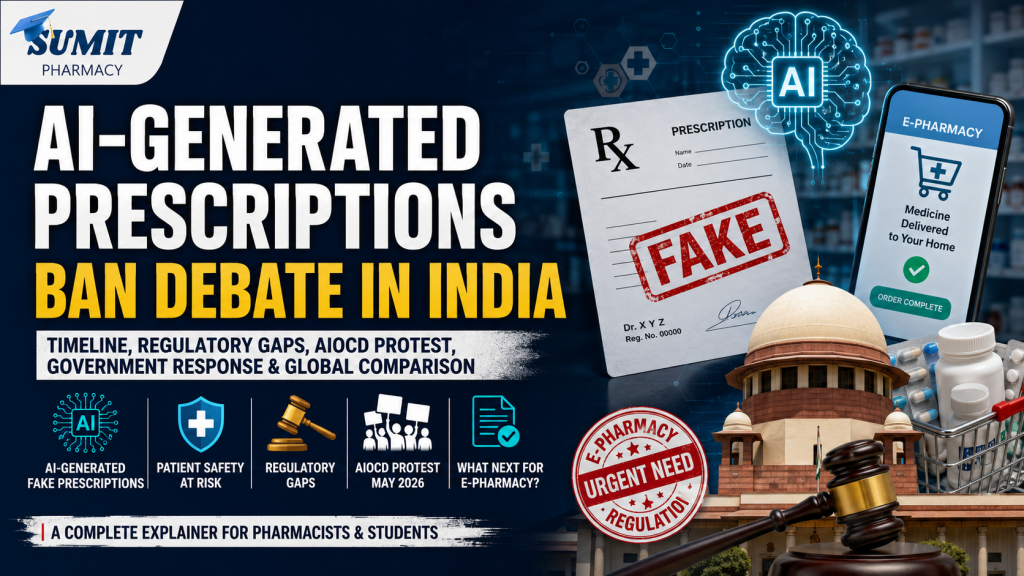
AI-generated prescriptions ban debate in India has become one of the biggest regulatory controversies in the Indian pharmaceutical sector in 2026. The debate began after reports revealed that AI-generated fake medical prescriptions were allegedly being accepted by certain online pharmacy platforms, raising serious concerns about patient safety, prescription verification, and drug regulation.
Over 12 lakh chemist shops participated in a nationwide protest demanding stronger regulation of e-pharmacies and the rejection of AI-generated prescriptions. The controversy has since involved the All India Organisation of Chemists and Druggists (AIOCD), the Central Drugs Standard Control Organisation (CDSCO), policymakers, healthcare professionals, and the pharmaceutical industry.
This article provides an evidence-based analysis of the AI-generated prescriptions ban debate in India, including the complete timeline, regulatory background, government response, international comparisons, and its impact on pharmacists, pharmacy students, and the future of digital healthcare.
Quick Answer
The debate is not about doctors using AI to prescribe medicines. It is about AI tools being misused to fabricate fake prescriptions — complete with fictitious hospital names and doctor details — which certain unregulated online pharmacy platforms have been accepting without proper verification. The All India Organisation of Chemists and Druggists (AIOCD) has demanded that the government declare such AI-generated prescriptions invalid nationwide, withdraw two regulatory notifications it says enable the problem (GSR 817(E) and GSR 220(E)), and shut down illegal e-pharmacies. The demand led to a nationwide chemist strike on 20 May 2026. As of writing, CDSCO says the matter is under “active review,” with no final policy announced yet.
What Is Actually Being Debated (Important Clarification)
Before going further, it’s worth being precise about what this debate actually is — because headlines can make it sound like something it isn’t.
This is not a debate about whether AI chatbots or clinical decision-support tools should be allowed to autonomously prescribe medicines to patients. That is a separate, emerging global conversation (covered in the international comparison section below).
This is a debate about prescription fraud enabled by AI content-generation tools. Investigative reporting found that certain online platforms were accepting scanned or uploaded prescriptions that were AI-generated fabrications — complete with invented hospital letterheads, fake doctor names, and fabricated registration details — well-crafted enough to pass through automated or minimal-effort verification systems used by some e-pharmacy platforms. These fraudulent documents were reportedly being used to procure antibiotics, psychotropic drugs, opioids, and Schedule H/Schedule X medicines that should never be sold without genuine medical oversight.
Understanding this distinction matters because it reframes the debate correctly: it’s fundamentally a prescription verification and e-pharmacy regulation problem, with AI acting as the tool that made forgery easier and harder to detect — not a debate about AI replacing doctors.
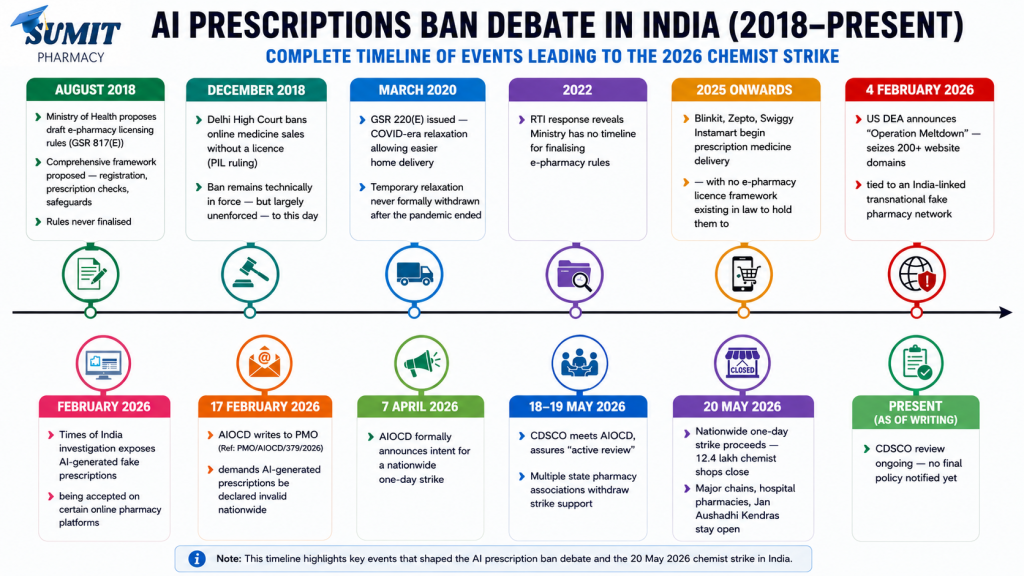
Timeline: How This Escalated Into a National Strike
The Core Regulatory Gap Nobody Fixed for 8 Years
The AI-prescription controversy didn’t emerge in a vacuum — it exposed a regulatory hole that has existed since 2018.
Gap One: No legal definition of “e-pharmacy.” Despite draft rules being proposed in August 2018, India still has no statutory definition of what an “e-pharmacy” legally is. A 2022 RTI response from the Ministry confirmed that finalisation timelines couldn’t even be estimated at that stage.
Gap Two: A pandemic-era relaxation that never ended. GSR 220(E), issued in March 2020 specifically to ease medicine home-delivery during lockdown, was never formally withdrawn. Online platforms have continued relying on this six-year-old emergency provision as operating cover, long after the emergency it was designed for ended.
Gap Three: No prescription-reuse detection. Under Drug Rule 65 of the Drugs and Cosmetics Rules, 1945, a physical/offline pharmacist is legally required to verify a prescription before dispensing. There is no equivalent statutory obligation clearly enforced on online platforms, and no central registry exists to flag the same scanned prescription being reused repeatedly to procure antibiotics or habit-forming drugs.
Gap Four: An unenforced court order. The Delhi High Court’s 2018 ruling technically banning online medicine sales without a licence remains legally in force — but has not translated into enforcement action against major platforms operating today.
This combination — no legal category, an outdated relaxation still in use, and weak verification obligations — is precisely what AIOCD argues has created the conditions for AI-generated prescription fraud to flourish undetected.
AIOCD’s Case: Why Chemists Are Alarmed
The All India Organisation of Chemists and Druggists, representing over 1.3 million licensed pharmacy stores, built its case around three core patient-safety arguments:
- Undetectable forgery at scale. Offline chemists retain human oversight — physical verification, patient interaction, and the discretion to refuse a sale when something looks wrong. Online platforms, AIOCD argues, largely lack this layer, making AI-generated fake prescriptions — bearing fictitious hospital names and doctor details — very difficult to catch.
- Antimicrobial resistance (AMR). AIOCD specifically linked unchecked antibiotic sales enabled by fake prescriptions to India’s antimicrobial resistance crisis, citing ICMR findings that commonly used antibiotics for pneumonia and urinary tract infections are becoming increasingly ineffective due to indiscriminate use and self-medication — a concern the Prime Minister himself referenced in a “Mann Ki Baat” address.
- Unfair economics threatening neighbourhood pharmacies. AIOCD also flagged that online platforms offer consumer discounts of 20–50%, while government price control norms (DPCO) fix retailer margins at 16% and wholesaler margins at 8% for price-controlled medicines. AIOCD contends platforms sustain these discounts by burning capital to capture market share — a practice that threatens the survival of small, rural and semi-urban chemists, on whom AIOCD estimates roughly 50 million livelihoods depend.
AIOCD’s specific demands to the government: withdraw GSR 817(E) and GSR 220(E), shut down illegal/unregulated e-pharmacy platforms (including blocking websites and payment gateways), and declare AI-generated prescriptions invalid nationwide.
The Other Side: Why Not Everyone Backed the Strike
The picture isn’t unanimous within the pharmacy trade itself.
Several state-level retail pharmacy associations — reported across West Bengal, Kerala, Punjab, Maharashtra, Karnataka, Haryana, Uttar Pradesh, Ladakh, Gujarat, Chhattisgarh, Sikkim, and Uttarakhand — formally declined to join the strike, citing the need to ensure uninterrupted access to essential medicines for vulnerable patients.
The Bangalore District Chemists and Druggists Association went further, warning that a nationwide shutdown could actually push more consumers toward online pharmacies — strengthening the very platforms AIOCD was protesting against, rather than weakening them.
Major pharmacy chains, hospital-attached medical stores, Jan Aushadhi Kendras, and AMRIT Pharmacy outlets all remained open on strike day, partly following assurances from CDSCO that the sector’s concerns were under active regulatory review.
This split reveals a genuine strategic disagreement within the profession: is a supply disruption the right pressure tactic, or does it hand more market share to the platforms being criticised?
Where the Government Stands Right Now
As of the most recent reporting, CDSCO has stated that the issues raised by AIOCD are under “active review”, with the regulatory framework governing e-pharmacies being “thoroughly examined.” However, no final policy decision — on withdrawing GSR 817(E)/GSR 220(E), on formally defining e-pharmacies, or on declaring AI-generated prescriptions invalid — had been announced at the time of writing.
Separately, CDSCO has been active on an adjacent front: ordering strict action against illegal sale and promotion of GLP-1 weight-loss drugs, suggesting heightened regulator attention on online drug sales generally, even without a dedicated AI-prescription policy yet in place.
This section will be updated as soon as a formal policy decision is notified.
Old System vs Online System: A Side-by-Side Look
| Aspect | Offline Chemist (Drug Rule 65) | Online Platform (Current Practice) |
|---|---|---|
| Prescription verification | Legally mandated before dispensing | No clear equivalent statutory obligation |
| Human oversight | Physical checks, patient interaction | Often automated/minimal-effort review |
| Reuse detection | Pharmacist’s personal knowledge of regular patients | No central registry to flag duplicate prescriptions |
| Legal operating basis | Licensed under Drugs & Cosmetics Act | Operating under a 2018 draft rule (never finalised) + 2020 pandemic relaxation (never withdrawn) |
| Accountability if fraud slips through | Pharmacist and store licence at direct risk | Ambiguous — no dedicated e-pharmacy regulator with clear enforcement mandate |
| Price regulation | Bound by DPCO margin caps | Deep discounting (20–50%) reported, funded by venture capital rather than margin |
Impact on B.Pharm & Pharm.D Students
Pharmaceutical Jurisprudence: This controversy is a live case study in why prescription verification (Drug Rule 65) exists and what happens when enforcement mechanisms lag behind technology. Expect exam and viva questions on the legal gap between offline and online dispensing obligations.
Regulatory Affairs and Health Policy: For students interested in regulatory affairs careers, this is a textbook example of “regulatory lag” — where technology (AI content generation, instant delivery apps) moves faster than the legal framework meant to govern it. Understanding this case helps in interviews for CDSCO, drug inspector, or pharma regulatory roles.
Community Pharmacy practice: If you plan to run or work in a retail pharmacy, this debate directly affects your competitive environment — margin pressure from discounting platforms is a real business consideration, not just a policy abstraction.
Digital health and pharmacoinformatics: With AI now formally entering the B.Pharm 2026 syllabus (Python, data analytics, digital healthcare), this controversy is also a cautionary case study on AI misuse — useful context if you’re building or studying health-tech tools, since verification and fraud-resistance need to be designed in from the start, not bolted on later.
GPAT/interview relevance: A current-affairs question like “What regulatory notification created the loophole exploited in the 2026 AI-prescription fraud controversy?” (Answer: GSR 220(E), the 2020 pandemic relaxation) is a realistic, specific, high-value fact to know.
Impact on Retail Pharmacy & E-Pharmacy Business
Independent/unorganized retail: Faces the most direct competitive pressure — both from aggressive e-pharmacy discounting and from the reputational damage that any fraud-enabled sales cause to the wider profession’s public trust.
Organized offline chains (Apollo Pharmacy, Wellness Forever, etc.) sit in an interesting position — some also operate online arms, meaning they’re simultaneously part of the “chemist” lobby and adjacent to the “e-pharmacy” business model being scrutinised.
E-pharmacy platforms (Tata 1mg, PharmEasy, and quick-commerce entrants like Blinkit, Zepto, and Swiggy Instamart) face rising regulatory and reputational risk. None currently operate under a uniform, legally defined e-pharmacy licence — a gap that cuts both ways: it has allowed rapid market expansion, but it also means there’s no established compliance benchmark they can point to as proof of adequate safeguards if scrutiny intensifies.
Jan Aushadhi Kendras and AMRIT Pharmacy outlets remained unaffected/operational through the strike, reinforcing their role as a stable public-sector access point regardless of how the online-versus-offline dispute resolves.
Impact on Pharmaceutical Companies & Supply Chain
While this controversy is primarily a retail/dispensing-level issue, it has ripple effects upstream:
- Antibiotic manufacturers face indirect reputational exposure, since unchecked antibiotic sales via fraudulent prescriptions are a contributor to India’s antimicrobial resistance crisis — a topic manufacturers are increasingly expected to engage with responsibly (antibiotic stewardship messaging, tamper-evident packaging).
- Opioid and psychotropic drug manufacturers may see increased scrutiny on distribution-chain traceability, given AIOCD’s specific allegation that these categories are being accessed through fraudulent prescriptions.
- Pharma companies with direct-to-consumer digital arms will need to watch this space closely — any eventual e-pharmacy regulation (if GSR 817(E) is finally notified in updated form) could reshape how companies structure online sales and delivery partnerships.
- Digital health and health-tech investors should note this as a signal that India’s e-pharmacy regulatory vacuum is unlikely to persist indefinitely — companies building in this space would be well-advised to build prescription-verification rigor proactively rather than reactively.
How Other Countries Regulate AI in Prescribing & Healthcare
It’s worth noting upfront: no major country currently has a specific law addressing “AI-generated fake prescriptions for e-pharmacy fraud” in the exact way India’s current debate frames it. Instead, global regulatory attention has focused on a related but distinct question — how much oversight AI clinical tools and AI-enabled medical software need.
United States (FDA): The FDA regulates AI-enabled clinical decision support and diagnostic software as medical devices, with an evolving lifecycle-oversight approach (Predetermined Change Control Plans, now featured in roughly 10% of 2025 AI device clearances) rather than a one-time approval. In January 2026, the FDA actually reduced oversight for certain low-risk digital health and AI-enabled wellness products, signalling a calibrated, risk-based approach rather than blanket restriction. Separately, the FDA and EMA jointly published shared guiding principles for AI use across the medicines lifecycle in January 2026, emphasizing auditability and human oversight — themes directly relevant to India’s verification-gap problem.
European Union (AI Act): Under the EU AI Act (Regulation (EU) 2024/1689), AI systems that function as or are embedded in regulated medical devices are automatically classified as “high-risk,” triggering strict obligations around risk management, human oversight, and auditability, with compliance deadlines phasing in through August 2026 and into 2027. This risk-based classification approach is arguably closer to what India’s regulatory framework could eventually adopt for both AI clinical tools and, by extension, prescription-verification technology.
The key takeaway for India: while other countries are building tiered, risk-based frameworks for legitimate AI use in healthcare, India’s current debate is a step behind — it’s still trying to close a basic prescription-verification loophole that predates most AI-specific healthcare regulation elsewhere. This suggests India’s eventual e-pharmacy rules may need to address both problems simultaneously: legitimate AI/digital health innovation, and fraud-resistant verification infrastructure.
Frequently Asked Questions
1. Is AI actually being used by doctors to write prescriptions in India? That’s not what this controversy is about. It concerns AI tools being misused to fabricate fake prescription documents — with invented hospital and doctor details — to fraudulently obtain restricted medicines online, not doctors using AI clinically to prescribe.
2. What exactly did AIOCD ask the Prime Minister to do? AIOCD asked the government to withdraw notifications GSR 817(E) and GSR 220(E), shut down illegal and unregulated e-pharmacy platforms, and declare AI-generated prescriptions invalid nationwide.
3. Has the government banned AI-generated prescriptions? Not as of this writing. CDSCO has stated the matter is under “active review,” but no final policy decision has been notified.
4. Why did some pharmacy associations refuse to join the May 20 strike? Several state-level associations and major chains chose to stay open, citing patient access to essential medicines as a priority, and citing CDSCO’s assurance of an active regulatory review as sufficient reason to avoid disruption for the time being.
5. What are GSR 817(E) and GSR 220(E)? GSR 817(E) refers to the 2018 draft e-pharmacy licensing rules, which were never finalised into law. GSR 220(E) is a March 2020 notification that relaxed prescription/delivery rules during the COVID-19 lockdown and was never formally withdrawn afterward.
6. Do online pharmacies have to verify prescriptions like offline chemists do? Offline pharmacists are bound by Drug Rule 65 to verify prescriptions before dispensing. Online platforms currently operate without a clearly enforced equivalent obligation, which is central to AIOCD’s argument.
7. Can the same prescription be used multiple times to buy medicines online? AIOCD alleges this is happening in practice, since there is no central registry to detect a scanned prescription being reused repeatedly across purchases.
8. Are big platforms like Tata 1mg, PharmEasy, Blinkit, and Zepto operating illegally? They are operating in a genuine legal grey zone — there is no finalised e-pharmacy licensing framework in India, so no such licence currently exists in law for any platform to hold, which is precisely the regulatory gap at the heart of this debate.
9. How is this connected to antimicrobial resistance (AMR)? AIOCD argues that fraudulent prescriptions are enabling unchecked antibiotic sales, which contributes to bacteria developing resistance faster — a concern echoed by ICMR data and referenced by the Prime Minister in a national address.
10. Did the US or EU face a similar “AI prescription fraud” controversy? Not in the same specific form. The US saw a related but different action — the DEA’s “Operation Meltdown,” which seized over 200 domains tied to an India-linked fake online pharmacy network — but this was about counterfeit pharmacy websites generally, not specifically AI-generated fake prescriptions.
11. Does this affect hospital pharmacies or Jan Aushadhi stores? No — these operate under existing prescription/medication-order systems and remained functional through the industry strike, unaffected by the core e-pharmacy verification debate.
12. What should I watch for next on this issue? Watch for any formal CDSCO notification on e-pharmacy licensing, any amendment or withdrawal of GSR 817(E)/GSR 220(E), and any specific rule addressing AI-generated document verification. This article will be updated when a policy decision is notified.
The Bigger Picture
This controversy sits at the intersection of two forces reshaping Indian pharmacy in 2026: rapid digital/AI adoption in healthcare delivery, and a regulatory system still catching up to decisions made nearly a decade ago. It’s also connected to the broader wave of regulatory tightening happening in parallel — the new cough syrup prescription rule, the Schedule M GMP overhaul, and updated pharmacovigilance reporting requirements all reflect the same underlying theme: Indian drug regulation is actively closing long-standing enforcement gaps in 2026.
For pharmacists and students, the lesson isn’t just about this one controversy — it’s about recognising that regulatory frameworks in a digitizing healthcare system need to evolve as fast as the technology being deployed within it. AI didn’t create the underlying verification gap in India’s e-pharmacy system. It simply made that gap much easier to exploit — and much harder to ignore.
Official Sources & External References
- AIOCD Flags AI-Generated Fake Prescriptions, Writes to PM Seeking Shutdown of Unregulated E-Pharmacies — Medical Dialogues
- Chemists Warn PM That Fake AI Prescriptions Are Enabling Illegal Drug Sales — Business Standard
- 12.4 Lakh Chemists Call May 20 Shutdown Against E-Pharmacies — MediaNama
- Pharmacy Shops Open Despite Strike Call Over E-Pharmacies — NewKerala
- May 20 Chemist Strike Loses State Support As CDSCO Reviews E-Pharmacy Concerns — Medical Dialogues
- AI Prescriptions & Fake Drugs: The Dark Side of E-Pharmacies Driving the 2026 Protest — purshoLOGY
- EU AI Act High-Risk Compliance: Pharma & Medical Devices — IntuitionLabs
- FDA Limits Oversight of AI Health Software and Wearables — Telehealth.org
- Central Drugs Standard Control Organisation (CDSCO) — official notifications and circulars: cdsco.gov.in
Related Reads
- Cough Syrup Prescription Rule India 2026: The Complete Guide
- Regulatory Affairs as a Career for B.Pharm Graduates
- New PCI B.Pharm Syllabus 2026: AI, Python & Data Analytics Explained
About the Author
Reviewed by: Sumit Singh, M.Pharm (Pharmaceutics), Founder — Sumit Pharmacy Last Updated: 4 July 2026
Sumit Pharmacy publishes evidence-based pharmacy education content, career guides, and regulatory updates for B.Pharm, M.Pharm, and Pharm.D students across India.
Stay Updated: Every week, Sumit Pharmacy publishes evidence-based pharmacy news, career guides, and regulatory updates. Bookmark this page — this article will be updated the moment CDSCO announces a formal policy decision on e-pharmacy regulation.